PET LOR / sinogram descriptors parallelproj.pet_lors
A LOR / sinogram descriptor maps detector lines of response to sinogram bins and
is the link between a scanner geometry and a projector (see Quickstart).
For cylindrical scanners use RegularPolygonPETLORDescriptor together
with a Michelogram (the axial plane layout); for modular block / panel
scanners use EqualBlockPETLORDescriptor.
SinogramSpatialAxisOrder controls the ordering of the sinogram axes.
PET line-of-response (LOR) descriptors - definition of PET sinograms / histograms
Defines how detector endpoint pairs map to sinogram bins (plane, view, radial
bin) through the Michelogram axial layout and the
RegularPolygonPETLORDescriptor class. Also covers sinogram axis
ordering conventions, zig-zag crystal pairing, and utilities for computing
LOR start/end coordinates and visualising the scanner geometry.
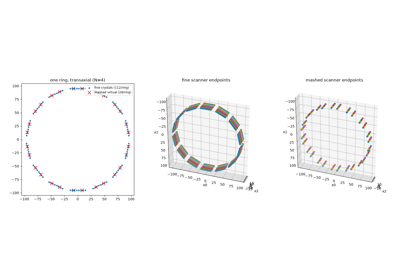
Moreover, also implements EqualBlockPETLORDescriptor that allows to
define PET data histograms for scanners consisting of equal Block without cylindrical
symmetry.
- class parallelproj.pet_lors.EqualBlockPETLORDescriptor(scanner: ModularizedPETScannerGeometry, all_block_pairs: Array)[source]
Bases:
PETLORDescriptorLOR descriptor for scanners whose modules all have the same number of endpoints.
LORs are defined by pairs of modules (blocks) that are in coincidence. The
all_block_pairsarray encodes these pairs as an integer array of shape(num_block_pairs, 2), where each row[i, j]means moduleiand modulejform a valid coincidence pair. Every endpoint in blockiis paired with every endpoint in blockj, givingnum_lor_endpoints_per_block ** 2LORs per block pair.Prefer
RegularPolygonPETLORDescriptorfor cylindrically-symmetric scanners, which exploits the regular-polygon geometry to define sinogram axes (plane, view, radial) directly. Use this class for scanners with arbitrary or non-cylindrical block arrangements where no such sinogram parameterisation exists.Examples

Non-TOF and TOF projections using a modularized (block) PET scanner geometry
Non-TOF and TOF projections using a modularized (block) PET scanner geometry- Parameters:
scanner (ModularizedPETScannerGeometry) – A modularized PET scanner consisting of block modules with the same number of LOR endpoints.
all_block_pairs (Array) – An array containing pairs of integer numbers encoding which block pairs are in coincidence and form valid LORs.
Examples
Non-TOF and TOF projections using a modularized (block) PET scanner geometry
Non-TOF and TOF projections using a modularized (block) PET scanner geometry- property all_block_pairs: Array
all block pairs in coincidence
- property dev: str
device to use for storing the LOR endpoints
- get_lor_coordinates(block_pair_nums: None | Array = None) tuple[Array, Array][source]
Get the coordinates of LORs for the given block pair numbers.
- Parameters:
block_pair_nums (None or Array, optional) – The block pair numbers for which to retrieve the LOR coordinates. If None, all block pair numbers will be used.
- Returns:
tuple[Array, Array]
A tuple containing two arrays –
the start coordinates of the LORs, with shape (N, 3), where N is the total number of LORs.
the end coordinates of the LORs, with shape (N, 3)
- Return type:
tuple[Array, Array]
Examples
- property num_block_pairs: int
number of block pairs in coincidence
- property num_lorendpoints_per_block: int
number of LOR endpoints per block
- property num_lors_per_block_pair: int
number of LORs per block pair
- property scanner: ModularizedPETScannerGeometry
the scanner for which coincidences are described
- show_block_pair_lors(ax: Axes, block_pair_nums: Array, lw: float = 0.2, **kwargs) None[source]
show all LORs connecting all endpoints between blocks forming a block pairs
- Parameters:
ax (plt.Axes) – a 3D matplotlib axes
block_pair_nums (Array) – Integer array of block pair indices to show.
lw (float, optional) – the line width, by default 0.2
- Return type:
None
Examples
Non-TOF and TOF projections using a modularized (block) PET scanner geometry
Non-TOF and TOF projections using a modularized (block) PET scanner geometry
- property xp: ModuleType
array module to use for storing the LOR endpoints

- class parallelproj.pet_lors.LOREndpointOrder(*values)[source]
Bases:
EnumWhich physical endpoint of each LOR is the start (
xstart) vs the end (xend).Non-TOF projections are unaffected (an LOR is geometrically symmetric). For TOF, the TOF-bin axis is defined along
xstart -> xend, so swapping the endpoints reverses the TOF bins (bink<-> binnum_tofbins - 1 - k). Use this to match a given vendor’s start/end – and hence TOF-bin – convention.Note
TOFParameters.tofcenter_offsetis measured alongxstart -> xendand is not adjusted automatically. If you combine a non-zerotofcenter_offsetwithEND_START, negate the offset yourself.Examples
- END_START = 2
xstartandxendare exchanged for every LOR.Examples
- START_END = 1
xstartis the descriptor’s start endpoint (default; original behaviour).Examples
- classmethod __getitem__(name)
Return the member matching name.
Examples

- class parallelproj.pet_lors.Michelogram(num_rings: int, max_ring_difference: int, span: int = 1, layout: MichelogramLayout = MichelogramLayout.STANDARD, segment_order: SegmentOrder = SegmentOrder.POSITIVE_FIRST)[source]
Bases:
objectAxial plane layout for a cylindrical PET scanner under odd span.
Encapsulates the segment / axial-position combinatorics that map every valid ring pair \((s, e)\) onto a sinogram plane index under span conventions.
For span \(S\) (odd) and a maximum ring difference \(D\), each ring pair with \(|e - s| \le D\) is assigned a segment via
ring_diff_to_segment(). Ring pairs sharing the same \((\text{segment},\; s + e)\) collapse into a single plane. Planes are ordered by \((|\text{seg}|,\; -\text{seg},\; s + e)\) \([0, +1, -1, +2, -2, \ldots]\) with axial bins increasing in \(s + e\) (equivalently in z for equispaced rings).The class knows nothing about ring z-positions, scanner radius, or sinogram axis ordering – it operates on pure integer indices. Consumers (e.g.
RegularPolygonPETLORDescriptor,SinogramAxialCompressionOperator) combine it with the geometry- and array-API-specific information they need.For span
= 1the layout reduces to the unspanned Michelogram (each ring pair is its own plane withmax_multiplicity== 1); the orderingrd = 0, +1, -1, +2, -2, ...with each ring difference sorted by ring sum.- Parameters:
num_rings (int) – Number of detector rings (\(R \ge 1\)).
max_ring_difference (int) – Maximum ring difference \(|e - s|\) considered (\(\ge 0\)). Values larger than
num_rings - 1have no extra effect.span (int, optional) – Axial compression factor – must be odd and \(\ge 1\). Default
1(no compression). Ignored (and reported asNone) forlayout=MichelogramLayout.GE.layout (MichelogramLayout, optional) – Axial plane layout / segmentation convention, by default
MichelogramLayout.STANDARD. SeeMichelogramLayout.segment_order (SegmentOrder, optional) – Order of the signed oblique segments, by default
SegmentOrder.POSITIVE_FIRST(0, +1, -1, +2, -2, ...). UseSegmentOrder.NEGATIVE_FIRSTfor0, -1, +1, -2, +2, .... This only permutes the sinogram planes; segment numbering and plane counts are unchanged. SeeSegmentOrder.
Examples
>>> m = Michelogram(num_rings=3, max_ring_difference=2, span=3)
>>> int(m.num_planes)
7
>>> int(m.max_multiplicity)
2
>>> int(m.ring_diff_to_segment(0)), int(m.ring_diff_to_segment(2)),         int(m.ring_diff_to_segment(-2))
(0, 1, -1)
>>> m.plane_segment.tolist()  # POSITIVE_FIRST (default): +1 before -1
[0, 0, 0, 0, 0, 1, -1]
>>> m2 = Michelogram(3, 2, span=3, segment_order=SegmentOrder.NEGATIVE_FIRST)
>>> m2.plane_segment.tolist()  # NEGATIVE_FIRST: -1 before +1
[0, 0, 0, 0, 0, -1, 1]
Examples
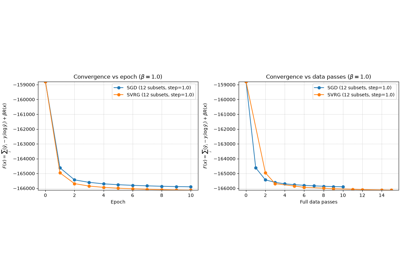
Convergence comparison: SGD vs SVRG with logcosh regularization
Convergence comparison: SGD vs SVRG with logcosh regularization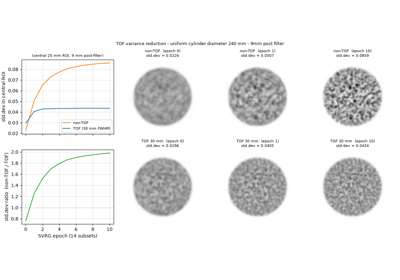
TOF vs non-TOF: variance reduction in a uniform cylinder
TOF vs non-TOF: variance reduction in a uniform cylinder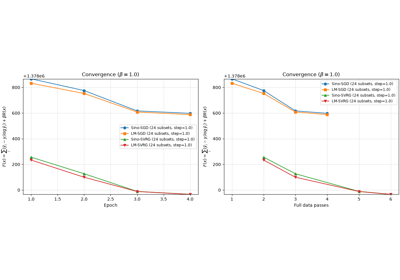
Convergence comparison: SGD vs SVRG with regularization (sinogram and listmode)
Convergence comparison: SGD vs SVRG with regularization (sinogram and listmode)
PDHG and LM-SPDHG to optimize the Poisson logL and total variation
PDHG and LM-SPDHG to optimize the Poisson logL and total variation
Transmission reconstruction: MLTR, SPS and L-BFGS-B
Transmission reconstruction: MLTR, SPS and L-BFGS-B
Accelerating MLTR with ordered subsets (OS-MLTR) and SVRG
Accelerating MLTR with ordered subsets (OS-MLTR) and SVRG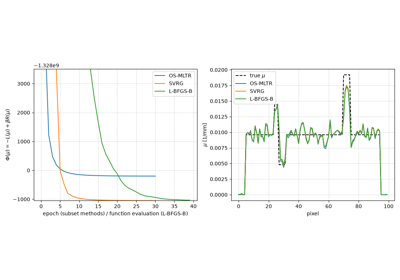
Penalised transmission reconstruction (MAPTR) with an edge-preserving prior
Penalised transmission reconstruction (MAPTR) with an edge-preserving prior
Joint activity and attenuation reconstruction (MLAA) for TOF PET
Joint activity and attenuation reconstruction (MLAA) for TOF PET- average_z_per_plane(ring_positions) tuple[ndarray, ndarray][source]
Mean ring z-coordinate per plane, separately for start and end rings.
Equivalent to averaging
ring_positionsover the contributing ring pairs of each plane. For span=1planes this is trivially the single contributing ring’s z; for span> 1planes it produces the averaged-LOR z-position used by the spanned setup ofRegularPolygonPETLORDescriptorand byshow_segment_lors().- Parameters:
ring_positions (array-like, shape
(num_rings,)) – z-coordinate of each ring (any backend; converted vianp.asarray).- Returns:
start_z (np.ndarray, shape
(num_planes,), dtypefloat32)end_z (np.ndarray, shape
(num_planes,), dtypefloat32)
- Return type:
tuple[ndarray, ndarray]
Examples
- compression_index_maps(target_span: int) tuple[ndarray, ndarray, ndarray, ndarray][source]
Build gather/scatter index maps to a higher-span Michelogram.
Convenience wrapper around
compression_index_maps_to()that builds the target Michelogram internally asMichelogram(self.num_rings, self.max_ring_difference, span=target_span, segment_order=self.segment_order)(the segment ordering is inherited fromself).- Parameters:
target_span (int) – Odd integer
>= self.span; additionally(target_span // self.span)must be odd.- Return type:
- Raises:
ValueError – If
target_spanis not a positive odd integer. Further validation errors are raised bycompression_index_maps_to().
Examples
- compression_index_maps_to(target: Michelogram) tuple[ndarray, ndarray, ndarray, ndarray][source]
Build gather/scatter index maps to a pre-built target Michelogram.
Returns the integer index structures needed to map planes of this Michelogram onto planes of
target.Both Michelograms must describe the same scanner geometry (
target.num_rings == self.num_rings), andtarget.spanmust be an integer multiple ofself.span. Because both spans are odd by construction, the ratiotarget.span / self.spanis then automatically odd, which guarantees that every ring pair of any input plane shares the same target plane – so the operation is a single-valued gather.The target’s
max_ring_differencemust be at leastself.max_ring_differenceso every input ring pair has a target plane. If it is strictly greater, the resulting maps still work but some output planes will have zero multiplicity (output bins that no input ring pair contributes to).- Parameters:
target (Michelogram) – Pre-built target Michelogram. Validation rules above.
- Returns:
target_for_p1 (np.ndarray, shape
(self.num_planes,), dtypeint64) – For each plane of this Michelogram, the corresponding plane index intarget.idx2d (np.ndarray, shape
(target.num_planes, target_max_mult),int64) – For each target plane, the indices in this Michelogram that contribute, right-padded with0. Usemaskto filter.mask (np.ndarray, same shape as
idx2d, dtypefloat32) –1.0for valid entries,0.0for right-padding.target_multiplicity (np.ndarray, shape
(target.num_planes,),int32) – Number of self-planes folded into each target plane.
- Raises:
TypeError – If
targetis not aMichelograminstance.ValueError – If
target.num_ringsdiffers fromself.num_rings; iftarget.span < self.span; ifself.spandoes not dividetarget.span; or iftarget.max_ring_difference < self.max_ring_difference.
- Return type:
tuple[ndarray, ndarray, ndarray, ndarray]
Examples
- classmethod ge(num_rings: int, max_ring_difference: int, segment_order: SegmentOrder = SegmentOrder.POSITIVE_FIRST) Michelogram[source]
Convenience constructor for the GE-style layout.
Equivalent to
Michelogram(num_rings, max_ring_difference,
layout=MichelogramLayout.GE, segment_order=segment_order)
. SeeMichelogramLayoutfor the segmentation definition andSegmentOrderfor the segment ordering.Examples
- Parameters:
num_rings (int)
max_ring_difference (int)
segment_order (SegmentOrder)
- Return type:
- property layout: MichelogramLayout
Axial plane layout convention (
STANDARDorGE).
- property max_multiplicity: int
Largest plane multiplicity (most ring pairs in any one plane).
- property max_ring_difference: int
Maximum ring difference \(|e - s|\).
- property num_planes: int
Total number of sinogram planes.
- property num_rings: int
Number of rings.
- property parent_plane_indices: ndarray | None
Plane indices of this michelogram’s planes in the parent it was derived from, shape
(num_planes,), dtypeint64– orNonefor a normally-constructedMichelogram.Set only by
select_segments(): entrykis the plane index that restricted planekhad in the full michelogram, so a full sinogram can be reduced to the restricted one withfull_sino[..., parent_plane_indices, ...]along the plane axis.
- property plane_axial_midpoint_int: ndarray
Integer axial midpoint \(s + e\) (= twice the actual midpoint) for each plane, shape
(num_planes,), dtypeint32.
- property plane_end_rings: ndarray
Contributing end ring indices per plane, right-padded with
0.Shape
(num_planes, max_multiplicity), dtypeint32. Useplane_maskto identify the valid entries.
- plane_for_ring_pair(s: int, e: int) int[source]
Plane index for the ring pair
(s, e).- Raises:
IndexError – If either
soreis outside[0, num_rings).ValueError – If \(|e - s| > \text{max\_ring\_difference}\).
- Parameters:
s (int)
e (int)
- Return type:
int
Examples
- property plane_for_ring_pair_table: ndarray
(num_rings, num_rings)lookup table whose entry[s, e]is the plane index for ring pair(s, e), or-1if \(|e - s| > \text{max\_ring\_difference}\).
- property plane_mask: ndarray
Validity mask for
plane_start_rings/plane_end_rings.Shape
(num_planes, max_multiplicity), dtypefloat32. Entries are1.0for valid contributing ring pairs and0.0for right-padding.
- property plane_multiplicity: ndarray
Number of ring pairs contributing to each plane, shape
(num_planes,), dtypeint32.
- property plane_segment: ndarray
Signed segment number for each plane, shape
(num_planes,), dtypeint32.
- property plane_start_rings: ndarray
Contributing start ring indices per plane, right-padded with
0.Shape
(num_planes, max_multiplicity), dtypeint32. Useplane_maskto identify the valid entries.
- ring_diff_to_segment(rd: int) int[source]
Signed segment number for a given ring difference \(e - s\).
For the
STANDARDlayout:0if \(|rd| \le \text{half\_span}\), otherwise \(\pm k\) with \(k = \lceil (|rd| - \text{half\_span}) / S \rceil\) and the sign of \(rd\).For the
GElayout:0if \(|rd| \le 1\), otherwise \(\pm k\) with \(k = \lfloor |rd| / 2 \rfloor\) (so each oblique segment holds the ring-difference pair \(\{2k, 2k+1\}\)) and the sign of \(rd\).Examples
- Parameters:
rd (int)
- Return type:
int
- property segment_order: SegmentOrder
Order of the signed oblique segments (
POSITIVE_FIRSTorNEGATIVE_FIRST).
- select_segments(segments: Sequence[int]) Michelogram[source]
Return a new
Michelogramkeeping only the given segments.max_ring_difference/span/layoutstill define the segmentation;segmentsselects which of the resulting signed segments to keep. The selection is treated as a set – plane ordering remains governed bysegment_order, so the restricted michelogram is the order-preserving subsequence of this one, with plane indices renumbered0 .. K-1. Segment labels are unchanged (e.g.select_segments([1])yields planes whoseplane_segmentis still1, not0).The result exposes
parent_plane_indices(the plane index each kept plane had here), enabling gather/scatter between the full and restricted sinograms (seeSinogramSegmentSelectionOperator).- Parameters:
segments (Sequence[int]) – Signed segment numbers to keep. Order and duplicates are ignored.
- Raises:
TypeError – If
segmentsis not a sequence of ints (e.g. a bareint).ValueError – If
segmentsis empty or contains a segment that does not exist for this michelogram.
- Return type:
Examples
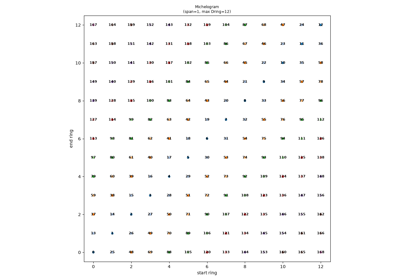
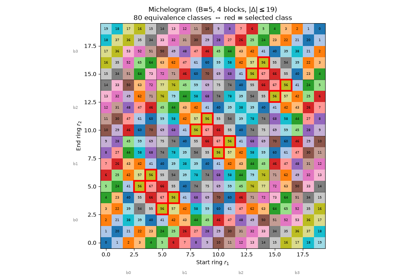
- show(ax: Axes, show_merge_lines: bool = True, plane_index_fontsize: float = 6, **kwargs) None[source]
Draw the Michelogram scatter plot onto
ax.Each point represents a valid ring pair
(s, e), colored byabs(segment). Forspan > 1, ring pairs that share the same(segment, s + e)and therefore collapse into the same sinogram plane are connected by a thin grey line whenshow_merge_linesisTrue.- Parameters:
ax (plt.Axes) – 2-D matplotlib axes (not 3-D).
show_merge_lines (bool, optional) – Draw lines connecting ring pairs that merge into the same plane. Defaults to
True. Only has a visible effect forspan > 1.plane_index_fontsize (float, optional) – Font size of the per-plane index annotations placed at each ring-pair (or merged-group) centroid. Defaults to
6. Useful knob when the Michelogram is large (lower to avoid overlap) or small (raise for readability).**kwargs – Forwarded to
ax.scatter(e.g.s=4,cmap="RdBu_r").
- Return type:
None
Examples
- show_segment_lors(ring_positions, axs=None, uncompressed_lor_kwargs: dict | None = None, compressed_lor_kwargs: dict | None = None, inset_plane_index_fontsize: float = 4)[source]
Side-view LOR diagram per segment with a Michelogram inset.
Mirrors the descriptor’s
RegularPolygonPETLORDescriptor.show_segment_lors(), but takesring_positionsexplicitly so the Michelogram can be visualised standalone (e.g. withnp.arange(num_rings)for a purely schematic plot, or with the user’s actual ring z-positions).Subplots are arranged in a 2-row grid (when negative segments exist):
columns indexed by
abs(segment): 0, 1, 2, …row 0 non-negative segments (0, +1, +2, …)
row 1, col 0 Michelogram inset
row 1, col >= 1 negative segments (-1, -2, …)
Each LOR subplot shows the uncompressed (per-ring-pair) LORs as solid black lines and the compressed (axially-averaged) LORs as dashed coloured lines.
- Parameters:
ring_positions (array-like, shape
(num_rings,)) – z-coordinate of each ring.axs (2-D array-like of Axes, optional) – Pre-existing axes of shape
(n_rows, n_cols). IfNone, a new figure is created.uncompressed_lor_kwargs (dict, optional) – Style overrides for the uncompressed LOR lines.
compressed_lor_kwargs (dict, optional) – Style overrides for the compressed LOR lines.
inset_plane_index_fontsize (float)
- Return type:
matplotlib.figure.Figure
Examples
- property span: int | None
Axial compression factor (odd), or
Nonefor the GE layout.



- class parallelproj.pet_lors.MichelogramLayout(*values)[source]
Bases:
EnumAxial plane layout / segmentation convention for a
Michelogram.Examples
- GE = 2
GE-style mixed axial layout.
Segment 0 collects ring differences \(\{-1, 0, +1\}\) (the \(\pm 1\) cross planes are summed into virtual direct planes at the intermediate axial positions, exactly as in a Siemens span-3 segment 0), while every oblique segment \(\pm k\) collects the ring-difference pair \(\{\pm 2k, \pm(2k+1)\}\) without combination. Segments are ordered
0, +1, -1, +2, -2, ...with axial positions increasing within each segment.spanis ignored for this layout (seeMichelogram.span, which returnsNone). This is the segment (theta) / ring-difference (dZ) plane ordering used by GE-style sinograms (also known as “span 2” in STIR). Combine it with a matchingRegularPolygonPETLORDescriptorfor the GE scanner of interest.Examples
- STANDARD = 1
Siemens/CTI-style layout parameterised by an odd
span(default).Examples
- classmethod __getitem__(name)
Return the member matching name.
Examples
- class parallelproj.pet_lors.PETLORDescriptor(scanner: ModularizedPETScannerGeometry)[source]
Bases:
ABCabstract base class to describe which modules / indices in modules of a modularized PET scanner are in coincidence; defining geometrical LORs
Examples
Non-TOF and TOF projections using a modularized (block) PET scanner geometry
Non-TOF and TOF projections using a modularized (block) PET scanner geometry
Convergence comparison: SGD vs SVRG with logcosh regularization
Convergence comparison: SGD vs SVRG with logcosh regularization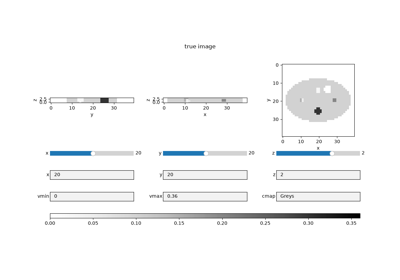
PDHG and SPDHG for PET reconstruction with a directional TV prior
PDHG and SPDHG for PET reconstruction with a directional TV prior
TOF vs non-TOF: variance reduction in a uniform cylinder
TOF vs non-TOF: variance reduction in a uniform cylinder
Convergence comparison: SGD vs SVRG with regularization (sinogram and listmode)
Convergence comparison: SGD vs SVRG with regularization (sinogram and listmode)
Penalised transmission reconstruction (MAPTR) with an edge-preserving prior
Penalised transmission reconstruction (MAPTR) with an edge-preserving prior- Parameters:
scanner (ModularizedPETScannerGeometry) – a modularized PET scanner
Examples
Non-TOF and TOF projections using a modularized (block) PET scanner geometry
Non-TOF and TOF projections using a modularized (block) PET scanner geometry
Convergence comparison: SGD vs SVRG with logcosh regularization
Convergence comparison: SGD vs SVRG with logcosh regularization
PDHG and SPDHG for PET reconstruction with a directional TV prior
PDHG and SPDHG for PET reconstruction with a directional TV prior
TOF vs non-TOF: variance reduction in a uniform cylinder
TOF vs non-TOF: variance reduction in a uniform cylinder
Convergence comparison: SGD vs SVRG with regularization (sinogram and listmode)
Convergence comparison: SGD vs SVRG with regularization (sinogram and listmode)
Penalised transmission reconstruction (MAPTR) with an edge-preserving prior
Penalised transmission reconstruction (MAPTR) with an edge-preserving prior- property dev: str
device to use for storing the LOR endpoints
- abstractmethod get_lor_coordinates() tuple[Array, Array][source]
Return the start and end world coordinates of all (or a subset of) LORs.
Subclasses may accept optional keyword arguments to restrict which LORs are returned (e.g.
views=for sinogram descriptors,block_pair_nums=for block descriptors). Calling with no arguments always returns all LORs.- Returns:
xstart (Array) – Float array of shape
(..., 3)with the world coordinates of the LOR start points. The leading dimensions depend on the concrete subclass:(N, 3)for block-based descriptors,(*spatial_sinogram_shape, 3)for sinogram-based descriptors.xend (Array) – Float array with the same shape as
xstartcontaining the LOR end points.
- Return type:
tuple[Array, Array]
Examples
- property scanner: ModularizedPETScannerGeometry
the scanner for which coincidences are described
- property xp: ModuleType
array module to use for storing the LOR endpoints
- class parallelproj.pet_lors.RadialDirection(*values)[source]
Bases:
EnumDirection in which the sinogram radial (tangential) index increases.
The central radial bin always connects detectors
(0, N/2); this enum controls which side of the centre positive radial offsets fall on.Examples
- MINUS = 2
Radial index increases with decreasing detector-index difference.
Examples
- PLUS = 1
Radial index increases with increasing detector-index difference (default).
Examples
- classmethod __getitem__(name)
Return the member matching name.
Examples
- class parallelproj.pet_lors.RegularPolygonPETLORDescriptor(scanner: RegularPolygonPETScannerGeometry, michelogram: Michelogram | None = None, radial_trim: int = 3, sinogram_order: SinogramSpatialAxisOrder = SinogramSpatialAxisOrder.RVP, zig_zag_order: SinogramZigZagOrder = SinogramZigZagOrder.END_FIRST, view_direction: ViewDirection = ViewDirection.PLUS, radial_direction: RadialDirection = RadialDirection.PLUS, lor_endpoint_order: LOREndpointOrder = LOREndpointOrder.START_END, view0_shift: int = 0)[source]
Bases:
PETLORDescriptorLOR descriptor for a regular polygon PET scanner where we have coincidences within and between “rings (polygons of modules)” The geometrical LORs can be sorted into a sinogram having a “plane”, “view” and “radial” axis.
Examples
Convergence comparison: SGD vs SVRG with logcosh regularization
Convergence comparison: SGD vs SVRG with logcosh regularization
PDHG and SPDHG for PET reconstruction with a directional TV prior
PDHG and SPDHG for PET reconstruction with a directional TV prior
TOF vs non-TOF: variance reduction in a uniform cylinder
TOF vs non-TOF: variance reduction in a uniform cylinder
Convergence comparison: SGD vs SVRG with regularization (sinogram and listmode)
Convergence comparison: SGD vs SVRG with regularization (sinogram and listmode)
PDHG and LM-SPDHG to optimize the Poisson logL and total variation
PDHG and LM-SPDHG to optimize the Poisson logL and total variation
Transmission reconstruction: MLTR, SPS and L-BFGS-B
Transmission reconstruction: MLTR, SPS and L-BFGS-B
Accelerating MLTR with ordered subsets (OS-MLTR) and SVRG
Accelerating MLTR with ordered subsets (OS-MLTR) and SVRG
Penalised transmission reconstruction (MAPTR) with an edge-preserving prior
Penalised transmission reconstruction (MAPTR) with an edge-preserving prior
Joint activity and attenuation reconstruction (MLAA) for TOF PET
Joint activity and attenuation reconstruction (MLAA) for TOF PET- Parameters:
scanner (RegularPolygonPETScannerGeometry) – a regular polygon PET scanner.
michelogram (Michelogram, optional) – the axial plane layout – the single source of truth for the spanning combinatorics (segments, axial midpoints, ring-pair grouping, ordering). If
None(default), a span-1 layout with no constraint on the ring difference is used, i.e.Michelogram(scanner.num_rings, scanner.num_rings - 1, span=1). The Michelogram must havenum_rings == scanner.num_rings.radial_trim (int, optional) – number of geometrial LORs to disregard in the radial direction. Defaults to 3.
sinogram_order (SinogramSpatialAxisOrder, optional) – the order of the sinogram axes. Defaults to
SinogramSpatialAxisOrder.RVP.zig_zag_order (SinogramZigZagOrder, optional) – the zig-zag ordering convention for in-ring detector pairs. Defaults to
SinogramZigZagOrder.END_FIRST.view_direction (ViewDirection, optional) – direction in which the view index increases (
PLUSdefault). View 0’s central bin always connects detectors(0, N/2).radial_direction (RadialDirection, optional) – direction in which the radial index increases (
PLUSdefault). Together withring_endpoint_ordering(crystal numbering) andview_directionthese knobs reproduce any vendor’s(view, radial) <-> detector-pairconvention.lor_endpoint_order (LOREndpointOrder, optional) – which physical endpoint of each LOR is the start (
xstart) vs the end (xend), by defaultLOREndpointOrder.START_END. Only matters for TOF, where it reverses the TOF-bin axis; non-TOF projections are unchanged. SeeLOREndpointOrder(note thetofcenter_offsetcaveat for non-zero offsets).view0_shift (int, optional) – non-negative integer
m(default 0) that shifts the detector anchor of the views: view 0’s central radial bin then connects detectors((0 + m) mod N, (N/2 + m) mod N)instead of(0, N/2)(N= number of detectors per ring). The same shift is applied to every view, i.e. it rotates theview -> detector-pairassignment bymcrystals.
Examples
Convergence comparison: SGD vs SVRG with logcosh regularization
Convergence comparison: SGD vs SVRG with logcosh regularization
PDHG and SPDHG for PET reconstruction with a directional TV prior
PDHG and SPDHG for PET reconstruction with a directional TV prior
TOF vs non-TOF: variance reduction in a uniform cylinder
TOF vs non-TOF: variance reduction in a uniform cylinder
Convergence comparison: SGD vs SVRG with regularization (sinogram and listmode)
Convergence comparison: SGD vs SVRG with regularization (sinogram and listmode)
PDHG and LM-SPDHG to optimize the Poisson logL and total variation
PDHG and LM-SPDHG to optimize the Poisson logL and total variation
Transmission reconstruction: MLTR, SPS and L-BFGS-B
Transmission reconstruction: MLTR, SPS and L-BFGS-B
Accelerating MLTR with ordered subsets (OS-MLTR) and SVRG
Accelerating MLTR with ordered subsets (OS-MLTR) and SVRG
Penalised transmission reconstruction (MAPTR) with an edge-preserving prior
Penalised transmission reconstruction (MAPTR) with an edge-preserving prior
Joint activity and attenuation reconstruction (MLAA) for TOF PET
Joint activity and attenuation reconstruction (MLAA) for TOF PET- property dev: str
device to use for storing the LOR endpoints
- property end_in_ring_index: Array
end index within ring for all views - shape (num_views, num_rad)
- property end_plane_index: Array
end ring index for all planes (only defined for single-ring-pair planes)
- property end_plane_z: Array
end z-coordinate for all planes (averaged over constituent ring pairs for span > 1)
- get_distributed_views_and_slices(num_subsets: int, num_dim: int) tuple[list[Array], list[tuple[slice, ...]]][source]
distribute sinogram views numbers into subsets
- Parameters:
num_subsets (int) – number of subsets
num_dim (int) – number of dimensions of the sinogram to setup the subset slices (e.g. 3 for non-TOF, 4 for TOF)
- Returns:
subset views numbers and subset slices
- Return type:
tuple[list[Array], list[tuple[slice, …]]]
Examples
TOF vs non-TOF: variance reduction in a uniform cylinder
TOF vs non-TOF: variance reduction in a uniform cylinder
Penalised transmission reconstruction (MAPTR) with an edge-preserving prior
Penalised transmission reconstruction (MAPTR) with an edge-preserving prior
- get_lor_coordinates(views: None | Array = None) tuple[Array, Array][source]
return the start and end coordinates of all LORs / or a subset of views
- Parameters:
views (None | Array, optional) – the views to consider, by default None means all views
- Returns:
xstart (Array) – Float array of shape
(*spatial_sinogram_shape, 3)containing the LOR start coordinates for the selected views.xend (Array) – Float array of the same shape as
xstartcontaining the LOR end coordinates.
- Return type:
tuple[Array, Array]
Examples
- property lor_endpoint_order: LOREndpointOrder
which physical endpoint is the LOR start (
xstart) vs end (xend)
- property max_ring_difference: int
the maximum ring difference
- property michelogram: Michelogram
The
Michelogramdescribing the axial plane layout.This is the single source of truth for the spanning combinatorics (segments, axial midpoints, ring-pair grouping, ordering). Useful for visualization, axial compression operators, or any user code that needs access to the integer ring-pair structure.
- property num_planes: int
number of planes in the sinogram
- property num_rad: int
number of radial elements in the sinogram
- property num_views: int
number of views in the sinogram
- property plane_axis_num: int
the axis number of the plane axis
- property plane_multiplicity: Array
number of ring pairs contributing to each plane (always 1 for span=1)
- property plane_segment: Array
Signed segment number for each plane (equals the ring difference
rdfor span=1).
- property radial_axis_num: int
the axis number of the radial axis
- property radial_direction: RadialDirection
direction in which the radial index increases
- property radial_trim: int
number of geometrial LORs to disregard in the radial direction
- property scanner: RegularPolygonPETScannerGeometry
the scanner for which coincidences are described
- show_michelogram(ax: Axes, show_merge_lines: bool = True, **kwargs) None[source]
Visualize the Michelogram.
Thin wrapper around
Michelogram.show(); see that method for full documentation of arguments.Examples
- Parameters:
ax (Axes)
show_merge_lines (bool)
- Return type:
None
- show_segment_lors(axs=None, uncompressed_lor_kwargs: dict | None = None, compressed_lor_kwargs: dict | None = None)[source]
Side-view LOR diagram per segment with the Michelogram inset.
Thin wrapper around
Michelogram.show_segment_lors(); this method supplies the scanner’s ring positions automatically. SeeMichelogram.show_segment_lors()for full documentation.Examples
- Parameters:
uncompressed_lor_kwargs (dict | None)
compressed_lor_kwargs (dict | None)
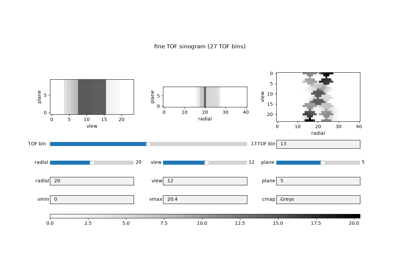
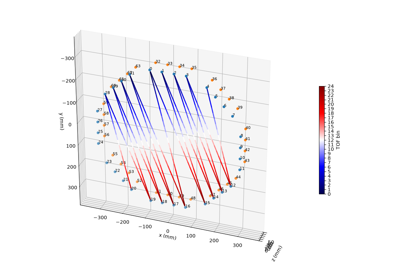
- show_tof_bins(ax: Axes3D, tof_parameters: TOFParameters, views: int | Array | None = None, plane: int = 0, show_endpoints: bool = True, bin_cmap: str = 'seismic', show_bin_labels: bool = False, label_fontsize: float = 8.0, lw: float = 2.0, show_colorbar: bool = False) None[source]
Visualise the TOF bin grid for the specified sinogram views and plane.
Each LOR is drawn as a sequence of coloured line segments – one per TOF bin – directly along the LOR (“zebra” style). Bin colour runs from blue (bin 0, xstart side) to red (bin N-1, xend side) via
bin_cmap. Bins whose extent falls completely outside the physical LOR (i.e. beyond the detector positions) are silently skipped, so short edge LORs naturally show fewer coloured segments than central ones.- Parameters:
ax (Axes3D) – 3-D matplotlib axes to draw on. The caller is responsible for creating the figure and axes.
tof_parameters (TOFParameters) – TOF bin geometry (number of bins, bin width, centre offset).
views (int, array-like, or None) –
Sinogram view index / indices to draw.
int– draw only that view.array-like – draw those specific views.
None(default) – draw the single middle view (num_views // 2).
plane (int) – Sinogram plane index (axial ring pair). Default
0.show_endpoints (bool) – Call
show_lor_endpoints()to annotate detector positions. DefaultTrue.bin_cmap (str) – Matplotlib colourmap for the bin segments. Default
"seismic".show_bin_labels (bool) – Annotate the bin numbers on the central LOR of the drawn set. Default
False(useful only for scanners with few LORs).label_fontsize (float) – Font size for bin labels when
show_bin_labels=True.lw (float) – Line width of the coloured bin segments. Default
2.0.show_colorbar (bool) – Add a colorbar mapping bin index to colour. Default
False.
- Return type:
None
Examples
- show_views(ax: Axes, views: Array, planes: Array, lw: float = 0.2, **kwargs) None[source]
Show all LORs for the given views and planes.
- Parameters:
ax (plt.Axes) – A 3D matplotlib axes.
views (Array) – Integer array of view indices to display.
planes (Array) – Integer array of plane indices to display.
lw (float, optional) – Line width, by default 0.2.
- Return type:
None
Examples
- property sinogram_order: SinogramSpatialAxisOrder
the order of the sinogram axes
- property span: int | None
axial compression factor (1 = no compression;
Nonefor GE layout)
- property spatial_sinogram_shape: tuple[int, ...]
the shape of the sinogram in spatial order
- property start_in_ring_index: Array
start index within ring for all views - shape (num_views, num_rad)
- property start_plane_index: Array
start ring index for all planes (only defined for single-ring-pair planes)
- property start_plane_z: Array
start z-coordinate for all planes (averaged over constituent ring pairs for span > 1)
- property view0_shift: int
detector-anchor shift
mof the views (view 0’s central bin connects((0 + m) mod N, (N/2 + m) mod N))
- property view_axis_num: int
the axis number of the view axis
- property view_direction: ViewDirection
direction in which the view index increases
- property xp: ModuleType
array module to use for storing the LOR endpoints
- property zig_zag_order: SinogramZigZagOrder
the zig-zag ordering convention for in-ring detector pairs
- class parallelproj.pet_lors.SegmentOrder(*values)[source]
Bases:
EnumOrder in which the signed oblique segments are laid out in a
Michelogram.Segment 0 always comes first; the two conventions differ only in whether the positive or the negative member of each \(\pm k\) pair precedes the other. This is a pure permutation of the sinogram planes – the number of planes, their multiplicities and the segment numbering (
Michelogram.ring_diff_to_segment()) are unaffected.Examples
- NEGATIVE_FIRST = 2
Segments ordered
0, -1, +1, -2, +2, ....Examples
- POSITIVE_FIRST = 1
Segments ordered
0, +1, -1, +2, -2, ...(default).Examples
- classmethod __getitem__(name)
Return the member matching name.
Examples
- class parallelproj.pet_lors.SinogramAxialCompressionOperator(lor_descriptor: RegularPolygonPETLORDescriptor, target_span: int | None = None, mode: str = 'sum', num_tof_bins: int | None = None, target_layout: MichelogramLayout = MichelogramLayout.STANDARD, target_segment_order: SegmentOrder = SegmentOrder.POSITIVE_FIRST)[source]
Bases:
LinearOperatorLinear operator that axially compresses a span-1 PET sinogram to a higher odd span (or GE).
The output layout is chosen with
target_layout: a STANDARD higher oddspan(default) or the GE layout (target_layout=MichelogramLayout.GE, which ignorestarget_span). In both cases every span-1 ring pair is assigned to an output plane by the targetMichelogram. A useful consequence: themode="average"adjoint distributes a compressed sinogram back onto the span-1 grid while preserving counts – e.g. to un-combine a GE sinogram into span-1 (and then, say, mash it withSinogramMashingOperator).For an input
RegularPolygonPETLORDescriptorwithspan=1and a target odd span \(S\), every span-1 ring pair \((s, e)\) is assigned to an output bin \((\text{segment}, \text{axial midpoint})\) wheresegmentis determined by the ring difference \(rd = e - s\) under target span \(S\) (seeMichelogram.ring_diff_to_segment()),axial midpointis \(s + e\) (an integer equal to twice the actual midpoint).
All span-1 ring pairs sharing the same \((\text{segment}, s + e)\) collapse into a single output plane.
Two reduction modes are supported:
mode="sum"(default). The output plane is the sum of the contributing input planes:\[y_n \;=\; \sum_{p_1 \in \mathcal{G}(n)} x_{p_1} \qquad \left(G^T y\right)_{p_1} \;=\; y_{\,\tau(p_1)}\,.\]This is the natural reduction for counts-like sinograms – emission data, measured counts, randoms, etc. – which add when ring pairs are grouped together.
mode="average". The output plane is the mean of the contributing input planes:\[y_n \;=\; \frac{1}{m_n} \sum_{p_1 \in \mathcal{G}(n)} x_{p_1} \qquad \left(G_{\rm avg}^T y\right)_{p_1} \;=\; \frac{y_{\,\tau(p_1)}}{m_{\,\tau(p_1)}}\,.\]This is the natural reduction for multiplicative-factor sinograms – attenuation factors, sensitivity / normalisation factors, geometric efficiency – which should average rather than sum when ring pairs are grouped together.
In both expressions, \(\mathcal{G}(n)\) is the set of input plane indices mapped to output plane \(n\), \(m_n = |\mathcal{G}(n)|\) is the plane multiplicity, and \(\tau(p_1)\) is the output plane index for input plane \(p_1\).
Output plane ordering matches that of
RegularPolygonPETLORDescriptorconstructed with the same scanner,radial_trim,max_ring_difference, andsinogram_orderbut withspan=target_span. That companion descriptor is exposed asout_lor_descriptorfor visualization (e.g.show_michelogram,show_segment_lors) or for composing the operator with a span-\(S\) projector.The closed-form operator 2-norms are
\[\|G_{\rm sum}\|_2 = \sqrt{\max_n m_n}\,, \qquad \|G_{\rm avg}\|_2 = 1 / \sqrt{\min_n m_n}\,,\]derived from \(G_{\rm sum} G_{\rm sum}^T = \operatorname{diag}(m_n)\) and \(G_{\rm avg} G_{\rm avg}^T = \operatorname{diag}(1/m_n)\).
norm()returns these directly without power iteration.- Parameters:
lor_descriptor (RegularPolygonPETLORDescriptor) – A
span=1LOR descriptor whose sinogram is to be compressed.target_span (int or None) – Odd integer
>= 1giving the target axial compression (STANDARD layout).1is accepted and yields an identity-like operator (each input plane maps to a single output plane in the same span-1 order). Ignored (and may beNone) whentarget_layoutisMichelogramLayout.GE.mode ({"sum", "average"}, optional) – Reduction mode.
"sum"(default) is appropriate for counts-like sinograms;"average"is appropriate for multiplicative-factor sinograms such as attenuation or sensitivity factors."average"is also the mode whose adjoint distributes a compressed sinogram back to span-1 while preserving counts (e.g. to un-combine a GE sinogram).num_tof_bins (int or None, optional) – If
None(default), the operator acts on the 3D spatial sinogram with shapeRegularPolygonPETLORDescriptor.spatial_sinogram_shape. If a positive integer, the operator acts on a 4D TOF sinogram whose trailing axis (sizenum_tof_bins) is the TOF axis and is passed through unchanged.target_layout (MichelogramLayout, optional) – Axial layout of the output sinogram.
STANDARD(default) usestarget_span;GEcompresses the span-1 input to the GE layout (target_spanis ignored). The GE target requires a span-1 input.target_segment_order (SegmentOrder, optional) – Segment ordering of the output sinogram, by default
SegmentOrder.POSITIVE_FIRST. SeeSegmentOrder.
Examples
>>> import array_api_compat.numpy as xp
>>> import parallelproj.pet_scanners as pps
>>> import parallelproj.pet_lors as ppl
>>> scanner = pps.RegularPolygonPETScannerGeometry(
...     xp, "cpu", radius=65.0, num_sides=12, num_lor_endpoints_per_side=4,
...     lor_spacing=4.0, ring_positions=xp.asarray([0.0, 1.0, 2.0]),
...     symmetry_axis=2,
... )
>>> lor_s1 = ppl.RegularPolygonPETLORDescriptor(
...     scanner, ppl.Michelogram(scanner.num_rings, 2, span=1), radial_trim=1,
... )
>>> comp = ppl.SinogramAxialCompressionOperator(lor_s1, target_span=3)
>>> comp.in_shape, comp.out_shape
((..., ..., 9), (..., ..., 7))
>>> comp.adjointness_test(xp, "cpu")
True
Examples
- property H: AdjointLinearOperator
adjoint operator \(A^H\)
- __call__(x: Array) Array
alias to apply(x)
Examples
- Parameters:
x (Array)
- Return type:
Array
- adjoint(y: Array) Array
(scaled) adjoint step \(x = \overline{\alpha} A^H y\)
- Parameters:
y (Array)
- Return type:
Array
Examples
- adjointness_test(xp: ModuleType | None = None, dev: str | None = None, verbose: bool = False, iscomplex: bool = False, dtype: type | None = None, **kwargs) bool
test whether the adjoint is correctly implemented
- Parameters:
xp (ModuleType, optional) – array module to use. Defaults to the operator’s own namespace (
self.xp) when it exposes one; otherwise must be given.dev (str, optional) – device (cpu or cuda). Defaults to the operator’s own device (
self.dev) when it exposes one, else the default device.verbose (bool, optional) – verbose output
iscomplex (bool, optional) – use complex arrays
dtype (type | None, optional) – data type of the arrays
**kwargs (dict) – passed to np.isclose
- Returns:
whether the adjoint is correctly implemented
- Return type:
bool
Examples
- apply(x: Array) Array
(scaled) forward step \(y = \alpha A x\)
- Parameters:
x (Array)
- Return type:
Array
Examples
- property in_shape: tuple[int, ...]
Spatial sinogram shape of the span-1 input, optionally with a trailing TOF axis.
- property lor_descriptor: RegularPolygonPETLORDescriptor
The input (span-1) LOR descriptor.
- property max_plane_multiplicity: int
Largest plane multiplicity (\(\|G\|_2^2\)).
- property mode: str
Reduction mode, either
"sum"or"average".
- norm(xp: ModuleType, dev: str, num_iter: int = 30, iscomplex: bool = False, verbose: bool = False) float[source]
Operator 2-norm in closed form.
Because each input plane belongs to exactly one output plane,
mode="sum": \(G G^T = \operatorname{diag}(m_n)\) and therefore \(\|G\|_2 = \sqrt{\max_n m_n}\).mode="average": \(G_{\rm avg} G_{\rm avg}^T = \operatorname{diag}(1/m_n)\) and therefore \(\|G_{\rm avg}\|_2 = 1 / \sqrt{\min_n m_n}\).
Both norms are independent of TOF,
xp, anddev; the inherited signature is retained for compatibility withLinearOperator.normbut its arguments (xp,dev,num_iter,iscomplex,verbose) are ignored.Examples
- Parameters:
xp (ModuleType)
dev (str)
num_iter (int)
iscomplex (bool)
verbose (bool)
- Return type:
float
- property num_planes_in: int
Number of span-1 input planes.
- property num_planes_out: int
Number of span-\(S\) output planes.
- property num_tof_bins: int | None
Number of TOF bins, or
Nonefor a non-TOF operator.
- property out_lor_descriptor: RegularPolygonPETLORDescriptor
Auto-built companion descriptor whose plane ordering matches this operator’s output.
- property out_shape: tuple[int, ...]
Spatial sinogram shape of the compressed output, optionally with a trailing TOF axis.
- property plane_multiplicity: Array
Number of span-1 planes that collapse into each output plane.
Shape
(num_planes_n,). Equals the diagonal of \(G G^T\).
- property scale: float | complex
scalar factor applied to the linear operator
- property target_layout: MichelogramLayout
Axial layout of the output sinogram (
STANDARDorGE).
- property target_plane_for_input_plane: Array
Output plane index for each span-1 input plane.
Shape
(num_planes_1,). Useful for the closed-form check \((G^T G\,\mathbf{1})_{p_1} = m_{\,\tau(p_1)}\).
- property target_span: int | None
Target span (odd, >= 1), or
Nonefor a GE-layout target.
- class parallelproj.pet_lors.SinogramMashingOperator(lor_descriptor: RegularPolygonPETLORDescriptor, transaxial_factor: int = 1, axial_factor: int = 1, mode: str = 'sum', coarse_radial_trim: int | None = None, num_tof_bins: int | None = None)[source]
Bases:
LinearOperatorDetector mashing for a span-1 regular-polygon PET sinogram.
Groups neighbouring detectors into larger virtual detectors located at the average endpoint position, dramatically reducing the number of LORs.
transaxial_factor(\(N\)) groups \(N\) neighbouring crystals within each polygon side;axial_factor(\(M\)) groups \(M\) neighbouring rings.
Because within-side averaging of uniformly spaced crystals (and of ring positions) again yields a regular polygon, the mashed geometry is itself a
RegularPolygonPETScannerGeometry, exposed ascoarse_scanner, with a matching span-1coarse_lor_descriptor. A standardRegularPolygonPETProjectorbuilt on the latter projects directly along the mashed LORs (the fast, approximate forward model), while this operator composed with the fine projector is the exact mashed model.The operator maps every fine sinogram bin to the coarse bin whose two virtual detectors contain the fine bin’s two endpoints, and
mode="sum"(default) sums the contributing fine bins – the natural reduction for counts-like data (emission, measured counts);mode="average"takes their mean – appropriate for multiplicative factors (attenuation, normalisation) and matching a single coarse-geometry projector.
The adjoint scatters/broadcasts accordingly. Each fine bin maps to exactly one coarse bin, so \(G G^T = \operatorname{diag}(m_n)\) and the closed-form 2-norms are \(\|G_{\rm sum}\| = \sqrt{\max_n m_n}\), \(\|G_{\rm avg}\| = 1/\sqrt{\min_n m_n}\) with \(m_n\) the per-coarse-bin multiplicity;
norm()returns these directly.Constraints: the input descriptor must have
span == 1,Nmust dividenum_lor_endpoints_per_sideandMmust dividenum_rings. GE-layout sinograms are mashed by composition: convert GE -> span-1 with the average-mode adjoint of a span-1 <-> GESinogramAxialCompressionOperator, mash the span-1 sinogram with this operator, giving a pure span-1 coarse sinogram (see the detector-mashing example).- Parameters:
lor_descriptor (RegularPolygonPETLORDescriptor) – the fine (un-mashed) span-1 descriptor.
transaxial_factor (int, optional) – number of neighbouring within-side crystals to mash (
N), default 1.axial_factor (int, optional) – number of neighbouring rings to mash (
M), default 1.mode ({"sum", "average"}, optional) – reduction mode, default
"sum".coarse_radial_trim (int or None, optional) – radial trim of the coarse descriptor.
None(default) derives it automatically from the fine->coarse mapping so that every coarse radial bin with at least one non-degenerate fine contributor is kept (no trimming-induced count loss) while no empty peripheral coarse radial bins remain. Pass an explicit non-negative integer to override this (a larger value trims additional radial bins and will discard the fine LORs that map into them).num_tof_bins (int or None, optional) – if given, the operator acts on a 4D TOF sinogram whose trailing axis is passed through unchanged (an approximation: the averaged LOR direction differs slightly from the fine LORs).
Notes
TOF binning of the mashed LOR is approximate because the averaged endpoints define a slightly different LOR direction than the individual fine LORs.
Examples
- property H: AdjointLinearOperator
adjoint operator \(A^H\)
- __call__(x: Array) Array
alias to apply(x)
Examples
- Parameters:
x (Array)
- Return type:
Array
- adjoint(y: Array) Array
(scaled) adjoint step \(x = \overline{\alpha} A^H y\)
- Parameters:
y (Array)
- Return type:
Array
Examples
- adjointness_test(xp: ModuleType | None = None, dev: str | None = None, verbose: bool = False, iscomplex: bool = False, dtype: type | None = None, **kwargs) bool
test whether the adjoint is correctly implemented
- Parameters:
xp (ModuleType, optional) – array module to use. Defaults to the operator’s own namespace (
self.xp) when it exposes one; otherwise must be given.dev (str, optional) – device (cpu or cuda). Defaults to the operator’s own device (
self.dev) when it exposes one, else the default device.verbose (bool, optional) – verbose output
iscomplex (bool, optional) – use complex arrays
dtype (type | None, optional) – data type of the arrays
**kwargs (dict) – passed to np.isclose
- Returns:
whether the adjoint is correctly implemented
- Return type:
bool
Examples
- apply(x: Array) Array
(scaled) forward step \(y = \alpha A x\)
- Parameters:
x (Array)
- Return type:
Array
Examples
- property axial_factor: int
number of rings mashed together (
M).
- property coarse_lor_descriptor: RegularPolygonPETLORDescriptor
the mashed (output) LOR descriptor.
- property coarse_scanner
the mashed (averaged-endpoint) regular-polygon scanner geometry.
- property in_shape: tuple[int, ...]
fine spatial sinogram shape (optionally with a trailing TOF axis).
- property lor_descriptor: RegularPolygonPETLORDescriptor
the fine (input) LOR descriptor.
- property mode: str
reduction mode,
"sum"or"average".
- norm(xp: ModuleType | None = None, dev: str | None = None, num_iter: int = 30, iscomplex: bool = False, verbose: bool = False) float[source]
Closed-form operator 2-norm (arguments accepted but ignored).
mode="sum"->sqrt(max multiplicity);mode="average"->1 / sqrt(min multiplicity).Examples
- Parameters:
xp (ModuleType | None)
dev (str | None)
num_iter (int)
iscomplex (bool)
verbose (bool)
- Return type:
float
- property num_tof_bins: int | None
number of TOF bins, or
Nonefor a non-TOF operator.
- property out_shape: tuple[int, ...]
coarse spatial sinogram shape (optionally with a trailing TOF axis).
- property scale: float | complex
scalar factor applied to the linear operator
- property transaxial_factor: int
number of within-side crystals mashed together (
N).
- class parallelproj.pet_lors.SinogramSegmentSelectionOperator(lor_descriptor: RegularPolygonPETLORDescriptor, segments: Sequence[int], num_tof_bins: int | None = None)[source]
Bases:
LinearOperatorSelect a subset of Michelogram segments from a sinogram.
Given a (full)
RegularPolygonPETLORDescriptorand a list ofsegmentsto keep, this operatorbuilds a companion
restricted_lor_descriptor– identical to the input descriptor but with the segment-restricted Michelogram (Michelogram.select_segments()) – which you use to build the projector that produces/consumes the restricted sinogram directly;as a
LinearOperator, forward-gathers the selected planes of a full sinogram into the restricted one, and its adjoint scatters a restricted sinogram back into a zero-filled full sinogram.
The mapping only touches the plane axis (
lor_descriptor.plane_axis_num), so both non-TOF(..., plane, ...)and TOF(..., plane, ..., tof)sinograms are supported (passnum_tof_bins). Because it is a pure plane selection (each kept plane maps to exactly one distinct output plane), forward and adjoint are exact transposes and \(\|G\|_2 = 1\).- Parameters:
lor_descriptor (RegularPolygonPETLORDescriptor) – the full LOR descriptor whose sinogram is the operator input.
segments (Sequence[int]) – signed segment numbers to keep (order/duplicates ignored; ordering of the restricted planes follows the michelogram’s
segment_order).num_tof_bins (int, optional) – if given, the sinograms carry a trailing TOF axis of this length;
None(default) for non-TOF sinograms.
Example
>>> import array_api_compat.numpy as xp
>>> import parallelproj.pet_scanners as pps
>>> import parallelproj.pet_lors as ppl
>>> scanner = pps.RegularPolygonPETScannerGeometry(
...     xp, "cpu", radius=65.0, num_sides=4, num_lor_endpoints_per_side=2,
...     lor_spacing=4.0, ring_positions=xp.asarray([0.0, 1.0, 2.0]),
...     symmetry_axis=2)
>>> full = ppl.RegularPolygonPETLORDescriptor(
...     scanner, ppl.Michelogram(scanner.num_rings, 2, span=1))
>>> sel = ppl.SinogramSegmentSelectionOperator(full, segments=[0, -1, 1])
>>> sel.restricted_lor_descriptor.num_planes <= full.num_planes
True
Examples
- property H: AdjointLinearOperator
adjoint operator \(A^H\)
- __call__(x: Array) Array
alias to apply(x)
Examples
- Parameters:
x (Array)
- Return type:
Array
- adjoint(y: Array) Array
(scaled) adjoint step \(x = \overline{\alpha} A^H y\)
- Parameters:
y (Array)
- Return type:
Array
Examples
- adjointness_test(xp: ModuleType | None = None, dev: str | None = None, verbose: bool = False, iscomplex: bool = False, dtype: type | None = None, **kwargs) bool
test whether the adjoint is correctly implemented
- Parameters:
xp (ModuleType, optional) – array module to use. Defaults to the operator’s own namespace (
self.xp) when it exposes one; otherwise must be given.dev (str, optional) – device (cpu or cuda). Defaults to the operator’s own device (
self.dev) when it exposes one, else the default device.verbose (bool, optional) – verbose output
iscomplex (bool, optional) – use complex arrays
dtype (type | None, optional) – data type of the arrays
**kwargs (dict) – passed to np.isclose
- Returns:
whether the adjoint is correctly implemented
- Return type:
bool
Examples
- apply(x: Array) Array
(scaled) forward step \(y = \alpha A x\)
- Parameters:
x (Array)
- Return type:
Array
Examples
- property in_shape: tuple[int, ...]
Spatial sinogram shape of the full input, optionally with a trailing TOF axis.
- property lor_descriptor: RegularPolygonPETLORDescriptor
The full (input) LOR descriptor.
- norm(xp: ModuleType, dev: str, num_iter: int = 30, iscomplex: bool = False, verbose: bool = False) float[source]
Operator 2-norm in closed form.
Each kept plane maps to exactly one distinct output plane, so the rows of the selection matrix are orthonormal, \(G G^T = I\) and \(\|G\|_2 = 1\). The inherited signature is kept for API compatibility; its arguments are ignored.
Examples
- Parameters:
xp (ModuleType)
dev (str)
num_iter (int)
iscomplex (bool)
verbose (bool)
- Return type:
float
- property num_planes_in: int
Number of planes in the full input sinogram.
- property num_planes_out: int
Number of planes in the segment-restricted output sinogram.
- property num_tof_bins: int | None
Number of TOF bins, or
Nonefor non-TOF sinograms.
- property out_shape: tuple[int, ...]
Spatial sinogram shape of the segment-restricted output, optionally with a trailing TOF axis.
- property restricted_lor_descriptor: RegularPolygonPETLORDescriptor
Companion descriptor with the segment-restricted Michelogram; use it to build the projector for the restricted sinogram.
- property scale: float | complex
scalar factor applied to the linear operator
- property segments: tuple[int, ...]
Kept segments, in the michelogram’s
segment_order.
- class parallelproj.pet_lors.SinogramSpatialAxisOrder(*values)[source]
Bases:
Enumorder of spatial axis in a sinogram R (radial), V (view), P (plane)
Examples
Convergence comparison: SGD vs SVRG with logcosh regularization
Convergence comparison: SGD vs SVRG with logcosh regularization
PDHG and SPDHG for PET reconstruction with a directional TV prior
PDHG and SPDHG for PET reconstruction with a directional TV prior
TOF vs non-TOF: variance reduction in a uniform cylinder
TOF vs non-TOF: variance reduction in a uniform cylinder
Convergence comparison: SGD vs SVRG with regularization (sinogram and listmode)
Convergence comparison: SGD vs SVRG with regularization (sinogram and listmode)
Penalised transmission reconstruction (MAPTR) with an edge-preserving prior
Penalised transmission reconstruction (MAPTR) with an edge-preserving prior- PRV = 5
[plane,radial,view]
Examples
- PVR = 6
[plane,view,radial]
Examples
- RPV = 2
[radial,plane,view]
Examples
- RVP = 1
[radial,view,plane]
Examples
Convergence comparison: SGD vs SVRG with logcosh regularization
Convergence comparison: SGD vs SVRG with logcosh regularization
PDHG and SPDHG for PET reconstruction with a directional TV prior
PDHG and SPDHG for PET reconstruction with a directional TV prior
TOF vs non-TOF: variance reduction in a uniform cylinder
TOF vs non-TOF: variance reduction in a uniform cylinder
Convergence comparison: SGD vs SVRG with regularization (sinogram and listmode)
Convergence comparison: SGD vs SVRG with regularization (sinogram and listmode)
PDHG and LM-SPDHG to optimize the Poisson logL and total variation
PDHG and LM-SPDHG to optimize the Poisson logL and total variation
Transmission reconstruction: MLTR, SPS and L-BFGS-B
Transmission reconstruction: MLTR, SPS and L-BFGS-B
Accelerating MLTR with ordered subsets (OS-MLTR) and SVRG
Accelerating MLTR with ordered subsets (OS-MLTR) and SVRG
Penalised transmission reconstruction (MAPTR) with an edge-preserving prior
Penalised transmission reconstruction (MAPTR) with an edge-preserving prior
Joint activity and attenuation reconstruction (MLAA) for TOF PET
Joint activity and attenuation reconstruction (MLAA) for TOF PET
- VPR = 4
[view,plane,radial]
Examples
- VRP = 3
[view,radial,plane]
Examples
- classmethod __getitem__(name)
Return the member matching name.
Examples
- class parallelproj.pet_lors.SinogramZigZagOrder(*values)[source]
Bases:
EnumZig-zag ordering of in-ring detector pairs for each sinogram view.
For a scanner with \(n\) detector endpoints per ring and view index 0, the two variants differ in which detector (start or end) steps first as the radial bin index increases from the central LOR outward.
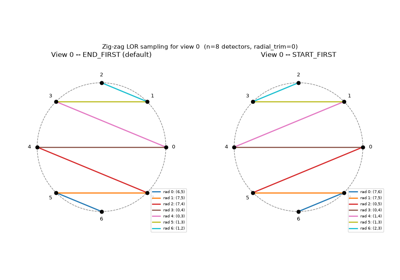
END_FIRSTThe end detector steps first for each new radial pair. Pairs (start, end) at view 0: (0,n-1), (0,n-2), (1,n-2), (1,n-3), …
START_FIRSTThe start detector steps first for each new radial pair. Pairs (start, end) at view 0: (0,n-1), (1,n-1), (1,n-2), (2,n-2), …
Examples
- END_FIRST = 1
End crystal steps first (default, historically used convention).
Examples
- START_FIRST = 2
Start crystal steps first.
Examples
- classmethod __getitem__(name)
Return the member matching name.
Examples
- class parallelproj.pet_lors.TOFBinMashingOperator(tof_parameters: TOFParameters, non_tof_data_shape: tuple[int, ...], mashing_factor: int = 1, mode: str = 'sum')[source]
Bases:
LinearOperatorLinear operator that mashes (groups) neighbouring TOF bins.
Groups every
mashing_factor(\(G\)) consecutive TOF bins of a TOF-binned data array into a single coarse bin. The reduction acts only on the trailing (TOF) axis; all leading (non-TOF) axes – e.g. the spatial sinogram axes, or listmode/block indices – are passed through unchanged. The operator is therefore geometry-agnostic: it works on any array whose last axis is the TOF axis (a plain length-num_tofbinsvector included).With \(G\) dividing the number of fine TOF bins, the fine bin index \(t\) maps to coarse bin \(t // G\), i.e. coarse bin \(c\) collects the fine bins \(\{cG, cG+1, \dots, cG+G-1\}\).
Two reduction modes are supported:
mode="sum"(default) – the coarse bin is the sum of its \(G\) fine bins:\[y_c \;=\; \sum_{g=0}^{G-1} x_{\,cG+g} \qquad \left(A^T y\right)_t \;=\; y_{\,t // G}\,.\]This is the natural reduction for counts-like TOF data. Because a TOF-bin weight is a Gaussian integrated over the bin’s extent and integrals over adjacent bins add exactly to the integral over their union, sum-mashing a TOF forward projection is (up to the
num_sigmastruncation) identical to projecting directly onto the coarse TOF grid described bycoarse_tof_parameters.mode="average"– the coarse bin is the mean of its \(G\) fine bins:\[y_c \;=\; \frac{1}{G} \sum_{g=0}^{G-1} x_{\,cG+g} \qquad \left(A_{\rm avg}^T y\right)_t \;=\; \frac{y_{\,t // G}}{G}\,.\]
The closed-form operator 2-norms follow from \(A A^T = G\,I\) (
sum) and \(A_{\rm avg} A_{\rm avg}^T = (1/G)\,I\):\[\|A_{\rm sum}\|_2 = \sqrt{G}\,, \qquad \|A_{\rm avg}\|_2 = 1 / \sqrt{G}\,.\]norm()returns these directly without power iteration.- Parameters:
tof_parameters (TOFParameters) – TOF parameters of the fine (input) data.
num_tofbinssets the fine TOF axis length; the mashed parameters are exposed ascoarse_tof_parameters.non_tof_data_shape (tuple of int) – Shape of the leading (non-TOF) axes. For a standard TOF sinogram pass
lor_descriptor.spatial_sinogram_shape; pass()to act on a bare length-num_tofbinsTOF vector.mashing_factor (int, optional) – Number of neighbouring TOF bins grouped together (\(G\)), default
1(identity along the TOF axis). Must dividetof_parameters.num_tofbins.mode ({"sum", "average"}, optional) – Reduction mode, default
"sum".
Notes
TOF-bin centring is a matter of convention and is not altered by this operator: for an odd
num_tofbinsthe centre is the central bin (the LOR midpoint at TOF position 0); for an evennum_tofbinsthe centre sits between the two central bins. Choosenum_tofbinsandmashing_factorso the coarse grid keeps the centring you want (e.g. an oddnum_tofbinswith an oddmashing_factoryields an odd coarse bin count and keeps a central bin).Examples
>>> import array_api_compat.numpy as xp
>>> import parallelproj.tof as ppt
>>> import parallelproj.pet_lors as ppl
>>> tp = ppt.TOFParameters(num_tofbins=27, tofbin_width=25.0, sigma_tof=40.0)
>>> op = ppl.TOFBinMashingOperator(tp, (5, 8), mashing_factor=3)
>>> op.in_shape, op.out_shape
((5, 8, 27), (5, 8, 9))
>>> op.coarse_tof_parameters.num_tofbins, op.coarse_tof_parameters.tofbin_width
(9, 75.0)
>>> op.adjointness_test(xp, "cpu")
True
Examples
- property H: AdjointLinearOperator
adjoint operator \(A^H\)
- __call__(x: Array) Array
alias to apply(x)
Examples
- Parameters:
x (Array)
- Return type:
Array
- adjoint(y: Array) Array
(scaled) adjoint step \(x = \overline{\alpha} A^H y\)
- Parameters:
y (Array)
- Return type:
Array
Examples
- adjointness_test(xp: ModuleType | None = None, dev: str | None = None, verbose: bool = False, iscomplex: bool = False, dtype: type | None = None, **kwargs) bool
test whether the adjoint is correctly implemented
- Parameters:
xp (ModuleType, optional) – array module to use. Defaults to the operator’s own namespace (
self.xp) when it exposes one; otherwise must be given.dev (str, optional) – device (cpu or cuda). Defaults to the operator’s own device (
self.dev) when it exposes one, else the default device.verbose (bool, optional) – verbose output
iscomplex (bool, optional) – use complex arrays
dtype (type | None, optional) – data type of the arrays
**kwargs (dict) – passed to np.isclose
- Returns:
whether the adjoint is correctly implemented
- Return type:
bool
Examples
- apply(x: Array) Array
(scaled) forward step \(y = \alpha A x\)
- Parameters:
x (Array)
- Return type:
Array
Examples
- property coarse_tof_parameters: TOFParameters
TOF parameters of the mashed grid.
num_tofbinsis divided bymashing_factorandtofbin_widthis multiplied by it;sigma_tof(the physical timing resolution),num_sigmasandtofcenter_offsetare unchanged.
- property in_shape: tuple[int, ...]
fine data shape
non_tof_data_shape + (num_tofbins,).
- property mashing_factor: int
number of neighbouring TOF bins mashed together (
G).
- property mode: str
reduction mode,
"sum"or"average".
- property non_tof_data_shape: tuple[int, ...]
shape of the leading (non-TOF) axes.
- norm(xp: ModuleType | None = None, dev: str | None = None, num_iter: int = 30, iscomplex: bool = False, verbose: bool = False) float[source]
Closed-form operator 2-norm (arguments accepted but ignored).
mode="sum"->sqrt(mashing_factor);mode="average"->1 / sqrt(mashing_factor).Examples
- Parameters:
xp (ModuleType | None)
dev (str | None)
num_iter (int)
iscomplex (bool)
verbose (bool)
- Return type:
float
- property out_shape: tuple[int, ...]
mashed data shape
non_tof_data_shape + (num_tofbins // G,).
- property scale: float | complex
scalar factor applied to the linear operator
- property tof_parameters: TOFParameters
the fine (input) TOF parameters.
- class parallelproj.pet_lors.ViewDirection(*values)[source]
Bases:
EnumDirection in which the sinogram view index increases.
View 0 is always the central LOR through detectors
(0, N/2); this enum only controls whether increasing the view index advances the detector pair in the+or-direction around the ring.Examples
- MINUS = 2
View index increases with decreasing detector index.
Examples
- PLUS = 1
View index increases with increasing detector index (default).
Examples
- classmethod __getitem__(name)
Return the member matching name.
Examples
- parallelproj.pet_lors.get_lor_descriptor_G1(xp, dev, **kwargs) RegularPolygonPETLORDescriptor[source]
Demo LOR descriptor G1.
A cylindrical TOF PET scanner with 28 detector modules, a 623.6 mm face-to-face (bore) distance and 5 axial units (45 crystal rings), using the mixed cross-plane axial layout. All defaults reproduce the reference definition; any of the
_get_lor_descriptor_g()arguments can be overridden via keyword (e.g.num_units=6,radial_trim=30).- Parameters:
xp (ModuleType) – array-API module.
dev (str) – device.
**kwargs – overrides forwarded to
_get_lor_descriptor_g().
- Return type:
Examples
- parallelproj.pet_lors.get_lor_descriptor_G2(xp, dev, **kwargs) RegularPolygonPETLORDescriptor[source]
Demo LOR descriptor G2.
A cylindrical TOF PET scanner with 34 detector modules, a 744.1 mm face-to-face (bore) distance and, by default, 4 axial units (36 crystal rings), using the mixed cross-plane axial layout. It shares the same 25 mm LYSO crystals as G1 (hence the same
avg_doi_mm). The axial extent is configurable vianum_units(this scanner family also ships in 5- and 6-unit configurations); any other_get_lor_descriptor_g()argument can likewise be overridden via keyword.- Parameters:
xp (ModuleType) – array-API module.
dev (str) – device.
**kwargs – overrides forwarded to
_get_lor_descriptor_g().
- Return type:
Examples