Functions parallelproj.functions
This module provides the objective-function building blocks for iterative
reconstruction: data-fidelity terms and priors together with their gradients,
(approximate) Hessians and proximal operators. The main data-fidelity term is
NegPoissonLogL (the negative Poisson log-likelihood); LogCosh
is an edge-preserving prior; and C2AffineObjective composes a function
with an affine map (e.g. a projector). The abstract base classes define the
differentiability and proximal interfaces that the algorithms rely on – as a
user you normally start from the concrete classes above.
Functions and proximal operators.
Provides a hierarchy of differentiable and non-differentiable scalar functions – including the negative Poisson log-likelihood, quadratic penalties, and the mixed L2-L1 norm – together with their gradients, Hessian-diagonal-vector products, and closed-form proximal operators where available. All classes are array-API compatible and work with NumPy, CuPy, and PyTorch.
- class parallelproj.functions.C1AffineObjective(loss: C1Function, op: LinearOperator, s: Array | None = None)[source]
Bases:
C1FunctionComposes a prediction-space
C1Functionwith an affine forward model.Turns \(g(\bar{y})\) into \(f(x) = g(A x + s)\) using the chain rule:
\[\nabla_x f(x) = A^H \nabla_{\bar{y}} g(A x + s).\]Any scaling is carried exclusively by the
betaattribute ofloss. When \(s\) isNonethe pure linear model \(\bar{y} = A x\) is used, avoiding the addition entirely.- Parameters:
loss (C1Function) – A
C1Functionoperating on the prediction space.op (LinearOperator) – The linear part of the forward model \(A\).
s (Array or None, optional) – Additive contamination term \(s\) (e.g. scatter/randoms).
None(default) selects the pure linear model \(\bar{y} = A x\).
Examples

Convergence comparison: SGD vs SVRG with logcosh regularization
Convergence comparison: SGD vs SVRG with logcosh regularization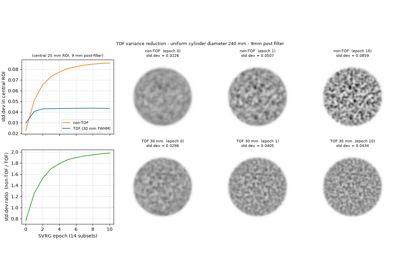
TOF vs non-TOF: variance reduction in a uniform cylinder
TOF vs non-TOF: variance reduction in a uniform cylinder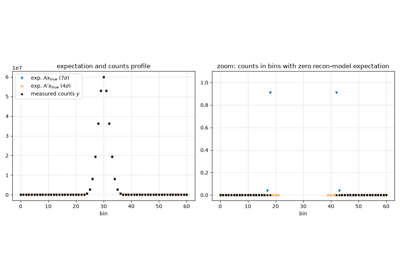
Exact vs. “safe epsilon” mode of the negative Poisson log-likelihood
Exact vs. "safe epsilon" mode of the negative Poisson log-likelihood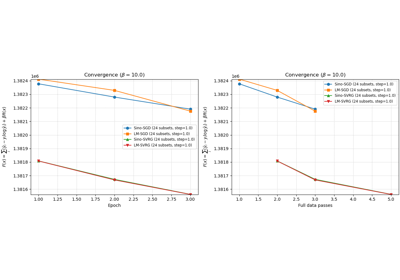
Convergence comparison: SGD vs SVRG with regularization (sinogram and listmode)
Convergence comparison: SGD vs SVRG with regularization (sinogram and listmode)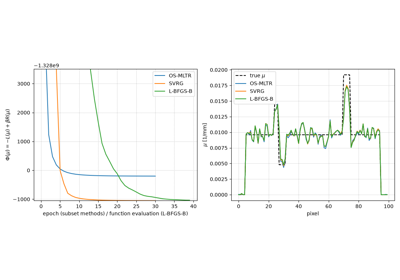
Penalised transmission reconstruction (MAPTR) with an edge-preserving prior
Penalised transmission reconstruction (MAPTR) with an edge-preserving prior- __call__(x: Array) float
Evaluate \(\beta f(x)\).
- Parameters:
x (Array) – Point at which to evaluate the function.
- Returns:
Scaled scalar function value.
- Return type:
float
Examples
- property beta: float
Multiplicative scale factor \(\beta\) (should be > 0).
- call_and_gradient(x: Array) tuple[float, Array]
Evaluate \(\beta f(x)\) and its gradient simultaneously.
- Parameters:
x (Array) – Point at which to evaluate.
- Returns:
Scaled function value and gradient.
- Return type:
tuple[float, Array]
Examples
- gradient(x: Array) Array
Gradient of \(\beta f(x)\).
- Parameters:
x (Array) – Point at which to evaluate the gradient.
- Returns:
Array of the same shape as x containing \(\beta \nabla f(x)\).
- Return type:
Array
Examples
Exact vs. “safe epsilon” mode of the negative Poisson log-likelihood
Exact vs. "safe epsilon" mode of the negative Poisson log-likelihood
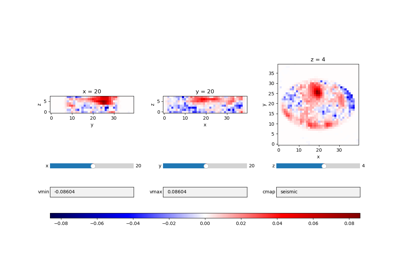
Penalised transmission reconstruction (MAPTR) with an edge-preserving prior
Penalised transmission reconstruction (MAPTR) with an edge-preserving prior

- class parallelproj.functions.C1Function(beta: float = 1.0)[source]
Bases:
ABCAbstract base class for continuously differentiable (C1) scalar functions with an optional scalar scale factor \(\beta\).
The public interface (
__call__(),gradient(),call_and_gradient()) evaluates \(\beta f(x)\). Subclasses only implement the unscaled private methods_call()and_gradient(); \(\beta\) is applied automatically.- Parameters:
beta (float, optional) – Multiplicative scale factor \(\beta\) applied to the function value and all derivatives. Defaults to
1.0.
Examples
Convergence comparison: SGD vs SVRG with logcosh regularization
Convergence comparison: SGD vs SVRG with logcosh regularization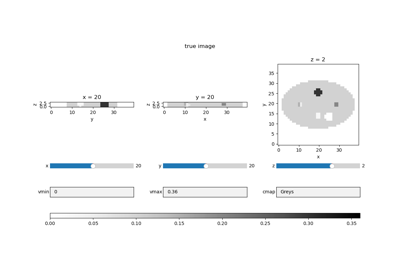
PDHG and SPDHG for PET reconstruction with a directional TV prior
PDHG and SPDHG for PET reconstruction with a directional TV prior
TOF vs non-TOF: variance reduction in a uniform cylinder
TOF vs non-TOF: variance reduction in a uniform cylinder
Exact vs. “safe epsilon” mode of the negative Poisson log-likelihood
Exact vs. "safe epsilon" mode of the negative Poisson log-likelihood
Convergence comparison: SGD vs SVRG with regularization (sinogram and listmode)
Convergence comparison: SGD vs SVRG with regularization (sinogram and listmode)
Penalised transmission reconstruction (MAPTR) with an edge-preserving prior
Penalised transmission reconstruction (MAPTR) with an edge-preserving prior- __call__(x: Array) float[source]
Evaluate \(\beta f(x)\).
- Parameters:
x (Array) – Point at which to evaluate the function.
- Returns:
Scaled scalar function value.
- Return type:
float
Examples
- property beta: float
Multiplicative scale factor \(\beta\) (should be > 0).
- call_and_gradient(x: Array) tuple[float, Array][source]
Evaluate \(\beta f(x)\) and its gradient simultaneously.
- Parameters:
x (Array) – Point at which to evaluate.
- Returns:
Scaled function value and gradient.
- Return type:
tuple[float, Array]
Examples
- gradient(x: Array) Array[source]
Gradient of \(\beta f(x)\).
- Parameters:
x (Array) – Point at which to evaluate the gradient.
- Returns:
Array of the same shape as x containing \(\beta \nabla f(x)\).
- Return type:
Array
Examples
Exact vs. “safe epsilon” mode of the negative Poisson log-likelihood
Exact vs. "safe epsilon" mode of the negative Poisson log-likelihood
Penalised transmission reconstruction (MAPTR) with an edge-preserving prior
Penalised transmission reconstruction (MAPTR) with an edge-preserving prior
- class parallelproj.functions.C1FunctionWithConjProx(beta: float = 1.0)[source]
Bases:
C1Function,FunctionWithConjProxAbstract base class for C1 functions that also admit a closed-form proximal operator of their convex conjugate.
Use this as the base class when your function is differentiable and has a cheap closed-form \(\operatorname{prox}_{\sigma f^*}\). Subclasses must implement
_call(),_gradient(), and_prox_convex_conj(). The \(\beta\) scaling and the publicprox_convex_conj()wrapper are inherited and require no override.See
NegPoissonLogLandHalfSquaredL2Deviationfor concrete examples.Examples
Convergence comparison: SGD vs SVRG with logcosh regularization
Convergence comparison: SGD vs SVRG with logcosh regularization
PDHG and SPDHG for PET reconstruction with a directional TV prior
PDHG and SPDHG for PET reconstruction with a directional TV prior
TOF vs non-TOF: variance reduction in a uniform cylinder
TOF vs non-TOF: variance reduction in a uniform cylinder
Exact vs. “safe epsilon” mode of the negative Poisson log-likelihood
Exact vs. "safe epsilon" mode of the negative Poisson log-likelihood
Convergence comparison: SGD vs SVRG with regularization (sinogram and listmode)
Convergence comparison: SGD vs SVRG with regularization (sinogram and listmode)- Parameters:
beta (float)
- __call__(x: Array) float
Evaluate \(\beta f(x)\).
- Parameters:
x (Array) – Point at which to evaluate the function.
- Returns:
Scaled scalar function value.
- Return type:
float
Examples
- property beta: float
Multiplicative scale factor \(\beta\) (should be > 0).
- call_and_gradient(x: Array) tuple[float, Array]
Evaluate \(\beta f(x)\) and its gradient simultaneously.
- Parameters:
x (Array) – Point at which to evaluate.
- Returns:
Scaled function value and gradient.
- Return type:
tuple[float, Array]
Examples
- gradient(x: Array) Array
Gradient of \(\beta f(x)\).
- Parameters:
x (Array) – Point at which to evaluate the gradient.
- Returns:
Array of the same shape as x containing \(\beta \nabla f(x)\).
- Return type:
Array
Examples
Exact vs. “safe epsilon” mode of the negative Poisson log-likelihood
Exact vs. "safe epsilon" mode of the negative Poisson log-likelihood
- prox(x: Array, sigma: float | Array) Array
Proximal operator of \(\beta f\) via Moreau’s identity.
\[\text{prox}_{\sigma (\beta f)}(x) = x - \sigma \, \text{prox}_{(1/\sigma)(\beta f)^*}(x / \sigma)\]where the inner prox uses step-size \(1/\sigma\).
Subclasses with a cheaper closed-form direct prox may override this.
- Parameters:
x (Array) – Input array.
sigma (float or Array) – Step-size parameter \(\sigma > 0\).
- Returns:
\(\text{prox}_{\sigma (\beta f)}(x)\).
- Return type:
Array
Examples
- prox_convex_conj(y: Array, sigma: float | Array) Array
Proximal operator of the convex conjugate of \(\beta f\).
Uses the identity
\[\text{prox}_{\sigma (\beta f)^*}(y) = \beta \, \text{prox}_{(\sigma / \beta)\, f^*}(y / \beta)\]to reduce to the unscaled
_prox_convex_conj().- Parameters:
y (Array) – Input array.
sigma (float or Array) – Step-size parameter \(\sigma > 0\).
- Returns:
\(\text{prox}_{\sigma (\beta f)^*}(y)\).
- Return type:
Array
Examples
- class parallelproj.functions.C2AffineObjective(loss: C2Function, op: LinearOperator, s: Array | None = None)[source]
Bases:
C2Function,C1AffineObjectiveComposes a prediction-space
C2Functionwith an affine forward model.Extends
C1AffineObjectivewith second-order information. For \(f(x) = g(A x + s)\) the Hessian-vector product is:\[H_f(x)\, v = A^H \bigl(\operatorname{diag}(H_g(\bar{y})) \odot (A v)\bigr)\]where \(\bar{y} = A x + s\) (or \(\bar{y} = A x\) when \(s\) is
None) and \(\odot\) denotes elementwise multiplication. Any scaling is carried exclusively by thebetaattribute ofloss.- Parameters:
loss (C2Function) – A
C2Functionoperating on the prediction space.op (LinearOperator) – The linear part of the forward model \(A\).
s (Array or None, optional) – Additive contamination term \(s\) (e.g. scatter/randoms).
None(default) selects the pure linear model \(\bar{y} = A x\).
Examples
>>> import numpy as np
>>> from parallelproj.operators import MatrixOperator
>>> from parallelproj.functions import NegPoissonLogL, C2AffineObjective
>>> # 4-element image space, 6-element sinogram space
>>> A = np.random.rand(6, 4)
>>> op = MatrixOperator(A)
>>> s = 0.1 * np.ones(6)          # scatter/randoms contamination
>>> data = np.ones(6)             # measured counts
>>> x = np.ones(4)                # image estimate
>>> v = np.ones(4)                # direction vector
>>>
>>> loss = NegPoissonLogL(data)
>>> loss.beta = 0.5
>>> aff_obj = C2AffineObjective(loss, op, s)
>>>
>>> fx = aff_obj(x)                           # scalar value, scaled by beta=0.5
>>> grad = aff_obj.gradient(x)                          # shape (4,), scaled by beta=0.5
>>> hv   = aff_obj.hessian_diag_vec_prod(x, v)          # shape (4,), scaled by beta=0.5
Pure linear forward model with virtual bins (zero rows in \(A\)), handled by
NegPoissonLogL– the default (“safe epsilon”) mode is finite everywhere;exact=Truewould also work here since the virtual bins measure 0:>>> A2 = np.zeros((6, 4)) >>> A2[:4, :] = np.random.rand(4, 4) # last 2 rows are virtual (all zero) >>> op2 = MatrixOperator(A2) >>> data2 = np.array([2., 1., 3., 0., 0., 0.]) # virtual bins measure 0 >>> >>> loss2 = NegPoissonLogL(data2) >>> aff_obj2 = C2AffineObjective(loss2, op2) # no contamination s >>> >>> fx2 = aff_obj2(x) # scalar function value, no nan >>> grad2 = aff_obj2.gradient(x) # shape (4,), no nan >>> hv2 = aff_obj2.hessian_diag_vec_prod(x, v) # shape (4,), no nan
A regularised objective combining a data fidelity term and a roughness penalty via
SumC2Function:\[h(x) = \underbrace{f_{\text{PL}}(Ax + s)}_{\text{data fidelity}} + \underbrace{\beta_{\text{reg}} \cdot \tfrac{1}{2}\|Dx\|_2^2}_{\text{roughness penalty}}\]where \(D\) is a finite forward difference operator.
>>> from parallelproj.operators import FiniteForwardDifference
>>> from parallelproj.functions import HalfSquaredL2Deviation
>>> beta_reg = 0.1
>>> D   = FiniteForwardDifference(x.shape)            # finite differences in image space
>>> reg = C2AffineObjective(HalfSquaredL2Deviation(beta=beta_reg), D)
>>> data_fidelity = C2AffineObjective(NegPoissonLogL(data), op, s)
>>>
>>> obj_fun = data_fidelity + reg                     # SumC2Function
>>> obj_val = obj_fun(x)                              # scalar function value
>>> grad = obj_fun.gradient(x)                        # shape (4,)
>>> hv   = obj_fun.hessian_diag_vec_prod(x, v)        # shape (4,)
Examples
Convergence comparison: SGD vs SVRG with logcosh regularization
Convergence comparison: SGD vs SVRG with logcosh regularization
TOF vs non-TOF: variance reduction in a uniform cylinder
TOF vs non-TOF: variance reduction in a uniform cylinder
Exact vs. “safe epsilon” mode of the negative Poisson log-likelihood
Exact vs. "safe epsilon" mode of the negative Poisson log-likelihood
Convergence comparison: SGD vs SVRG with regularization (sinogram and listmode)
Convergence comparison: SGD vs SVRG with regularization (sinogram and listmode)
Penalised transmission reconstruction (MAPTR) with an edge-preserving prior
Penalised transmission reconstruction (MAPTR) with an edge-preserving prior
Joint activity and attenuation reconstruction (MLAA) for TOF PET
Joint activity and attenuation reconstruction (MLAA) for TOF PET- __call__(x: Array) float
Evaluate \(\beta f(x)\).
- Parameters:
x (Array) – Point at which to evaluate the function.
- Returns:
Scaled scalar function value.
- Return type:
float
Examples
- property beta: float
Multiplicative scale factor \(\beta\) (should be > 0).
- call_and_gradient(x: Array) tuple[float, Array]
Evaluate \(\beta f(x)\) and its gradient simultaneously.
- Parameters:
x (Array) – Point at which to evaluate.
- Returns:
Scaled function value and gradient.
- Return type:
tuple[float, Array]
Examples
- gradient(x: Array) Array
Gradient of \(\beta f(x)\).
- Parameters:
x (Array) – Point at which to evaluate the gradient.
- Returns:
Array of the same shape as x containing \(\beta \nabla f(x)\).
- Return type:
Array
Examples
Exact vs. “safe epsilon” mode of the negative Poisson log-likelihood
Exact vs. "safe epsilon" mode of the negative Poisson log-likelihood
Penalised transmission reconstruction (MAPTR) with an edge-preserving prior
Penalised transmission reconstruction (MAPTR) with an edge-preserving prior
- hessian_diag_vec_prod(x: Array, v: Array) Array
Scaled diagonal Hessian-vector product: \(\beta \operatorname{diag}(H_f(x))\, v\).
- Parameters:
x (Array) – Point at which to evaluate the Hessian diagonal.
v (Array) – Vector to multiply with the Hessian diagonal, same shape as x.
- Returns:
Array of the same shape as x containing \(\beta \operatorname{diag}(H_f(x)) \odot v\) (elementwise).
- Return type:
Array
Examples
Convergence comparison: SGD vs SVRG with logcosh regularization
Convergence comparison: SGD vs SVRG with logcosh regularization
Convergence comparison: SGD vs SVRG with regularization (sinogram and listmode)
Convergence comparison: SGD vs SVRG with regularization (sinogram and listmode)
- class parallelproj.functions.C2Function(beta: float = 1.0)[source]
Bases:
C1FunctionAbstract base class for twice continuously differentiable (C2) scalar functions with an optional scalar scale factor \(\beta\).
Extends
C1Functionwith curvature information. The publichessian_diag_vec_prod()returns \(\beta \operatorname{diag}(H_f(x))\, v\). Subclasses implement the unscaled_hessian_diag_vec_prod().Examples
Convergence comparison: SGD vs SVRG with logcosh regularization
Convergence comparison: SGD vs SVRG with logcosh regularization
PDHG and SPDHG for PET reconstruction with a directional TV prior
PDHG and SPDHG for PET reconstruction with a directional TV prior
TOF vs non-TOF: variance reduction in a uniform cylinder
TOF vs non-TOF: variance reduction in a uniform cylinder
Exact vs. “safe epsilon” mode of the negative Poisson log-likelihood
Exact vs. "safe epsilon" mode of the negative Poisson log-likelihood
Convergence comparison: SGD vs SVRG with regularization (sinogram and listmode)
Convergence comparison: SGD vs SVRG with regularization (sinogram and listmode)
Penalised transmission reconstruction (MAPTR) with an edge-preserving prior
Penalised transmission reconstruction (MAPTR) with an edge-preserving prior- Parameters:
beta (float)
- __call__(x: Array) float
Evaluate \(\beta f(x)\).
- Parameters:
x (Array) – Point at which to evaluate the function.
- Returns:
Scaled scalar function value.
- Return type:
float
Examples
- property beta: float
Multiplicative scale factor \(\beta\) (should be > 0).
- call_and_gradient(x: Array) tuple[float, Array]
Evaluate \(\beta f(x)\) and its gradient simultaneously.
- Parameters:
x (Array) – Point at which to evaluate.
- Returns:
Scaled function value and gradient.
- Return type:
tuple[float, Array]
Examples
- gradient(x: Array) Array
Gradient of \(\beta f(x)\).
- Parameters:
x (Array) – Point at which to evaluate the gradient.
- Returns:
Array of the same shape as x containing \(\beta \nabla f(x)\).
- Return type:
Array
Examples
Exact vs. “safe epsilon” mode of the negative Poisson log-likelihood
Exact vs. "safe epsilon" mode of the negative Poisson log-likelihood
Penalised transmission reconstruction (MAPTR) with an edge-preserving prior
Penalised transmission reconstruction (MAPTR) with an edge-preserving prior
- hessian_diag_vec_prod(x: Array, v: Array) Array[source]
Scaled diagonal Hessian-vector product: \(\beta \operatorname{diag}(H_f(x))\, v\).
- Parameters:
x (Array) – Point at which to evaluate the Hessian diagonal.
v (Array) – Vector to multiply with the Hessian diagonal, same shape as x.
- Returns:
Array of the same shape as x containing \(\beta \operatorname{diag}(H_f(x)) \odot v\) (elementwise).
- Return type:
Array
Examples
Convergence comparison: SGD vs SVRG with logcosh regularization
Convergence comparison: SGD vs SVRG with logcosh regularization
Convergence comparison: SGD vs SVRG with regularization (sinogram and listmode)
Convergence comparison: SGD vs SVRG with regularization (sinogram and listmode)
- class parallelproj.functions.C2FunctionWithConjProx(beta: float = 1.0)[source]
Bases:
C2Function,C1FunctionWithConjProxAbstract base class for C2 functions that also admit a closed-form proximal operator of their convex conjugate.
Combines
C2Function(Hessian diagonal) withC1FunctionWithConjProx(gradient, call, dual prox). Subclasses must implement_call(),_gradient(),_hessian_diag_vec_prod(), and_prox_convex_conj().MRO:
C2FunctionWithConjProx -> C2Function -> C1FunctionWithConjProx -> C1Function -> FunctionWithConjProx -> ABCExamples
Convergence comparison: SGD vs SVRG with logcosh regularization
Convergence comparison: SGD vs SVRG with logcosh regularization
PDHG and SPDHG for PET reconstruction with a directional TV prior
PDHG and SPDHG for PET reconstruction with a directional TV prior
TOF vs non-TOF: variance reduction in a uniform cylinder
TOF vs non-TOF: variance reduction in a uniform cylinder
Exact vs. “safe epsilon” mode of the negative Poisson log-likelihood
Exact vs. "safe epsilon" mode of the negative Poisson log-likelihood
Convergence comparison: SGD vs SVRG with regularization (sinogram and listmode)
Convergence comparison: SGD vs SVRG with regularization (sinogram and listmode)- Parameters:
beta (float)
- __call__(x: Array) float
Evaluate \(\beta f(x)\).
- Parameters:
x (Array) – Point at which to evaluate the function.
- Returns:
Scaled scalar function value.
- Return type:
float
Examples
- property beta: float
Multiplicative scale factor \(\beta\) (should be > 0).
- call_and_gradient(x: Array) tuple[float, Array]
Evaluate \(\beta f(x)\) and its gradient simultaneously.
- Parameters:
x (Array) – Point at which to evaluate.
- Returns:
Scaled function value and gradient.
- Return type:
tuple[float, Array]
Examples
- gradient(x: Array) Array
Gradient of \(\beta f(x)\).
- Parameters:
x (Array) – Point at which to evaluate the gradient.
- Returns:
Array of the same shape as x containing \(\beta \nabla f(x)\).
- Return type:
Array
Examples
Exact vs. “safe epsilon” mode of the negative Poisson log-likelihood
Exact vs. "safe epsilon" mode of the negative Poisson log-likelihood
- hessian_diag_vec_prod(x: Array, v: Array) Array
Scaled diagonal Hessian-vector product: \(\beta \operatorname{diag}(H_f(x))\, v\).
- Parameters:
x (Array) – Point at which to evaluate the Hessian diagonal.
v (Array) – Vector to multiply with the Hessian diagonal, same shape as x.
- Returns:
Array of the same shape as x containing \(\beta \operatorname{diag}(H_f(x)) \odot v\) (elementwise).
- Return type:
Array
Examples
- prox(x: Array, sigma: float | Array) Array
Proximal operator of \(\beta f\) via Moreau’s identity.
\[\text{prox}_{\sigma (\beta f)}(x) = x - \sigma \, \text{prox}_{(1/\sigma)(\beta f)^*}(x / \sigma)\]where the inner prox uses step-size \(1/\sigma\).
Subclasses with a cheaper closed-form direct prox may override this.
- Parameters:
x (Array) – Input array.
sigma (float or Array) – Step-size parameter \(\sigma > 0\).
- Returns:
\(\text{prox}_{\sigma (\beta f)}(x)\).
- Return type:
Array
Examples
- prox_convex_conj(y: Array, sigma: float | Array) Array
Proximal operator of the convex conjugate of \(\beta f\).
Uses the identity
\[\text{prox}_{\sigma (\beta f)^*}(y) = \beta \, \text{prox}_{(\sigma / \beta)\, f^*}(y / \beta)\]to reduce to the unscaled
_prox_convex_conj().- Parameters:
y (Array) – Input array.
sigma (float or Array) – Step-size parameter \(\sigma > 0\).
- Returns:
\(\text{prox}_{\sigma (\beta f)^*}(y)\).
- Return type:
Array
Examples
- class parallelproj.functions.FunctionWithConjProx(beta: float = 1.0)[source]
Bases:
ABCAbstract base class for functions with a closed-form proximal operator of their convex conjugate.
This class is a standalone root – it does not require the function to be differentiable. Non-smooth functions (e.g. total variation, indicator functions) that admit a closed-form \(\text{prox}_{\sigma f^*}\) should inherit directly from this class.
Differentiable functions that additionally have a closed-form dual prox should use
C1FunctionWithConjProxorC2FunctionWithConjProxinstead.The public
prox_convex_conj()handles the \(\beta\) scaling automatically. Subclasses implement only the unscaled private methods_call()and_prox_convex_conj().A default
prox()is provided via Moreau’s identity for convenience; subclasses may override it with a more efficient closed-form if available.- Parameters:
beta (float, optional) – Multiplicative scale factor \(\beta\). Defaults to
1.0.
Examples
Convergence comparison: SGD vs SVRG with logcosh regularization
Convergence comparison: SGD vs SVRG with logcosh regularization
PDHG and SPDHG for PET reconstruction with a directional TV prior
PDHG and SPDHG for PET reconstruction with a directional TV prior
TOF vs non-TOF: variance reduction in a uniform cylinder
TOF vs non-TOF: variance reduction in a uniform cylinder
Exact vs. “safe epsilon” mode of the negative Poisson log-likelihood
Exact vs. "safe epsilon" mode of the negative Poisson log-likelihood
Convergence comparison: SGD vs SVRG with regularization (sinogram and listmode)
Convergence comparison: SGD vs SVRG with regularization (sinogram and listmode)- __call__(x: Array) float[source]
Evaluate \(\beta f(x)\).
- Parameters:
x (Array) – Point at which to evaluate the function.
- Returns:
Scaled scalar function value \(\beta f(x)\).
- Return type:
float
Examples
- property beta: float
Multiplicative scale factor \(\beta\) (should be > 0).
- prox(x: Array, sigma: float | Array) Array[source]
Proximal operator of \(\beta f\) via Moreau’s identity.
\[\text{prox}_{\sigma (\beta f)}(x) = x - \sigma \, \text{prox}_{(1/\sigma)(\beta f)^*}(x / \sigma)\]where the inner prox uses step-size \(1/\sigma\).
Subclasses with a cheaper closed-form direct prox may override this.
- Parameters:
x (Array) – Input array.
sigma (float or Array) – Step-size parameter \(\sigma > 0\).
- Returns:
\(\text{prox}_{\sigma (\beta f)}(x)\).
- Return type:
Array
Examples
- prox_convex_conj(y: Array, sigma: float | Array) Array[source]
Proximal operator of the convex conjugate of \(\beta f\).
Uses the identity
\[\text{prox}_{\sigma (\beta f)^*}(y) = \beta \, \text{prox}_{(\sigma / \beta)\, f^*}(y / \beta)\]to reduce to the unscaled
_prox_convex_conj().- Parameters:
y (Array) – Input array.
sigma (float or Array) – Step-size parameter \(\sigma > 0\).
- Returns:
\(\text{prox}_{\sigma (\beta f)^*}(y)\).
- Return type:
Array
Examples
- class parallelproj.functions.FunctionWithProx(beta: float = 1.0)[source]
Bases:
ABCAbstract base class for functions with a closed-form proximal operator.
This class is a standalone root – it does not require the function to be differentiable. Functions (e.g. indicator functions, L1 norm) that admit a closed-form \(\text{prox}_{\sigma f}\) should inherit directly from this class.
The public
prox()handles the \(\beta\) scaling automatically. Subclasses implement only the unscaled private methods_call()and_prox().A default
prox_convex_conj()is provided via Moreau’s identity for convenience; subclasses may override it with a more efficient closed-form if available.- Parameters:
beta (float, optional) – Multiplicative scale factor \(\beta\). Defaults to
1.0.
Examples
PDHG and SPDHG for PET reconstruction with a directional TV prior
PDHG and SPDHG for PET reconstruction with a directional TV prior- __call__(x: Array) float[source]
Evaluate \(\beta f(x)\).
- Parameters:
x (Array) – Point at which to evaluate the function.
- Returns:
Scaled scalar function value \(\beta f(x)\).
- Return type:
float
Examples
- property beta: float
Multiplicative scale factor \(\beta\) (should be > 0).
- prox(x: Array, sigma: float | Array) Array[source]
Proximal operator of \(\beta f\).
\[\text{prox}_{\sigma (\beta f)}(x) = \text{prox}_{(\sigma \beta) f}(x)\]so the effective step size passed to the unscaled
_prox()is \(\sigma \beta\).- Parameters:
x (Array) – Input array.
sigma (float or Array) – Step-size parameter \(\sigma > 0\).
- Returns:
\(\text{prox}_{\sigma (\beta f)}(x)\).
- Return type:
Array
Examples
- prox_convex_conj(y: Array, sigma: float | Array) Array[source]
Proximal operator of the convex conjugate of \(\beta f\) via Moreau’s identity.
\[\text{prox}_{\sigma (\beta f)^*}(y) = y - \sigma \, \text{prox}_{(1/\sigma)(\beta f)}(y / \sigma)\]where the inner prox uses step-size \(1/\sigma\).
Subclasses with a cheaper closed-form dual prox may override this.
- Parameters:
y (Array) – Input array.
sigma (float or Array) – Step-size parameter \(\sigma > 0\).
- Returns:
\(\text{prox}_{\sigma (\beta f)^*}(y)\).
- Return type:
Array
Examples
- class parallelproj.functions.HalfSquaredL2Deviation(data: Array | None = None, weights: Array | None = None, beta: float = 1.0)[source]
Bases:
C2FunctionWithConjProxHalf squared L2 deviation from reference data, with optional weights.
Implements
\[f(x) = \frac{1}{2} \sum_i w_i (x_i - d_i)^2\]where \(w_i = 1\) when no weights are supplied (reducing to the standard \(\tfrac{1}{2}\|x - d\|_2^2\)).
Gradient:
\[\nabla f(x) = w \odot (x - d)\]Diagonal Hessian-vector product:
\[\operatorname{diag}(H_f(x)) \odot v = w \odot v\]The \(\tfrac{1}{2}\) prefactor is chosen so that the gradient contains no factor of 2, keeping expressions clean when \(\beta = 1\).
- Parameters:
data (Array or None, optional) – Reference array \(d\).
None(default) is equivalent to \(d = 0\) but avoids the subtraction entirely.weights (Array or None, optional) – Non-negative weight array \(w\) of the same shape as
data(orxwhendataisNone).None(default) is equivalent to unit weights but avoids the multiplication entirely.beta (float, optional) – Multiplicative scale factor \(\beta\). Defaults to
1.0.
Examples
- __call__(x: Array) float
Evaluate \(\beta f(x)\).
- Parameters:
x (Array) – Point at which to evaluate the function.
- Returns:
Scaled scalar function value.
- Return type:
float
Examples
- property beta: float
Multiplicative scale factor \(\beta\) (should be > 0).
- call_and_gradient(x: Array) tuple[float, Array]
Evaluate \(\beta f(x)\) and its gradient simultaneously.
- Parameters:
x (Array) – Point at which to evaluate.
- Returns:
Scaled function value and gradient.
- Return type:
tuple[float, Array]
Examples
- gradient(x: Array) Array
Gradient of \(\beta f(x)\).
- Parameters:
x (Array) – Point at which to evaluate the gradient.
- Returns:
Array of the same shape as x containing \(\beta \nabla f(x)\).
- Return type:
Array
Examples
- hessian_diag_vec_prod(x: Array, v: Array) Array
Scaled diagonal Hessian-vector product: \(\beta \operatorname{diag}(H_f(x))\, v\).
- Parameters:
x (Array) – Point at which to evaluate the Hessian diagonal.
v (Array) – Vector to multiply with the Hessian diagonal, same shape as x.
- Returns:
Array of the same shape as x containing \(\beta \operatorname{diag}(H_f(x)) \odot v\) (elementwise).
- Return type:
Array
Examples
- prox(x: Array, sigma: float | Array) Array
Proximal operator of \(\beta f\) via Moreau’s identity.
\[\text{prox}_{\sigma (\beta f)}(x) = x - \sigma \, \text{prox}_{(1/\sigma)(\beta f)^*}(x / \sigma)\]where the inner prox uses step-size \(1/\sigma\).
Subclasses with a cheaper closed-form direct prox may override this.
- Parameters:
x (Array) – Input array.
sigma (float or Array) – Step-size parameter \(\sigma > 0\).
- Returns:
\(\text{prox}_{\sigma (\beta f)}(x)\).
- Return type:
Array
Examples
- prox_convex_conj(y: Array, sigma: float | Array) Array
Proximal operator of the convex conjugate of \(\beta f\).
Uses the identity
\[\text{prox}_{\sigma (\beta f)^*}(y) = \beta \, \text{prox}_{(\sigma / \beta)\, f^*}(y / \beta)\]to reduce to the unscaled
_prox_convex_conj().- Parameters:
y (Array) – Input array.
sigma (float or Array) – Step-size parameter \(\sigma > 0\).
- Returns:
\(\text{prox}_{\sigma (\beta f)^*}(y)\).
- Return type:
Array
Examples
- class parallelproj.functions.LogCosh(delta: float | None = None, beta: float = 1.0)[source]
Bases:
C2FunctionSum of scaled log-cosh values, a smooth approximation to the L1 norm.
Implements
\[f(x) = \delta \sum_i \log\!\left(\cosh\!\left(\frac{x_i}{\delta}\right)\right)\]where \(\delta > 0\) is a transition scale parameter (default 1). The function satisfies \(f(0) = 0\) and has two limiting regimes:
Quadratic for \(|x_i| \ll \delta\): \(\delta\log(\cosh(u)) \approx u^2/2\), so \(f(x) \approx \tfrac{1}{2\delta}\sum_i x_i^2\).
Linear for \(|x_i| \gg \delta\): \(f(x) \approx \sum_i |x_i| - n\,\delta\log 2 \approx \sum_i |x_i|\).
The \(\delta\) prefactor ensures the asymptotic slope equals 1 regardless of \(\delta\), so the transition scale and the gradient magnitude at saturation are decoupled.
Gradient:
\[\nabla f(x)_i = \tanh\!\left(\frac{x_i}{\delta}\right)\]Diagonal Hessian-vector product:
\[\operatorname{diag}(H_f(x))_i \cdot v_i = \frac{1}{\delta}\,\operatorname{sech}^2\!\left(\frac{x_i}{\delta}\right) v_i = \frac{1 - \tanh^2(x_i/\delta)}{\delta}\, v_i\]The function value is computed via the numerically stable identity
\[\delta\log(\cosh(z)) = \delta\bigl(|z| + \log(1 + e^{-2|z|}) - \log 2\bigr), \quad z = x/\delta\]which avoids the overflow that \(\cosh(z) = (e^z + e^{-z})/2\) would cause for large \(|z|\).
- Parameters:
delta (float or None, optional) – Transition scale \(\delta > 0\).
None(default) is equivalent to \(\delta = 1\) but skips the division entirely.beta (float, optional) – Multiplicative scale factor \(\beta\). Defaults to
1.0.
Notes
The function value computation uses
math.prod(x.shape)to subtract the normalisation constant \(n \log 2\). This requires thatx.shapeis a concrete tuple of integers at call time, which holds for all supported backends (NumPy, CuPy, PyTorch) but would fail for frameworks with symbolic or lazy shapes.Examples
Convergence comparison: SGD vs SVRG with logcosh regularization
Convergence comparison: SGD vs SVRG with logcosh regularization
Convergence comparison: SGD vs SVRG with regularization (sinogram and listmode)
Convergence comparison: SGD vs SVRG with regularization (sinogram and listmode)
Penalised transmission reconstruction (MAPTR) with an edge-preserving prior
Penalised transmission reconstruction (MAPTR) with an edge-preserving prior
Joint activity and attenuation reconstruction (MLAA) for TOF PET
Joint activity and attenuation reconstruction (MLAA) for TOF PET- __call__(x: Array) float
Evaluate \(\beta f(x)\).
- Parameters:
x (Array) – Point at which to evaluate the function.
- Returns:
Scaled scalar function value.
- Return type:
float
Examples
- property beta: float
Multiplicative scale factor \(\beta\) (should be > 0).
- call_and_gradient(x: Array) tuple[float, Array]
Evaluate \(\beta f(x)\) and its gradient simultaneously.
- Parameters:
x (Array) – Point at which to evaluate.
- Returns:
Scaled function value and gradient.
- Return type:
tuple[float, Array]
Examples
- property delta: float | None
Transition scale \(\delta\).
- gradient(x: Array) Array
Gradient of \(\beta f(x)\).
- Parameters:
x (Array) – Point at which to evaluate the gradient.
- Returns:
Array of the same shape as x containing \(\beta \nabla f(x)\).
- Return type:
Array
Examples
- hessian_diag_vec_prod(x: Array, v: Array) Array
Scaled diagonal Hessian-vector product: \(\beta \operatorname{diag}(H_f(x))\, v\).
- Parameters:
x (Array) – Point at which to evaluate the Hessian diagonal.
v (Array) – Vector to multiply with the Hessian diagonal, same shape as x.
- Returns:
Array of the same shape as x containing \(\beta \operatorname{diag}(H_f(x)) \odot v\) (elementwise).
- Return type:
Array
Examples
- class parallelproj.functions.MixedL21Norm(beta: float = 1.0)[source]
Bases:
FunctionWithConjProxMixed L2-L1 norm (isotropic TV semi-norm on a gradient field).
For an array \(g\) whose first axis enumerates the gradient directions (as produced by
FiniteForwardDifference), the norm is\[f(g) = \sum_{\mathbf{i}} \|g_{:, \mathbf{i}}\|_2\]where the sum runs over all spatial multi-indices \(\mathbf{i}\) and the L2 norm is taken along axis 0.
The convex conjugate is the indicator of the mixed \(L_{\infty,2}\) unit ball:
\[\begin{split}f^*(p) = \begin{cases} 0 & \|p_{:, \mathbf{i}}\|_2 \leq 1 \; \forall \mathbf{i} \\ +\infty & \text{otherwise} \end{cases}\end{split}\]so its proximal operator is a pointwise projection onto the L2 unit ball along axis 0 (independent of \(\sigma\)):
\[\left(\text{prox}_{\sigma f^*}(y)\right)_{:, \mathbf{i}} = \frac{y_{:, \mathbf{i}}}{\max\!\left(\|y_{:, \mathbf{i}}\|_2,\, 1\right)}\]The direct
prox()(block soft-thresholding) is available via Moreau’s identity.- Parameters:
beta (float, optional) – Multiplicative scale factor \(\beta\) (regularization weight). Defaults to
1.0.
Examples
PDHG and SPDHG for PET reconstruction with a directional TV prior
PDHG and SPDHG for PET reconstruction with a directional TV prior- __call__(x: Array) float
Evaluate \(\beta f(x)\).
- Parameters:
x (Array) – Point at which to evaluate the function.
- Returns:
Scaled scalar function value \(\beta f(x)\).
- Return type:
float
Examples
- property beta: float
Multiplicative scale factor \(\beta\) (should be > 0).
- prox(x: Array, sigma: float | Array) Array
Proximal operator of \(\beta f\) via Moreau’s identity.
\[\text{prox}_{\sigma (\beta f)}(x) = x - \sigma \, \text{prox}_{(1/\sigma)(\beta f)^*}(x / \sigma)\]where the inner prox uses step-size \(1/\sigma\).
Subclasses with a cheaper closed-form direct prox may override this.
- Parameters:
x (Array) – Input array.
sigma (float or Array) – Step-size parameter \(\sigma > 0\).
- Returns:
\(\text{prox}_{\sigma (\beta f)}(x)\).
- Return type:
Array
Examples
- prox_convex_conj(y: Array, sigma: float | Array) Array
Proximal operator of the convex conjugate of \(\beta f\).
Uses the identity
\[\text{prox}_{\sigma (\beta f)^*}(y) = \beta \, \text{prox}_{(\sigma / \beta)\, f^*}(y / \beta)\]to reduce to the unscaled
_prox_convex_conj().- Parameters:
y (Array) – Input array.
sigma (float or Array) – Step-size parameter \(\sigma > 0\).
- Returns:
\(\text{prox}_{\sigma (\beta f)^*}(y)\).
- Return type:
Array
Examples
- class parallelproj.functions.NegPoissonLogL(data: Array, beta: float = 1.0, exact: bool = False, rel_eps: float = 1e-06, eps: float | None = None, enable_extra_checks: bool = False)[source]
Bases:
C2FunctionWithConjProxNegative Poisson log-likelihood as a function of expected counts.
Implements
\[f(\bar{y}) = \sum_i \bar{y}_i - y_i \log \bar{y}_i\]and its gradient w.r.t. the expected counts \(\bar{y}\):
\[\nabla_{\bar{y}} f = 1 - \frac{y}{\bar{y}}.\]This class operates directly on the predicted counts \(\bar{y}\) (passed as the argument
xto the callable interface), independently of how they were computed. UseC2AffineObjectiveto compose with a forward model \(\bar{y}(x) = A x + s\).Evaluation modes
exact=False(default, “safe epsilon” mode)All methods evaluate the shifted Poisson surrogate
\[f_\varepsilon(\bar{y}) = \sum_i (\bar{y}_i + \varepsilon) - (y_i + \varepsilon) \log(\bar{y}_i + \varepsilon)\]i.e. exactly the Poisson log-likelihood of the shifted data evaluated at the shifted expectation, with gradient \((\bar{y} - y)/(\bar{y} + \varepsilon)\) and Hessian diagonal \((y + \varepsilon)/(\bar{y} + \varepsilon)^2\), corresponding to a tiny known contamination \(\varepsilon\) added to both the data and the expectation. It is smooth and finite for all \(\bar{y} \geq 0\) (never
nan/inf), and the per-bin minimiser remains exactly at \(\bar{y}_i = y_i\): the gradient error w.r.t. the unshifted log-likelihood is \(\varepsilon (y - \bar{y}) / (\bar{y} (\bar{y} + \varepsilon))\), proportional to the residual and vanishing at the fit. By default \(\varepsilon\) =rel_eps * mean(y).exact=TrueThe unmodified log-likelihood. Bins with \(y_i = 0\) (virtual bins without geometric sensitivity, and active bins that measured zero counts) are handled exactly via their analytic values (\(f_i = \bar{y}_i\), gradient \(1\), Hessian diagonal \(0\)), so this mode requires only \(\bar{y}_i > 0\) in bins with \(y_i > 0\) – guaranteed e.g. by a strictly positive contamination in all non-virtual bins. If that requirement is violated, the value is \(+\infty\) and the gradient \(-\infty\) (mathematically correct: counts were observed where the model predicts none; numpy emits a
RuntimeWarning, cupy and torch produce the infinities silently).
Use
exact=Truewhenever \(\bar{y}_i = 0\) can be ruled out in every bin with counts; otherwise keep the default.Note
Prox-driven algorithms (PDHG / SPDHG) never divide by \(\bar{y}\) – the closed-form dual prox is stable even for zero-count bins – so with a strictly positive contamination they should use
exact=Trueand solve the exact problem. In the default mode,prox_convex_conj()is shifted consistently so that all methods of an instance refer to the same (surrogate) objective.Choosing eps. The default
rel_eps = 1e-6is appropriate for float32 data in units of counts (mean counts per bin roughly between 0.01 and 1000, covering TOF and non-TOF PET): the bias stays orders of magnitude below Poisson noise while \((y+\varepsilon)/ \varepsilon^2\) stays far from float32 overflow. When several instances must sum exactly to a full objective (subset algorithms), derive one globaleps = rel_eps * float(xp.mean(y_full))and pass it explicitly to every instance – otherwise each subset derives a slightly different \(\varepsilon\) from its own data mean.- Parameters:
data (Array) – Measured data \(y\) (non-negative).
beta (float, optional) – Multiplicative scale factor \(\beta\). Defaults to
1.0.exact (bool, optional) – If
True, evaluate the unmodified log-likelihood (with exact handling of bins where \(y_i = 0\)). Requires \(\bar{y}_i > 0\) in every bin with \(y_i > 0\). Defaults toFalse(shifted-Poisson surrogate, always finite).rel_eps (float, optional) – Relative epsilon used to derive \(\varepsilon\) =
rel_eps * mean(y)in the default mode. Ignored whenexact=Trueor whenepsis given. Defaults to1e-6.eps (float, optional) – Absolute \(\varepsilon\) override (must be > 0). Useful to share one global epsilon across subset objectives. Ignored when
exact=True.enable_extra_checks (bool, optional) – If
True, inspectxon every evaluation of the function value, gradient, or Hessian-diagonal product and emit aRuntimeWarningfor problematic inputs (negative values; in exact mode also non-positive values at bins with counts, which yield \(\pm\infty\)). Useful for debugging with cupy / torch, which – unlike numpy – producenan/infsilently. The checks cost one reduction and a device-to-host sync per call, so they are off by default.
Examples
Convergence comparison: SGD vs SVRG with logcosh regularization
Convergence comparison: SGD vs SVRG with logcosh regularization
PDHG and SPDHG for PET reconstruction with a directional TV prior
PDHG and SPDHG for PET reconstruction with a directional TV prior
TOF vs non-TOF: variance reduction in a uniform cylinder
TOF vs non-TOF: variance reduction in a uniform cylinder
Exact vs. “safe epsilon” mode of the negative Poisson log-likelihood
Exact vs. "safe epsilon" mode of the negative Poisson log-likelihood
Convergence comparison: SGD vs SVRG with regularization (sinogram and listmode)
Convergence comparison: SGD vs SVRG with regularization (sinogram and listmode)- __call__(x: Array) float
Evaluate \(\beta f(x)\).
- Parameters:
x (Array) – Point at which to evaluate the function.
- Returns:
Scaled scalar function value.
- Return type:
float
Examples
- property beta: float
Multiplicative scale factor \(\beta\) (should be > 0).
- call_and_gradient(x: Array) tuple[float, Array]
Evaluate \(\beta f(x)\) and its gradient simultaneously.
- Parameters:
x (Array) – Point at which to evaluate.
- Returns:
Scaled function value and gradient.
- Return type:
tuple[float, Array]
Examples
- property enable_extra_checks: bool
Whether input checks (with warnings) are performed on every evaluation.
- property eps: float
Effective epsilon of the shifted-Poisson surrogate (
0.0in exact mode).
- property exact: bool
Whether the unmodified (exact) log-likelihood is evaluated.
- gradient(x: Array) Array
Gradient of \(\beta f(x)\).
- Parameters:
x (Array) – Point at which to evaluate the gradient.
- Returns:
Array of the same shape as x containing \(\beta \nabla f(x)\).
- Return type:
Array
Examples
Exact vs. “safe epsilon” mode of the negative Poisson log-likelihood
Exact vs. "safe epsilon" mode of the negative Poisson log-likelihood
- hessian_diag_vec_prod(x: Array, v: Array) Array
Scaled diagonal Hessian-vector product: \(\beta \operatorname{diag}(H_f(x))\, v\).
- Parameters:
x (Array) – Point at which to evaluate the Hessian diagonal.
v (Array) – Vector to multiply with the Hessian diagonal, same shape as x.
- Returns:
Array of the same shape as x containing \(\beta \operatorname{diag}(H_f(x)) \odot v\) (elementwise).
- Return type:
Array
Examples
- prox(x: Array, sigma: float | Array) Array
Proximal operator of \(\beta f\) via Moreau’s identity.
\[\text{prox}_{\sigma (\beta f)}(x) = x - \sigma \, \text{prox}_{(1/\sigma)(\beta f)^*}(x / \sigma)\]where the inner prox uses step-size \(1/\sigma\).
Subclasses with a cheaper closed-form direct prox may override this.
- Parameters:
x (Array) – Input array.
sigma (float or Array) – Step-size parameter \(\sigma > 0\).
- Returns:
\(\text{prox}_{\sigma (\beta f)}(x)\).
- Return type:
Array
Examples
- prox_convex_conj(y: Array, sigma: float | Array) Array
Proximal operator of the convex conjugate of \(\beta f\).
Uses the identity
\[\text{prox}_{\sigma (\beta f)^*}(y) = \beta \, \text{prox}_{(\sigma / \beta)\, f^*}(y / \beta)\]to reduce to the unscaled
_prox_convex_conj().- Parameters:
y (Array) – Input array.
sigma (float or Array) – Step-size parameter \(\sigma > 0\).
- Returns:
\(\text{prox}_{\sigma (\beta f)^*}(y)\).
- Return type:
Array
Examples
- class parallelproj.functions.NegPoissonLogLListmode(lm_op: LinearOperator, sensitivity_image: Array, contamination_list: Array, contamination_sinogram_sum: float, eps: float = 0.0)[source]
Bases:
C2FunctionNegative Poisson log-likelihood for listmode (event-by-event) data.
Implements the listmode equivalent of
NegPoissonLogLwith an affine forward model \(\bar{y}_e = (A_{\text{LM}}\, x)_e + s_e\). The function value is\[f(x) = \langle \text{sens},\, x \rangle + c_{\text{sino}} - \sum_{e=1}^{N_{\text{ev}}} \log\bigl((A_{\text{LM}}\,x)_e + s_e\bigr)\]where
\(\text{sens} = A_{\text{full}}^T \mathbf{1}\) is the sensitivity image (backprojection of all-ones from the full sinogram),
\(c_{\text{sino}} = \sum_i s_i^{\text{sino}}\) is the scalar sum of the contamination over all sinogram bins, and
the sum runs over all \(N_{\text{ev}}\) detected events.
This is mathematically equivalent to the sinogram
NegPoissonLogLbecause \(\sum_e \log \bar{y}_{j_e} = \sum_i y_i \log \bar{y}_i\) (each event from bin \(i\) contributes \(\log \bar{y}_i\) and there are \(y_i\) such events).The gradient with respect to the image \(x\) is
\[\nabla_x f(x) = \text{sens} - A_{\text{LM}}^T \!\left(\frac{1}{A_{\text{LM}}\,x + s_{\text{LM}}}\right)\]and the diagonal Hessian-vector product is
\[\operatorname{diag}(H_f(x)) \odot v = A_{\text{LM}}^T \!\left( \frac{A_{\text{LM}}\, v}{(A_{\text{LM}}\,x + s_{\text{LM}})^2} \right).\]Note
Unlike
NegPoissonLogL, the forward model \(A_{\text{LM}}\) is built into this class rather than being supplied externally. Wrapping it withC2AffineObjectivewould double-compose the forward model and is therefore not supported.Note
No analogue of the
safehandling ofNegPoissonLogLis needed here: bins with \(y_i = 0\) cannot appear in the event list, so the indeterminate \(0 \cdot \log 0\) / \(0/0\) cases are excluded by construction. The only remaining failure mode is a detected event with zero predicted counts (\(\bar{y}_e = 0\), equivalent to \(y_i > 0\), \(\bar{y}_i = 0\) in sinogram space), which is a genuine model violation. With the defaulteps = 0, every call to__call__(),gradient(), orhessian_diag_vec_prod()therefore requires that all per-event predicted counts \((A_{\text{LM}}\,x)_e + s_e\) are strictly positive – guaranteed by a strictly positivecontamination_list, which is the normal situation in practice. AValueErroris raised otherwise.Optional epsilon smoothing (
eps > 0). When a strictly positive per-event contamination cannot be guaranteed (e.g. no contamination and a truncated / mismatched forward model), settingeps > 0evaluates the smoothed objective\[f_\varepsilon(x) = \langle \text{sens},\, x \rangle + c_{\text{sino}} - \sum_e \log\bigl(\bar{y}_e + \varepsilon\bigr),\]which in sinogram space equals \(\sum_i \bar{y}_i - y_i \log(\bar{y}_i + \varepsilon)\) – the epsilon shift applied to the expectation only. This is finite for all \(\bar{y}_e \geq 0\) and self-consistent (value, gradient, and Hessian derive from one convex function).
Note
The shifted Poisson surrogate of
NegPoissonLogL(epsilon added to the data and the expectation) cannot be implemented in listmode: its data-shift term \(\varepsilon \sum_i \log(\bar{y}_i + \varepsilon)\) sums over all sinogram bins and would require a full sinogram forward/backprojection per evaluation, defeating the purpose of listmode processing. As a consequence, the expectation-only shift used here has its per-bin minimiser at \(\bar{y}_i = y_i - \varepsilon\) (a bias of \(-\varepsilon\), negligible for small \(\varepsilon\) since event bins have \(y_i \geq 1\)), and the listmode and sinogram objectives differ at \(O(\varepsilon)\) when both use their epsilon modes.A good choice is
eps = 1e-6 * n_events / num_data_bins(i.e. \(10^{-6}\) times the mean emission sinogram value), withn_events = contamination_list.shape[0]andnum_data_binstaken from the projector / LOR descriptor of the full forward model used to compute the sensitivity image (e.g.math.prod(proj.out_shape)).- Parameters:
lm_op (LinearOperator) – Listmode forward projector \(A_{\text{LM}}\) mapping an image (shape:
n_voxels) to per-event predicted counts (shape:n_events).sensitivity_image (Array) – Sensitivity image \(A_{\text{full}}^T \mathbf{1}\) (same shape as the image \(x\)).
contamination_list (Array) – Per-event additive contamination \(s_{\text{LM}}\) (same shape as the listmode output, i.e.
n_events).contamination_sinogram_sum (float) – Scalar sum of the contamination over all sinogram bins, \(c_{\text{sino}} = \sum_i s_i^{\text{sino}}\).
eps (float, optional) – Epsilon added to the per-event predicted counts in all log / division terms (see above). Defaults to
0.0(exact log-likelihood), assuming a strictly positive contamination for every event.
Examples
Convergence comparison: SGD vs SVRG with regularization (sinogram and listmode)
Convergence comparison: SGD vs SVRG with regularization (sinogram and listmode)- __call__(x: Array) float
Evaluate \(\beta f(x)\).
- Parameters:
x (Array) – Point at which to evaluate the function.
- Returns:
Scaled scalar function value.
- Return type:
float
Examples
- property beta: float
Multiplicative scale factor \(\beta\) (should be > 0).
- call_and_gradient(x: Array) tuple[float, Array]
Evaluate \(\beta f(x)\) and its gradient simultaneously.
- Parameters:
x (Array) – Point at which to evaluate.
- Returns:
Scaled function value and gradient.
- Return type:
tuple[float, Array]
Examples
- property eps: float
Epsilon added to the per-event predicted counts (
0.0= exact mode).
- gradient(x: Array) Array
Gradient of \(\beta f(x)\).
- Parameters:
x (Array) – Point at which to evaluate the gradient.
- Returns:
Array of the same shape as x containing \(\beta \nabla f(x)\).
- Return type:
Array
Examples
- hessian_diag_vec_prod(x: Array, v: Array) Array
Scaled diagonal Hessian-vector product: \(\beta \operatorname{diag}(H_f(x))\, v\).
- Parameters:
x (Array) – Point at which to evaluate the Hessian diagonal.
v (Array) – Vector to multiply with the Hessian diagonal, same shape as x.
- Returns:
Array of the same shape as x containing \(\beta \operatorname{diag}(H_f(x)) \odot v\) (elementwise).
- Return type:
Array
Examples
- class parallelproj.functions.NonNegativeIndicator(beta: float = 1.0)[source]
Bases:
FunctionWithProxIndicator function of the non-negative orthant.
\[\begin{split}f(x) = \begin{cases} 0 & x \geq 0 \\ +\infty & \text{otherwise} \end{cases}\end{split}\]The proximal operator is the projection onto the non-negative orthant:
\[\text{prox}_{\sigma f}(x) = \max(x, 0)\]independent of \(\sigma\) and \(\beta\).
The dual prox (via Moreau’s identity) is the projection onto the non-positive orthant:
\[\text{prox}_{\sigma f^*}(y) = \min(y, 0)\]- Parameters:
beta (float, optional) – Multiplicative scale factor \(\beta\). Defaults to
1.0. For an indicator function the value is 0 or \(+\infty\) regardless of \(\beta > 0\). Theprox()output is also unaffected by \(\beta\), because the projection onto the non-negative orthant (\(\max(x, 0)\)) is independent of the step size.
Examples
PDHG and SPDHG for PET reconstruction with a directional TV prior
PDHG and SPDHG for PET reconstruction with a directional TV prior- __call__(x: Array) float
Evaluate \(\beta f(x)\).
- Parameters:
x (Array) – Point at which to evaluate the function.
- Returns:
Scaled scalar function value \(\beta f(x)\).
- Return type:
float
Examples
- property beta: float
Multiplicative scale factor \(\beta\) (should be > 0).
- prox(x: Array, sigma: float | Array) Array
Proximal operator of \(\beta f\).
\[\text{prox}_{\sigma (\beta f)}(x) = \text{prox}_{(\sigma \beta) f}(x)\]so the effective step size passed to the unscaled
_prox()is \(\sigma \beta\).- Parameters:
x (Array) – Input array.
sigma (float or Array) – Step-size parameter \(\sigma > 0\).
- Returns:
\(\text{prox}_{\sigma (\beta f)}(x)\).
- Return type:
Array
Examples
- prox_convex_conj(y: Array, sigma: float | Array) Array
Proximal operator of the convex conjugate of \(\beta f\) via Moreau’s identity.
\[\text{prox}_{\sigma (\beta f)^*}(y) = y - \sigma \, \text{prox}_{(1/\sigma)(\beta f)}(y / \sigma)\]where the inner prox uses step-size \(1/\sigma\).
Subclasses with a cheaper closed-form dual prox may override this.
- Parameters:
y (Array) – Input array.
sigma (float or Array) – Step-size parameter \(\sigma > 0\).
- Returns:
\(\text{prox}_{\sigma (\beta f)^*}(y)\).
- Return type:
Array
Examples
- class parallelproj.functions.SumC1Function(functions: Sequence[C1Function])[source]
Bases:
C1FunctionSum of an arbitrary number of
C1Functionobjects.Represents
\[h(x) = \sum_{k} f_k(x)\]where each \(f_k\) may itself carry its own \(\beta_k\). The gradients add accordingly:
\[\nabla h(x) = \sum_{k} \nabla f_k(x).\]Instances are most conveniently created via the
+operator on any twoC1Functionobjects, but can also be constructed directly to sum more than two terms at once.Note
This class inherits a
betaattribute (default1.0) that acts as an outer scale factor applied on top of the individualbeta_kof each component. Settingh.beta = cevaluates the sum as \(c \sum_k \beta_k f_k(x)\). In most cases you should leaveh.beta = 1.0and control scaling through the components.- Parameters:
functions (Sequence[C1Function]) – The functions \(f_k\) to sum. Must contain at least one element; an empty sequence raises a
ValueError.
Examples
- __call__(x: Array) float
Evaluate \(\beta f(x)\).
- Parameters:
x (Array) – Point at which to evaluate the function.
- Returns:
Scaled scalar function value.
- Return type:
float
Examples
- property beta: float
Multiplicative scale factor \(\beta\) (should be > 0).
- call_and_gradient(x: Array) tuple[float, Array]
Evaluate \(\beta f(x)\) and its gradient simultaneously.
- Parameters:
x (Array) – Point at which to evaluate.
- Returns:
Scaled function value and gradient.
- Return type:
tuple[float, Array]
Examples
- gradient(x: Array) Array
Gradient of \(\beta f(x)\).
- Parameters:
x (Array) – Point at which to evaluate the gradient.
- Returns:
Array of the same shape as x containing \(\beta \nabla f(x)\).
- Return type:
Array
Examples
- class parallelproj.functions.SumC2Function(functions: Sequence[C2Function])[source]
Bases:
C2Function,SumC1FunctionSum of an arbitrary number of
C2Functionobjects.Extends
SumC1Functionwith second-order information. The diagonal Hessian-vector product is:\[\operatorname{diag}\!\left(H_h(x)\right) \odot v = \sum_{k} \operatorname{diag}\!\left(H_{f_k}(x)\right) \odot v.\]- Parameters:
functions (Sequence[C2Function]) – The functions \(f_k\) to sum. Must contain at least one element.
Examples
Convergence comparison: SGD vs SVRG with logcosh regularization
Convergence comparison: SGD vs SVRG with logcosh regularization
Convergence comparison: SGD vs SVRG with regularization (sinogram and listmode)
Convergence comparison: SGD vs SVRG with regularization (sinogram and listmode)- __call__(x: Array) float
Evaluate \(\beta f(x)\).
- Parameters:
x (Array) – Point at which to evaluate the function.
- Returns:
Scaled scalar function value.
- Return type:
float
Examples
- property beta: float
Multiplicative scale factor \(\beta\) (should be > 0).
- call_and_gradient(x: Array) tuple[float, Array]
Evaluate \(\beta f(x)\) and its gradient simultaneously.
- Parameters:
x (Array) – Point at which to evaluate.
- Returns:
Scaled function value and gradient.
- Return type:
tuple[float, Array]
Examples
- gradient(x: Array) Array
Gradient of \(\beta f(x)\).
- Parameters:
x (Array) – Point at which to evaluate the gradient.
- Returns:
Array of the same shape as x containing \(\beta \nabla f(x)\).
- Return type:
Array
Examples
- hessian_diag_vec_prod(x: Array, v: Array) Array
Scaled diagonal Hessian-vector product: \(\beta \operatorname{diag}(H_f(x))\, v\).
- Parameters:
x (Array) – Point at which to evaluate the Hessian diagonal.
v (Array) – Vector to multiply with the Hessian diagonal, same shape as x.
- Returns:
Array of the same shape as x containing \(\beta \operatorname{diag}(H_f(x)) \odot v\) (elementwise).
- Return type:
Array
Examples