Note
Go to the end to download the full example code.
DePierro’s algorithm to optimize the Poisson logL with quadratic intensity prior
This example demonstrates the use of DePierro’s algorithm to minimize the negative Poisson log-likelihood function combined with a quadratic intensity prior:
subject to
using the linear forward model
import matplotlib.pyplot as plt
import numpy as np

import parallelproj.operators
from parallelproj import to_numpy_array
from parallelproj._examples_utils import suggest_array_backend_and_device

# To use a specific backend and/or device, replace the None arguments, e.g.:
#   xp, dev = suggest_array_backend_and_device(backend="numpy", dev="cpu") or by setting xp and dev manually
xp, dev = suggest_array_backend_and_device(None, None)
Using array API: array_api_compat.torch, device: cpu
Setup of the forward model \(\bar{y}(x) = A x + s\)
We setup a minimal linear forward operator \(A\) respresented by a 5x4 matrix and an arbitrary contamination vector \(s\) of length 5.
Note
The DePierro implementation below works with all linear operators that
subclass LinearOperator (e.g. the high-level projectors).
# setup an arbitrary 5x4 matrix
mat = xp.asarray(
    [
        [2.5, 1.2, 0.3, 0.1],
        [0.4, 3.1, 0.7, 0.2],
        [0.1, 0.3, 4.1, 2.5],
        [0.2, 0.5, 0.2, 0.9],
        [0.3, 0.1, 0.7, 0.2],
    ],
    dtype=xp.float64,
    device=dev,
)

op_A = parallelproj.operators.MatrixOperator(mat)
# setup an arbitrary contamination vector that has shape op_A.out_shape
contamination = xp.asarray([0.3, 0.2, 0.1, 0.4, 0.1], dtype=xp.float64, device=dev)
Setup of ground truth and data simulation
We setup an arbitrary ground truth \(x_{true}\) and simulate noise-free and noisy data \(y\) by adding Poisson noise.
# ground truth
x_true = xp.asarray([5.5, 10.7, 8.2, 7.9], dtype=xp.float64, device=dev)

# simulated noise-free data
noise_free_data = op_A(x_true) + contamination

# add Poisson noise
np.random.seed(1)
y = xp.asarray(
    np.random.poisson(to_numpy_array(noise_free_data)),
    device=dev,
    dtype=xp.float64,
)
x_prior = xp.full(op_A.in_shape, xp.min(x_true), dtype=xp.float64, device=dev)
beta = 0.3
num_iter = 50

# initialize x
x = xp.ones(op_A.in_shape, dtype=xp.float64, device=dev)
def cost_function(x):
    exp = op_A(x) + contamination
    if (xp.min(exp) < 0) or (xp.min(x) < 0):
        res = xp.finfo(xp.float64).max
    else:
        res = (xp.sum(exp - y * xp.log(exp))) + 0.5 * beta * xp.sum((x - x_prior) ** 2)
    return res
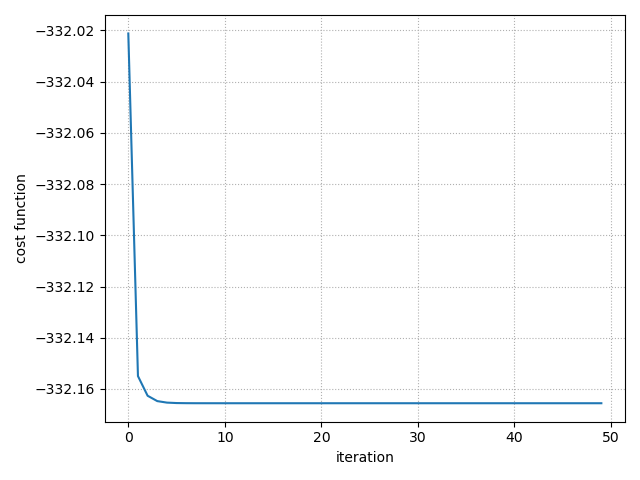
DePierro update to minimize \(f(x)\)
We apply multiple DePierro updates
to calculate the minimizer of \(f(x)\) iteratively.
See [1] for more details.
cost = xp.zeros(num_iter, dtype=xp.float64, device=dev)

# "b" - modified sensitivity image
mod_adjoint_ones = (
    op_A.adjoint(xp.ones(op_A.out_shape, dtype=xp.float64, device=dev)) - beta * x_prior
)

for i in range(num_iter):
    # evaluate the forward model
    exp = op_A(x) + contamination
    ratio = y / exp
    t = x * op_A.adjoint(ratio)
    x = 2 * t / (xp.sqrt(mod_adjoint_ones**2 + 4 * beta * t) + mod_adjoint_ones)
    cost[i] = cost_function(x)

print(f"Solution after {num_iter} DePierro iterations:")
print(x)
print(f"cost: {cost[-1]:.6e}")
Solution after 50 DePierro iterations:
tensor([6.2868, 7.2615, 6.7209, 6.4391], dtype=torch.float64)
cost: -3.321656e+02
if xp.__name__.endswith("numpy"):
    from scipy.optimize import fmin_powell

    x_ref = fmin_powell(cost_function, x, xtol=1e-6, ftol=1e-6)
    rel_dist = float(xp.sum((x - x_ref) ** 2)) / float(xp.sum(x_ref**2))

    print(f"\nReference solution using Powell optimizer:")
    print(x_ref)
    print(f"rel. distance to DePierro solution: {rel_dist:.2e}")
    print(f"cost: {cost_function(x_ref):.6e}")
fig, ax = plt.subplots(1, 1, tight_layout=True)
if xp.__name__.endswith("numpy"):
    ax.axhline(cost_function(x_ref), color="k", linestyle="--")
ax.plot(to_numpy_array(cost))
ax.set_xlabel("iteration")
ax.set_ylabel("cost function")
ax.grid(ls=":")
fig.show()
References
Total running time of the script: (0 minutes 0.067 seconds)