Linear operators parallelproj.operators
This module defines the LinearOperator base class used throughout
parallelproj. The public interface is op(x) (forward) and
op.adjoint(y) – or the adjoint operator op.H – while subclasses
implement the private _apply / _adjoint. Composite operators such as
CompositeLinearOperator let you chain a projector with image-based
models (e.g. a GaussianFilterOperator resolution model or an
ElementwiseMultiplicationOperator for attenuation) while the correct
adjoint is assembled automatically. Operators act on float32 array-API
arrays on CPU or GPU; the PET projectors in PET projectors parallelproj.projectors are themselves
linear operators.
Array-API-compatible linear operator abstractions and concrete implementations.
Provides the LinearOperator abstract base class – with forward and
adjoint application, norm estimation via power iteration, and an adjointness
test – together with concrete operators: dense matrix multiplication,
element-wise multiplication, Gaussian filtering, forward finite differences,
operator composition, and vertical stacking. All implementations dispatch
correctly across NumPy, CuPy, and PyTorch.
- class parallelproj.operators.AdjointLinearOperator(operator: LinearOperator)[source]
Bases:
LinearOperatorAdjoint of a linear operator
Wraps an existing
LinearOperatorso that__call__applies \(A^H\) andadjointapplies \(A\). The scale of this operator is always the complex conjugate of the wrapped operator’s scale; setting the scale on either one propagates to the other.Use the
LinearOperator.Hproperty rather than constructing this class directly.Examples
init method
- Parameters:
operator (LinearOperator) – the operator whose adjoint is to be represented
Examples
- property H: AdjointLinearOperator
adjoint operator \(A^H\)
- __call__(x: Array) Array
alias to apply(x)
Examples
- Parameters:
x (Array)
- Return type:
Array
- adjoint(y: Array) Array[source]
(scaled) adjoint step \(x = \alpha A y\).
- Parameters:
y (Array)
- Return type:
Array
Examples
- adjointness_test(xp: ModuleType | None = None, dev: str | None = None, verbose: bool = False, iscomplex: bool = False, dtype: type | None = None, **kwargs) bool
test whether the adjoint is correctly implemented
- Parameters:
xp (ModuleType, optional) – array module to use. Defaults to the operator’s own namespace (
self.xp) when it exposes one; otherwise must be given.dev (str, optional) – device (cpu or cuda). Defaults to the operator’s own device (
self.dev) when it exposes one, else the default device.verbose (bool, optional) – verbose output
iscomplex (bool, optional) – use complex arrays
dtype (type | None, optional) – data type of the arrays
**kwargs (dict) – passed to np.isclose
- Returns:
whether the adjoint is correctly implemented
- Return type:
bool
Examples
- apply(x: Array) Array[source]
(scaled) forward step \(y = \overline{\alpha} A^H x\).
Uses the property
scale(=conj(A.scale)) rather than the instance variable so that scale changes on eitherAorA.Hare always reflected.- Parameters:
x (Array)
- Return type:
Array
Examples
- property in_shape: tuple[int, ...]
Output shape of the wrapped operator (adjoint swaps in/out).
- norm(xp: ModuleType | None = None, dev: str | None = None, num_iter: int = 30, iscomplex: bool = False, verbose: bool = False) float
estimate norm of the linear operator using power iterations
- Parameters:
xp (ModuleType, optional) – array module to use. Defaults to the operator’s own namespace (
self.xp) when it exposes one; otherwise must be given.dev (str, optional) – device (cpu or cuda). Defaults to the operator’s own device (
self.dev) when it exposes one, else the default device.num_iter (int, optional) – number of power iterations
iscomplex (bool, optional) – use complex arrays
verbose (bool, optional) – verbose output
- Returns:
the norm of the linear operator
- Return type:
float
Examples
- property out_shape: tuple[int, ...]
Input shape of the wrapped operator (adjoint swaps in/out).
- property scale: float | complex
Complex conjugate of the wrapped operator’s scale.
Both
A.H.scaleandA.scaleread from and write to the same underlying value on the wrapped operator, so they are always consistent:A.H.scalereturnsconj(A.scale)A.H.scale = csetsA.scale = conj(c)Setting
A.scale = cis automatically reflected inA.H.scale
The
apply()andadjoint()methods onA.Hread this property (not the instance variable_scale) so the coupling is always active.
- class parallelproj.operators.CompositeLinearOperator(operators: Sequence[LinearOperator])[source]
Bases:
LinearOperatorComposite Linear Operator defined by a sequence of Linear Operators
Given a Sequence of operators
\[A^0, A^1, \ldots, A^{n-1}\]the composite linear operator is defined as
\[A(x) = A^0( A^1( ... ( A^{n-1}(x) ) ) )\]Examples
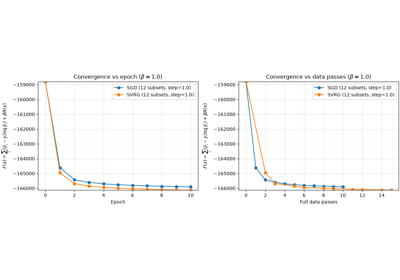
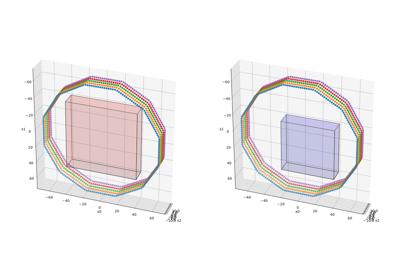
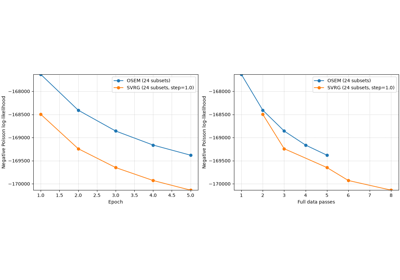
Convergence comparison: SGD vs SVRG with logcosh regularization
Convergence comparison: SGD vs SVRG with logcosh regularization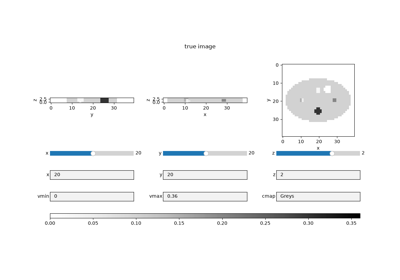
PDHG and SPDHG for PET reconstruction with a directional TV prior
PDHG and SPDHG for PET reconstruction with a directional TV prior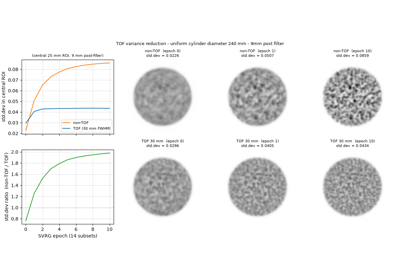
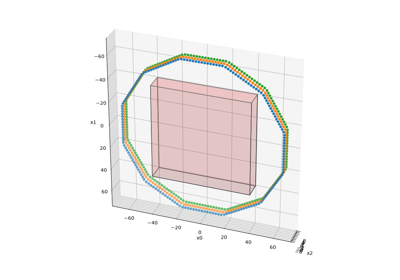
TOF vs non-TOF: variance reduction in a uniform cylinder
TOF vs non-TOF: variance reduction in a uniform cylinder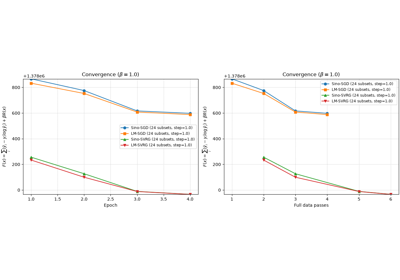
Convergence comparison: SGD vs SVRG with regularization (sinogram and listmode)
Convergence comparison: SGD vs SVRG with regularization (sinogram and listmode)
PDHG and LM-SPDHG to optimize the Poisson logL and total variation
PDHG and LM-SPDHG to optimize the Poisson logL and total variation
Joint activity and attenuation reconstruction (MLAA) for TOF PET
Joint activity and attenuation reconstruction (MLAA) for TOF PETinit method
- Parameters:
operators (Sequence[LinearOperator]) – Sequence of linear operators
Examples
Convergence comparison: SGD vs SVRG with logcosh regularization
Convergence comparison: SGD vs SVRG with logcosh regularization
PDHG and SPDHG for PET reconstruction with a directional TV prior
PDHG and SPDHG for PET reconstruction with a directional TV prior
TOF vs non-TOF: variance reduction in a uniform cylinder
TOF vs non-TOF: variance reduction in a uniform cylinder
Convergence comparison: SGD vs SVRG with regularization (sinogram and listmode)
Convergence comparison: SGD vs SVRG with regularization (sinogram and listmode)
PDHG and LM-SPDHG to optimize the Poisson logL and total variation
PDHG and LM-SPDHG to optimize the Poisson logL and total variation
Joint activity and attenuation reconstruction (MLAA) for TOF PET
Joint activity and attenuation reconstruction (MLAA) for TOF PET- property H: AdjointLinearOperator
adjoint operator \(A^H\)
- __call__(x: Array) Array
alias to apply(x)
Examples
- Parameters:
x (Array)
- Return type:
Array
- __getitem__(i: int) LinearOperator[source]
get the i-th operator \(A_i\)
Examples
- Parameters:
i (int)
- Return type:
- adjoint(y: Array) Array
(scaled) adjoint step \(x = \overline{\alpha} A^H y\)
- Parameters:
y (Array)
- Return type:
Array
Examples
Convergence comparison: SGD vs SVRG with logcosh regularization
Convergence comparison: SGD vs SVRG with logcosh regularization
PDHG and SPDHG for PET reconstruction with a directional TV prior
PDHG and SPDHG for PET reconstruction with a directional TV prior
TOF vs non-TOF: variance reduction in a uniform cylinder
TOF vs non-TOF: variance reduction in a uniform cylinder
Convergence comparison: SGD vs SVRG with regularization (sinogram and listmode)
Convergence comparison: SGD vs SVRG with regularization (sinogram and listmode)
- adjointness_test(xp: ModuleType | None = None, dev: str | None = None, verbose: bool = False, iscomplex: bool = False, dtype: type | None = None, **kwargs) bool
test whether the adjoint is correctly implemented
- Parameters:
xp (ModuleType, optional) – array module to use. Defaults to the operator’s own namespace (
self.xp) when it exposes one; otherwise must be given.dev (str, optional) – device (cpu or cuda). Defaults to the operator’s own device (
self.dev) when it exposes one, else the default device.verbose (bool, optional) – verbose output
iscomplex (bool, optional) – use complex arrays
dtype (type | None, optional) – data type of the arrays
**kwargs (dict) – passed to np.isclose
- Returns:
whether the adjoint is correctly implemented
- Return type:
bool
Examples
- apply(x: Array) Array
(scaled) forward step \(y = \alpha A x\)
- Parameters:
x (Array)
- Return type:
Array
Examples
- property in_shape: tuple[int, ...]
Input shape of the innermost (last) operator.
- norm(xp: ModuleType | None = None, dev: str | None = None, num_iter: int = 30, iscomplex: bool = False, verbose: bool = False) float
estimate norm of the linear operator using power iterations
- Parameters:
xp (ModuleType, optional) – array module to use. Defaults to the operator’s own namespace (
self.xp) when it exposes one; otherwise must be given.dev (str, optional) – device (cpu or cuda). Defaults to the operator’s own device (
self.dev) when it exposes one, else the default device.num_iter (int, optional) – number of power iterations
iscomplex (bool, optional) – use complex arrays
verbose (bool, optional) – verbose output
- Returns:
the norm of the linear operator
- Return type:
float
Examples
PDHG and SPDHG for PET reconstruction with a directional TV prior
PDHG and SPDHG for PET reconstruction with a directional TV prior
- property operators: Sequence[LinearOperator]
tuple of linear operators
- property out_shape: tuple[int, ...]
Output shape of the outermost (first) operator.
- property scale: float | complex
scalar factor applied to the linear operator
- class parallelproj.operators.ElementwiseMultiplicationOperator(values: Array)[source]
Bases:
LinearOperatorElement-wise multiplication operator (multiplication with a diagonal matrix)
Examples
Convergence comparison: SGD vs SVRG with logcosh regularization
Convergence comparison: SGD vs SVRG with logcosh regularization
PDHG and SPDHG for PET reconstruction with a directional TV prior
PDHG and SPDHG for PET reconstruction with a directional TV prior
TOF vs non-TOF: variance reduction in a uniform cylinder
TOF vs non-TOF: variance reduction in a uniform cylinder
Convergence comparison: SGD vs SVRG with regularization (sinogram and listmode)
Convergence comparison: SGD vs SVRG with regularization (sinogram and listmode)
PDHG and LM-SPDHG to optimize the Poisson logL and total variation
PDHG and LM-SPDHG to optimize the Poisson logL and total variationinit method
- Parameters:
values (Array) – values of the diagonal matrix
Examples
Convergence comparison: SGD vs SVRG with logcosh regularization
Convergence comparison: SGD vs SVRG with logcosh regularization
PDHG and SPDHG for PET reconstruction with a directional TV prior
PDHG and SPDHG for PET reconstruction with a directional TV prior
TOF vs non-TOF: variance reduction in a uniform cylinder
TOF vs non-TOF: variance reduction in a uniform cylinder
Convergence comparison: SGD vs SVRG with regularization (sinogram and listmode)
Convergence comparison: SGD vs SVRG with regularization (sinogram and listmode)
PDHG and LM-SPDHG to optimize the Poisson logL and total variation
PDHG and LM-SPDHG to optimize the Poisson logL and total variation- property H: AdjointLinearOperator
adjoint operator \(A^H\)
- __call__(x: Array) Array
alias to apply(x)
Examples
- Parameters:
x (Array)
- Return type:
Array
- adjoint(y: Array) Array
(scaled) adjoint step \(x = \overline{\alpha} A^H y\)
- Parameters:
y (Array)
- Return type:
Array
Examples
- adjointness_test(xp: ModuleType | None = None, dev: str | None = None, verbose: bool = False, iscomplex: bool = False, dtype: type | None = None, **kwargs) bool
test whether the adjoint is correctly implemented
- Parameters:
xp (ModuleType, optional) – array module to use. Defaults to the operator’s own namespace (
self.xp) when it exposes one; otherwise must be given.dev (str, optional) – device (cpu or cuda). Defaults to the operator’s own device (
self.dev) when it exposes one, else the default device.verbose (bool, optional) – verbose output
iscomplex (bool, optional) – use complex arrays
dtype (type | None, optional) – data type of the arrays
**kwargs (dict) – passed to np.isclose
- Returns:
whether the adjoint is correctly implemented
- Return type:
bool
Examples
- apply(x: Array) Array
(scaled) forward step \(y = \alpha A x\)
- Parameters:
x (Array)
- Return type:
Array
Examples
- property in_shape: tuple[int, ...]
Shape of the diagonal values array (operator is square).
- property iscomplex: bool
bool whether the operator is complex
- norm(xp: ModuleType | None = None, dev: str | None = None, num_iter: int = 30, iscomplex: bool = False, verbose: bool = False) float
estimate norm of the linear operator using power iterations
- Parameters:
xp (ModuleType, optional) – array module to use. Defaults to the operator’s own namespace (
self.xp) when it exposes one; otherwise must be given.dev (str, optional) – device (cpu or cuda). Defaults to the operator’s own device (
self.dev) when it exposes one, else the default device.num_iter (int, optional) – number of power iterations
iscomplex (bool, optional) – use complex arrays
verbose (bool, optional) – verbose output
- Returns:
the norm of the linear operator
- Return type:
float
Examples
- property out_shape: tuple[int, ...]
Shape of the diagonal values array (operator is square).
- property scale: float | complex
scalar factor applied to the linear operator
- property values: Array
values that get multiplied
- property xp: ModuleType
array module of the operator
- class parallelproj.operators.FiniteForwardDifference(in_shape: tuple[int, ...])[source]
Bases:
LinearOperatorForward finite-difference gradient operator for 1-D to 4-D images.
Maps an image of shape
in_shapeto a gradient field of shape(ndim, *in_shape)where axis 0 enumerates the spatial directions. At each boundary the difference wraps to zero: the last difference along each axis is forced to zero in the forward pass (as if the image is padded with a copy of the border value, so the difference there vanishes). The adjoint is the negative discrete divergence, consistent with the standard TV regularisation convention. Self-adjointness is verified byadjointness_test().Examples
Convergence comparison: SGD vs SVRG with logcosh regularization
Convergence comparison: SGD vs SVRG with logcosh regularization
PDHG and SPDHG for PET reconstruction with a directional TV prior
PDHG and SPDHG for PET reconstruction with a directional TV prior
Convergence comparison: SGD vs SVRG with regularization (sinogram and listmode)
Convergence comparison: SGD vs SVRG with regularization (sinogram and listmode)
PDHG and LM-SPDHG to optimize the Poisson logL and total variation
PDHG and LM-SPDHG to optimize the Poisson logL and total variation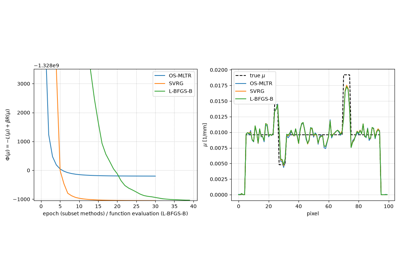
Penalised transmission reconstruction (MAPTR) with an edge-preserving prior
Penalised transmission reconstruction (MAPTR) with an edge-preserving prior
Joint activity and attenuation reconstruction (MLAA) for TOF PET
Joint activity and attenuation reconstruction (MLAA) for TOF PET- Parameters:
in_shape (tuple[int, ...]) – Shape of the input image. Must have 1 to 4 dimensions; raises
ValueErrorfor higher-dimensional inputs.
Examples
Convergence comparison: SGD vs SVRG with logcosh regularization
Convergence comparison: SGD vs SVRG with logcosh regularization
PDHG and SPDHG for PET reconstruction with a directional TV prior
PDHG and SPDHG for PET reconstruction with a directional TV prior
Convergence comparison: SGD vs SVRG with regularization (sinogram and listmode)
Convergence comparison: SGD vs SVRG with regularization (sinogram and listmode)
PDHG and LM-SPDHG to optimize the Poisson logL and total variation
PDHG and LM-SPDHG to optimize the Poisson logL and total variation
Penalised transmission reconstruction (MAPTR) with an edge-preserving prior
Penalised transmission reconstruction (MAPTR) with an edge-preserving prior
Joint activity and attenuation reconstruction (MLAA) for TOF PET
Joint activity and attenuation reconstruction (MLAA) for TOF PET- property H: AdjointLinearOperator
adjoint operator \(A^H\)
- __call__(x: Array) Array
alias to apply(x)
Examples
- Parameters:
x (Array)
- Return type:
Array
- adjoint(y: Array) Array
(scaled) adjoint step \(x = \overline{\alpha} A^H y\)
- Parameters:
y (Array)
- Return type:
Array
Examples
- adjointness_test(xp: ModuleType | None = None, dev: str | None = None, verbose: bool = False, iscomplex: bool = False, dtype: type | None = None, **kwargs) bool
test whether the adjoint is correctly implemented
- Parameters:
xp (ModuleType, optional) – array module to use. Defaults to the operator’s own namespace (
self.xp) when it exposes one; otherwise must be given.dev (str, optional) – device (cpu or cuda). Defaults to the operator’s own device (
self.dev) when it exposes one, else the default device.verbose (bool, optional) – verbose output
iscomplex (bool, optional) – use complex arrays
dtype (type | None, optional) – data type of the arrays
**kwargs (dict) – passed to np.isclose
- Returns:
whether the adjoint is correctly implemented
- Return type:
bool
Examples
- apply(x: Array) Array
(scaled) forward step \(y = \alpha A x\)
- Parameters:
x (Array)
- Return type:
Array
Examples
- property in_shape: tuple[int, ...]
shape of the input array
- property ndim: int
number of dimensions of the input array
- norm(xp: ModuleType | None = None, dev: str | None = None, num_iter: int = 30, iscomplex: bool = False, verbose: bool = False) float
estimate norm of the linear operator using power iterations
- Parameters:
xp (ModuleType, optional) – array module to use. Defaults to the operator’s own namespace (
self.xp) when it exposes one; otherwise must be given.dev (str, optional) – device (cpu or cuda). Defaults to the operator’s own device (
self.dev) when it exposes one, else the default device.num_iter (int, optional) – number of power iterations
iscomplex (bool, optional) – use complex arrays
verbose (bool, optional) – verbose output
- Returns:
the norm of the linear operator
- Return type:
float
Examples
- property out_shape: tuple[int, ...]
shape of the output array
- property scale: float | complex
scalar factor applied to the linear operator
- class parallelproj.operators.GaussianFilterOperator(in_shape: tuple[int, ...], **kwargs)[source]
Bases:
LinearOperatorIsotropic Gaussian smoothing operator (self-adjoint).
Works with NumPy, CuPy, and PyTorch (CPU and CUDA) arrays. GPU arrays (CuPy, and PyTorch CUDA round-tripped through CuPy via DLPack) are filtered with
cupyx.scipy.ndimage.gaussian_filter; CPU arrays usescipy.ndimage.gaussian_filter. Routing the GPU path throughcupyxmakes it independent of scipy’s array-API delegation, so it works regardless of theSCIPY_ARRAY_APIenv var or import order. All keyword arguments accepted bygaussian_filter(e.g.sigma,mode,truncate) are forwarded through**kwargs. Because the Gaussian kernel is symmetric, the adjoint equals the forward application.Examples
Convergence comparison: SGD vs SVRG with logcosh regularization
Convergence comparison: SGD vs SVRG with logcosh regularization
PDHG and SPDHG for PET reconstruction with a directional TV prior
PDHG and SPDHG for PET reconstruction with a directional TV prior
TOF vs non-TOF: variance reduction in a uniform cylinder
TOF vs non-TOF: variance reduction in a uniform cylinder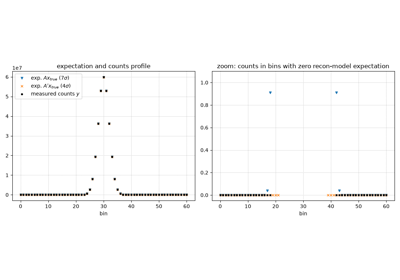
Exact vs. “safe epsilon” mode of the negative Poisson log-likelihood
Exact vs. "safe epsilon" mode of the negative Poisson log-likelihood
Convergence comparison: SGD vs SVRG with regularization (sinogram and listmode)
Convergence comparison: SGD vs SVRG with regularization (sinogram and listmode)
PDHG and LM-SPDHG to optimize the Poisson logL and total variation
PDHG and LM-SPDHG to optimize the Poisson logL and total variation
Joint activity and attenuation reconstruction (MLAA) for TOF PET
Joint activity and attenuation reconstruction (MLAA) for TOF PETinit method
- Parameters:
in_shape (tuple[int, ...]) – shape of the input array
**kwargs (dict) – passed to scipy.ndimage.gaussian_filter; most commonly
sigma(standard deviation in pixels), plus optionalmode,truncate, etc.
Examples
Convergence comparison: SGD vs SVRG with logcosh regularization
Convergence comparison: SGD vs SVRG with logcosh regularization
PDHG and SPDHG for PET reconstruction with a directional TV prior
PDHG and SPDHG for PET reconstruction with a directional TV prior
TOF vs non-TOF: variance reduction in a uniform cylinder
TOF vs non-TOF: variance reduction in a uniform cylinder
Exact vs. “safe epsilon” mode of the negative Poisson log-likelihood
Exact vs. "safe epsilon" mode of the negative Poisson log-likelihood
Convergence comparison: SGD vs SVRG with regularization (sinogram and listmode)
Convergence comparison: SGD vs SVRG with regularization (sinogram and listmode)
PDHG and LM-SPDHG to optimize the Poisson logL and total variation
PDHG and LM-SPDHG to optimize the Poisson logL and total variation
Joint activity and attenuation reconstruction (MLAA) for TOF PET
Joint activity and attenuation reconstruction (MLAA) for TOF PET- property H: AdjointLinearOperator
adjoint operator \(A^H\)
- __call__(x: Array) Array
alias to apply(x)
Examples
- Parameters:
x (Array)
- Return type:
Array
- adjoint(y: Array) Array
(scaled) adjoint step \(x = \overline{\alpha} A^H y\)
- Parameters:
y (Array)
- Return type:
Array
Examples
Exact vs. “safe epsilon” mode of the negative Poisson log-likelihood
Exact vs. "safe epsilon" mode of the negative Poisson log-likelihood
- adjointness_test(xp: ModuleType | None = None, dev: str | None = None, verbose: bool = False, iscomplex: bool = False, dtype: type | None = None, **kwargs) bool
test whether the adjoint is correctly implemented
- Parameters:
xp (ModuleType, optional) – array module to use. Defaults to the operator’s own namespace (
self.xp) when it exposes one; otherwise must be given.dev (str, optional) – device (cpu or cuda). Defaults to the operator’s own device (
self.dev) when it exposes one, else the default device.verbose (bool, optional) – verbose output
iscomplex (bool, optional) – use complex arrays
dtype (type | None, optional) – data type of the arrays
**kwargs (dict) – passed to np.isclose
- Returns:
whether the adjoint is correctly implemented
- Return type:
bool
Examples
- apply(x: Array) Array
(scaled) forward step \(y = \alpha A x\)
- Parameters:
x (Array)
- Return type:
Array
Examples
- property in_shape: tuple[int, ...]
Shape of the input (and output) array (operator is square).
- norm(xp: ModuleType | None = None, dev: str | None = None, num_iter: int = 30, iscomplex: bool = False, verbose: bool = False) float
estimate norm of the linear operator using power iterations
- Parameters:
xp (ModuleType, optional) – array module to use. Defaults to the operator’s own namespace (
self.xp) when it exposes one; otherwise must be given.dev (str, optional) – device (cpu or cuda). Defaults to the operator’s own device (
self.dev) when it exposes one, else the default device.num_iter (int, optional) – number of power iterations
iscomplex (bool, optional) – use complex arrays
verbose (bool, optional) – verbose output
- Returns:
the norm of the linear operator
- Return type:
float
Examples
- property out_shape: tuple[int, ...]
Shape of the output (and input) array (operator is square).
- property scale: float | complex
scalar factor applied to the linear operator
- class parallelproj.operators.GradientFieldProjectionOperator(gradient_field: Array, eta: float = 0.0)[source]
Bases:
LinearOperatorGradient field projection operator (self-adjoint).
Projects a gradient field onto the subspace orthogonal to a normalised structural prior gradient \(\xi_n\):
\[P_{\xi_n}x = x - \langle \xi_n, x \rangle \xi_n, \qquad \xi_n = g_n / \| g_n \|_{\eta}\]where \(g_n\) is the joint gradient field and \(\eta\) is a smoothing parameter for the pointwise gradient norm. The operator is self-adjoint (its own adjoint) because orthogonal projection operators are symmetric.
See Ehrhardt and Betcke, “Multicontrast MRI Reconstruction with Structure-Guided Total Variation” (doi: 10.1137/15M1047325).
Examples
PDHG and SPDHG for PET reconstruction with a directional TV prior
PDHG and SPDHG for PET reconstruction with a directional TV prior- Parameters:
gradient_field (Array) – a real gradient field. In 3D, the shape would be [3,n0,n1,n2]. In 2D, the shape would be [2,n0,n1]. This can be e.g. the output of the FiniteForwardDifference operator applied to a structural prior image.
eta (float, optional) – smoothing parameter used in the pointwise gradient norm default 0.0
Examples
PDHG and SPDHG for PET reconstruction with a directional TV prior
PDHG and SPDHG for PET reconstruction with a directional TV prior- property H: AdjointLinearOperator
adjoint operator \(A^H\)
- __call__(x: Array) Array
alias to apply(x)
Examples
- Parameters:
x (Array)
- Return type:
Array
- adjoint(y: Array) Array
(scaled) adjoint step \(x = \overline{\alpha} A^H y\)
- Parameters:
y (Array)
- Return type:
Array
Examples
- adjointness_test(xp: ModuleType | None = None, dev: str | None = None, verbose: bool = False, iscomplex: bool = False, dtype: type | None = None, **kwargs) bool
test whether the adjoint is correctly implemented
- Parameters:
xp (ModuleType, optional) – array module to use. Defaults to the operator’s own namespace (
self.xp) when it exposes one; otherwise must be given.dev (str, optional) – device (cpu or cuda). Defaults to the operator’s own device (
self.dev) when it exposes one, else the default device.verbose (bool, optional) – verbose output
iscomplex (bool, optional) – use complex arrays
dtype (type | None, optional) – data type of the arrays
**kwargs (dict) – passed to np.isclose
- Returns:
whether the adjoint is correctly implemented
- Return type:
bool
Examples
- apply(x: Array) Array
(scaled) forward step \(y = \alpha A x\)
- Parameters:
x (Array)
- Return type:
Array
Examples
- property dev: str
device of the operator
- property eta: float
smoothing parameter
- property in_shape: tuple[int, ...]
Shape of the gradient field
(ndim, *spatial_shape).
- norm(xp: ModuleType | None = None, dev: str | None = None, num_iter: int = 30, iscomplex: bool = False, verbose: bool = False) float
estimate norm of the linear operator using power iterations
- Parameters:
xp (ModuleType, optional) – array module to use. Defaults to the operator’s own namespace (
self.xp) when it exposes one; otherwise must be given.dev (str, optional) – device (cpu or cuda). Defaults to the operator’s own device (
self.dev) when it exposes one, else the default device.num_iter (int, optional) – number of power iterations
iscomplex (bool, optional) – use complex arrays
verbose (bool, optional) – verbose output
- Returns:
the norm of the linear operator
- Return type:
float
Examples
- property normalized_gradient_field: Array
normalized gradient field
- property out_shape: tuple[int, ...]
Shape of the gradient field
(ndim, *spatial_shape)(same asin_shape).
- property scale: float | complex
scalar factor applied to the linear operator
- property xp: ModuleType
array module of the operator
- class parallelproj.operators.LinearOperator[source]
Bases:
ABCAbstract base class for array-API-compatible linear operators.
Subclasses implement
_apply()(\(y = Ax\)) and_adjoint()(\(x = A^H y\)). The publicapply()andadjoint()methods apply an optional scalarscalefactor (\(\alpha A\) and \(\overline{\alpha} A^H\)). Utility methodsadjointness_test()andnorm()are provided for validation and step-size estimation.Examples
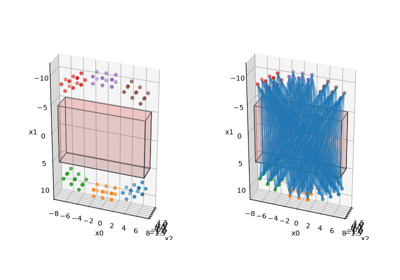
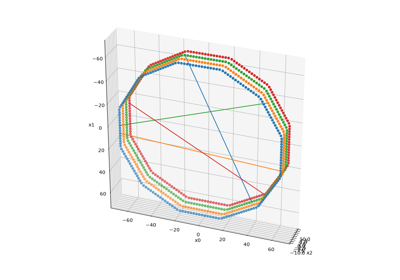
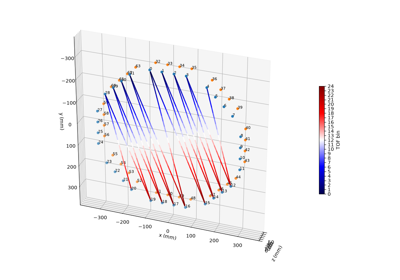
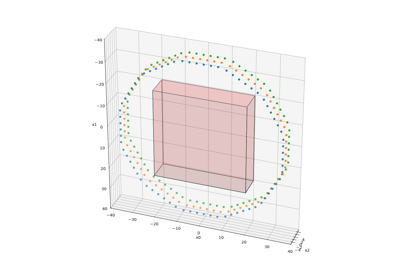
Non-TOF and TOF projections using a modularized (block) PET scanner geometry
Non-TOF and TOF projections using a modularized (block) PET scanner geometry
Convergence comparison: SGD vs SVRG with logcosh regularization
Convergence comparison: SGD vs SVRG with logcosh regularization
PDHG and SPDHG for PET reconstruction with a directional TV prior
PDHG and SPDHG for PET reconstruction with a directional TV prior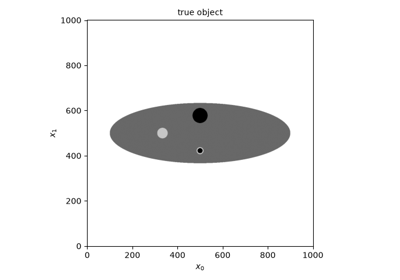
2D non-TOF filtered back projection (FBP) of Poisson data
2D non-TOF filtered back projection (FBP) of Poisson data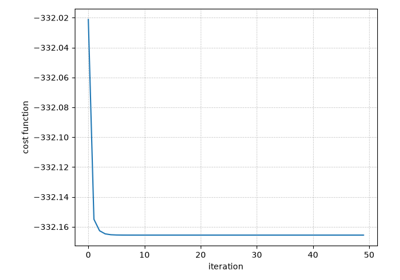
DePierro’s algorithm to optimize the Poisson logL with quadratic intensity prior
DePierro's algorithm to optimize the Poisson logL with quadratic intensity prior
TOF vs non-TOF: variance reduction in a uniform cylinder
TOF vs non-TOF: variance reduction in a uniform cylinder
Exact vs. “safe epsilon” mode of the negative Poisson log-likelihood
Exact vs. "safe epsilon" mode of the negative Poisson log-likelihood
Convergence comparison: SGD vs SVRG with regularization (sinogram and listmode)
Convergence comparison: SGD vs SVRG with regularization (sinogram and listmode)
Penalised transmission reconstruction (MAPTR) with an edge-preserving prior
Penalised transmission reconstruction (MAPTR) with an edge-preserving prior- property H: AdjointLinearOperator
adjoint operator \(A^H\)
- __call__(x: Array) Array[source]
alias to apply(x)
Examples
- Parameters:
x (Array)
- Return type:
Array
- adjoint(y: Array) Array[source]
(scaled) adjoint step \(x = \overline{\alpha} A^H y\)
- Parameters:
y (Array)
- Return type:
Array
Examples
Non-TOF and TOF projections using a modularized (block) PET scanner geometry
Non-TOF and TOF projections using a modularized (block) PET scanner geometry
Convergence comparison: SGD vs SVRG with logcosh regularization
Convergence comparison: SGD vs SVRG with logcosh regularization
PDHG and SPDHG for PET reconstruction with a directional TV prior
PDHG and SPDHG for PET reconstruction with a directional TV prior
2D non-TOF filtered back projection (FBP) of Poisson data
2D non-TOF filtered back projection (FBP) of Poisson data
DePierro’s algorithm to optimize the Poisson logL with quadratic intensity prior
DePierro's algorithm to optimize the Poisson logL with quadratic intensity prior
TOF vs non-TOF: variance reduction in a uniform cylinder
TOF vs non-TOF: variance reduction in a uniform cylinder
Exact vs. “safe epsilon” mode of the negative Poisson log-likelihood
Exact vs. "safe epsilon" mode of the negative Poisson log-likelihood
Convergence comparison: SGD vs SVRG with regularization (sinogram and listmode)
Convergence comparison: SGD vs SVRG with regularization (sinogram and listmode)
Penalised transmission reconstruction (MAPTR) with an edge-preserving prior
Penalised transmission reconstruction (MAPTR) with an edge-preserving prior
- adjointness_test(xp: ModuleType | None = None, dev: str | None = None, verbose: bool = False, iscomplex: bool = False, dtype: type | None = None, **kwargs) bool[source]
test whether the adjoint is correctly implemented
- Parameters:
xp (ModuleType, optional) – array module to use. Defaults to the operator’s own namespace (
self.xp) when it exposes one; otherwise must be given.dev (str, optional) – device (cpu or cuda). Defaults to the operator’s own device (
self.dev) when it exposes one, else the default device.verbose (bool, optional) – verbose output
iscomplex (bool, optional) – use complex arrays
dtype (type | None, optional) – data type of the arrays
**kwargs (dict) – passed to np.isclose
- Returns:
whether the adjoint is correctly implemented
- Return type:
bool
Examples
Non-TOF and TOF projections using a modularized (block) PET scanner geometry
Non-TOF and TOF projections using a modularized (block) PET scanner geometry
- apply(x: Array) Array[source]
(scaled) forward step \(y = \alpha A x\)
- Parameters:
x (Array)
- Return type:
Array
Examples
- abstract property in_shape: tuple[int, ...]
shape of the input array
- norm(xp: ModuleType | None = None, dev: str | None = None, num_iter: int = 30, iscomplex: bool = False, verbose: bool = False) float[source]
estimate norm of the linear operator using power iterations
- Parameters:
xp (ModuleType, optional) – array module to use. Defaults to the operator’s own namespace (
self.xp) when it exposes one; otherwise must be given.dev (str, optional) – device (cpu or cuda). Defaults to the operator’s own device (
self.dev) when it exposes one, else the default device.num_iter (int, optional) – number of power iterations
iscomplex (bool, optional) – use complex arrays
verbose (bool, optional) – verbose output
- Returns:
the norm of the linear operator
- Return type:
float
Examples
PDHG and SPDHG for PET reconstruction with a directional TV prior
PDHG and SPDHG for PET reconstruction with a directional TV prior
- abstract property out_shape: tuple[int, ...]
shape of the output array
- property scale: float | complex
scalar factor applied to the linear operator
- class parallelproj.operators.LinearOperatorSequence(operators: Sequence[LinearOperator])[source]
Bases:
Sequence[LinearOperator]Sequence of linear operators
\[A^0, A^1 \ldots, A^{n-1}\]that can be evaluated independently.
Examples
Convergence comparison: SGD vs SVRG with logcosh regularization
Convergence comparison: SGD vs SVRG with logcosh regularization
PDHG and SPDHG for PET reconstruction with a directional TV prior
PDHG and SPDHG for PET reconstruction with a directional TV prior
PDHG and LM-SPDHG to optimize the Poisson logL and total variation
PDHG and LM-SPDHG to optimize the Poisson logL and total variationinit method
- Parameters:
operators (Sequence[LinearOperator]) – Sequence of linear operators
Examples
Convergence comparison: SGD vs SVRG with logcosh regularization
Convergence comparison: SGD vs SVRG with logcosh regularization
PDHG and SPDHG for PET reconstruction with a directional TV prior
PDHG and SPDHG for PET reconstruction with a directional TV prior
PDHG and LM-SPDHG to optimize the Poisson logL and total variation
PDHG and LM-SPDHG to optimize the Poisson logL and total variation- __call__(x: Array) list[Array][source]
Alias for
apply().Examples
- Parameters:
x (Array)
- Return type:
list[Array]
- __getitem__(i: int) LinearOperator[source]
get the i-th linear operator \(A^i\)
Examples
- Parameters:
i (int)
- Return type:
- adjoint(y: list[Array]) Array[source]
Sum of adjoint outputs: \(\sum_i (A^i)^H y^i\).
- Parameters:
y (list[Array]) – List of
narrays, one per operator, each matching the corresponding operator’sout_shape.- Returns:
Sum of all adjoint outputs, shape
in_shape.- Return type:
Array
Examples
- apply(x: Array) list[Array][source]
Apply each operator independently: \((A^0(x), A^1(x), \ldots, A^{n-1}(x))\).
- Parameters:
x (Array) – Input array of shape
in_shape.- Returns:
List of
noutput arrays, one per operator.- Return type:
list[Array]
Examples
- count(value) integer -- return number of occurrences of value
Examples
- property in_shape: tuple[int, ...]
shape of the input array
- index(value[, start[, stop]]) integer -- return first index of value.
Raises ValueError if the value is not present.
Supporting start and stop arguments is optional, but recommended.
Examples
- norms(xp: ModuleType, dev: str) list[float][source]
\(\text{norm}(A^i)\) for all \(i\)
- Parameters:
xp (ModuleType) – array module to use
dev (str) – device (cpu or cuda)
- Returns:
norm of each operator in the sequence
- Return type:
list[float]
Examples
- property operators: Sequence[LinearOperator]
all subset operators
- property out_shapes: list[tuple[int, ...]]
shapes of the output array of all subset operators
- class parallelproj.operators.MatrixOperator(A: Array)[source]
Bases:
LinearOperatorLinear Operator defined by dense matrix multiplication
Examples
DePierro’s algorithm to optimize the Poisson logL with quadratic intensity prior
DePierro's algorithm to optimize the Poisson logL with quadratic intensity priorinit method
- Parameters:
A (Array) – 2D real or complex array representing the matrix
Examples
DePierro’s algorithm to optimize the Poisson logL with quadratic intensity prior
DePierro's algorithm to optimize the Poisson logL with quadratic intensity prior- property A: Array
matrix of the operator
- property H: AdjointLinearOperator
adjoint operator \(A^H\)
- __call__(x: Array) Array
alias to apply(x)
Examples
- Parameters:
x (Array)
- Return type:
Array
- adjoint(y: Array) Array
(scaled) adjoint step \(x = \overline{\alpha} A^H y\)
- Parameters:
y (Array)
- Return type:
Array
Examples
DePierro’s algorithm to optimize the Poisson logL with quadratic intensity prior
DePierro's algorithm to optimize the Poisson logL with quadratic intensity prior
- adjointness_test(xp: ModuleType | None = None, dev: str | None = None, verbose: bool = False, iscomplex: bool = False, dtype: type | None = None, **kwargs) bool
test whether the adjoint is correctly implemented
- Parameters:
xp (ModuleType, optional) – array module to use. Defaults to the operator’s own namespace (
self.xp) when it exposes one; otherwise must be given.dev (str, optional) – device (cpu or cuda). Defaults to the operator’s own device (
self.dev) when it exposes one, else the default device.verbose (bool, optional) – verbose output
iscomplex (bool, optional) – use complex arrays
dtype (type | None, optional) – data type of the arrays
**kwargs (dict) – passed to np.isclose
- Returns:
whether the adjoint is correctly implemented
- Return type:
bool
Examples
- apply(x: Array) Array
(scaled) forward step \(y = \alpha A x\)
- Parameters:
x (Array)
- Return type:
Array
Examples
- property in_shape: tuple[int, ...]
(ncols,)— number of columns of the matrix.
- property iscomplex: bool
bool whether the operator is complex
- norm(xp: ModuleType | None = None, dev: str | None = None, num_iter: int = 30, iscomplex: bool = False, verbose: bool = False) float
estimate norm of the linear operator using power iterations
- Parameters:
xp (ModuleType, optional) – array module to use. Defaults to the operator’s own namespace (
self.xp) when it exposes one; otherwise must be given.dev (str, optional) – device (cpu or cuda). Defaults to the operator’s own device (
self.dev) when it exposes one, else the default device.num_iter (int, optional) – number of power iterations
iscomplex (bool, optional) – use complex arrays
verbose (bool, optional) – verbose output
- Returns:
the norm of the linear operator
- Return type:
float
Examples
- property out_shape: tuple[int, ...]
(nrows,)— number of rows of the matrix.
- property scale: float | complex
scalar factor applied to the linear operator
- property xp: ModuleType
array module of the operator
- class parallelproj.operators.VstackOperator(operators: tuple[LinearOperator, ...])[source]
Bases:
LinearOperatorStack multiple linear operators vertically into a single operator.
All operators must share the same
in_shape. Each operator’s output is ravelled to a 1-D vector before concatenation, soout_shapeis always(sum of all output sizes,)regardless of the individual output shapes. The adjoint sums the individual adjoint outputs over all stacked operators.Examples
init method
- Parameters:
operators (tuple[LinearOperator, ...]) – tuple of linear operators
Examples
- property H: AdjointLinearOperator
adjoint operator \(A^H\)
- __call__(x: Array) Array
alias to apply(x)
Examples
- Parameters:
x (Array)
- Return type:
Array
- adjoint(y: Array) Array
(scaled) adjoint step \(x = \overline{\alpha} A^H y\)
- Parameters:
y (Array)
- Return type:
Array
Examples
- adjointness_test(xp: ModuleType | None = None, dev: str | None = None, verbose: bool = False, iscomplex: bool = False, dtype: type | None = None, **kwargs) bool
test whether the adjoint is correctly implemented
- Parameters:
xp (ModuleType, optional) – array module to use. Defaults to the operator’s own namespace (
self.xp) when it exposes one; otherwise must be given.dev (str, optional) – device (cpu or cuda). Defaults to the operator’s own device (
self.dev) when it exposes one, else the default device.verbose (bool, optional) – verbose output
iscomplex (bool, optional) – use complex arrays
dtype (type | None, optional) – data type of the arrays
**kwargs (dict) – passed to np.isclose
- Returns:
whether the adjoint is correctly implemented
- Return type:
bool
Examples
- apply(x: Array) Array
(scaled) forward step \(y = \alpha A x\)
- Parameters:
x (Array)
- Return type:
Array
Examples
- property in_shape: tuple[int, ...]
Common input shape shared by all stacked operators.
- norm(xp: ModuleType | None = None, dev: str | None = None, num_iter: int = 30, iscomplex: bool = False, verbose: bool = False) float
estimate norm of the linear operator using power iterations
- Parameters:
xp (ModuleType, optional) – array module to use. Defaults to the operator’s own namespace (
self.xp) when it exposes one; otherwise must be given.dev (str, optional) – device (cpu or cuda). Defaults to the operator’s own device (
self.dev) when it exposes one, else the default device.num_iter (int, optional) – number of power iterations
iscomplex (bool, optional) – use complex arrays
verbose (bool, optional) – verbose output
- Returns:
the norm of the linear operator
- Return type:
float
Examples
- property out_shape: tuple[int, ...]
(N,)— total size of all operator outputs ravelled and concatenated.
- property scale: float | complex
scalar factor applied to the linear operator