Note
Go to the end to download the full example code.
TOF vs non-TOF: variance reduction in a uniform cylinder
Why TOF reduces image noise
In a standard (non-TOF) PET scan each detected coincidence event tells us that an annihilation occurred somewhere along a line of response (LOR), but gives no information about where along it.
Time-of-flight (TOF) PET additionally measures the small difference in arrival times of the two 511 keV photons and uses that difference to localise the annihilation along the LOR to a Gaussian probability kernel:
where \(\ell\) is the distance from the LOR midpoint and \(\Delta t_\text{FWHM}\) is the scanner’s coincidence timing resolution (CTR). A CTR of 200 ps corresponds to a spatial FWHM of ~ 30 mm.
It is known that TOF reduces the variance in the center of a 2D cylinder with diameter \(D\), where the SNR gain is approximately
For \(D = 240\) mm and \(\text{FWHM} = 30\) mm this gives \(G \approx 2.3\), i.e. more than a two-fold noise reduction at the centre.
The convergence-speed trap
TOF reconstruction also converges faster than non-TOF reconstruction. This creates a common pitfall: if both reconstructions are stopped at the same (small) number of epochs, the TOF image may appear noisier than the non-TOF image – not because TOF is worse, but because TOF has already converged past its low-noise plateau while non-TOF is still climbing. Conversely, at very early epochs non-TOF may look smoother simply because it has not yet amplified the noise.
To observe the true asymptotic advantage of TOF one must run both algorithms long enough to reach (approximate) convergence.
What this example shows
A single-ring 2-D scanner with a uniform circular phantom.
SVRG (
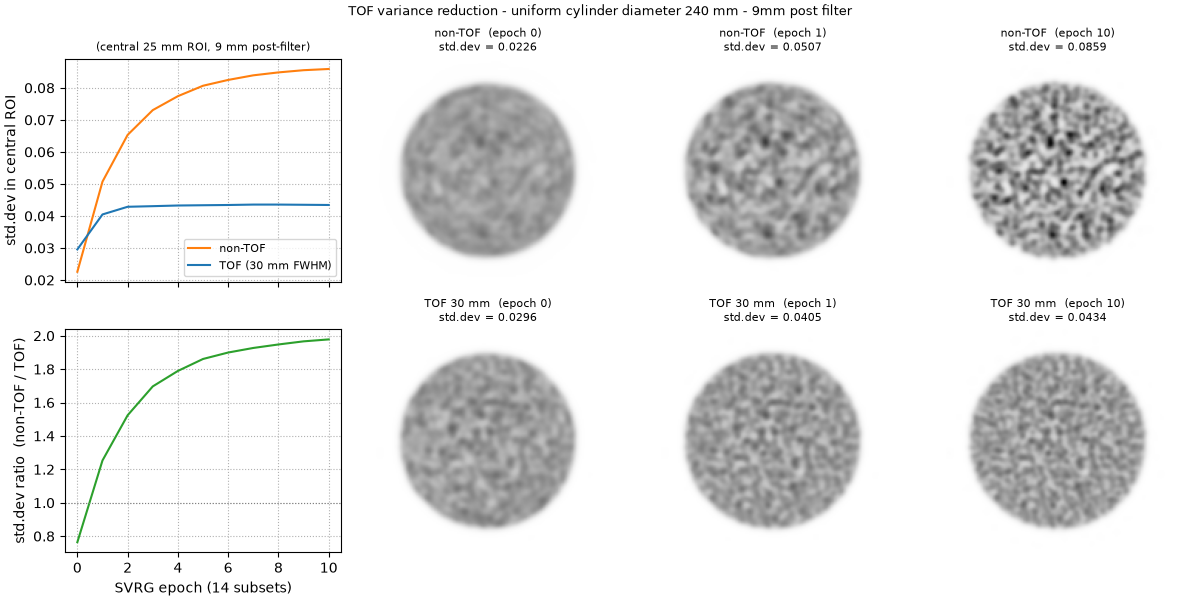
00_run_mlem_osem_svrg()) withnum_subsets=14subsets run fornum_epochs=10epochs (warm-started by a single OSEM epoch), applied independently to the non-TOF and TOF forward models. 10 SVRG epochs are sufficient for both to reach their respective noise plateaux.The standard deviation inside a small (25 mm-radius) central ROI is tracked after every epoch – this is a fast single-realisation proxy for the true noise level that avoids the need for Monte Carlo repeats.
Eight-panel figure:
Top-left: std.dev curves vs. SVRG epoch (epoch 0 = OSEM warm start) – shows faster TOF convergence and the lower asymptotic noise level.
Bottom-left: ratio non-TOF / TOF std.dev – values > 1 confirm that non-TOF is noisier; the ratio stabilises above 1 once both algorithms have converged.
2nd column: smoothed images after the OSEM warm start (epoch 0).
3rd column: smoothed images after 1 SVRG epoch, illustrating that at very early iterations TOF may appear noisier (it has already amplified noise while non-TOF is still initialisation-smooth).
Right column: final smoothed images after
num_epochsSVRG epochs for visual comparison of the asymptotic noise levels.
Note
The standard deviation in a single noise realisation is used here as a proxy for the true noise standard deviation. For a uniform phantom spatial variability inside the ROI equals the noise variability, so the single realisation is sufficient.
from __future__ import annotations
from collections.abc import Sequence
import matplotlib.pyplot as plt
import numpy as np

import parallelproj.operators
import parallelproj.tof
import parallelproj.pet_scanners
import parallelproj.pet_lors
import parallelproj.projectors
from parallelproj import to_numpy_array, Array
from parallelproj.functions import NegPoissonLogL, C2AffineObjective, C1Function

from copy import copy
from parallelproj._examples_utils import suggest_array_backend_and_device

# To use a specific backend and/or device, replace the None arguments, e.g.:
#   xp, dev = suggest_array_backend_and_device(backend="numpy", dev="cpu") or by setting xp and dev manually
xp, dev = suggest_array_backend_and_device(None, None)
Using array API: array_api_compat.torch, device: cpu
Key simulation parameters
num_epochs controls how many SVRG epochs are run after the OSEM
warm start. 10 epochs are enough for both non-TOF and TOF to be well
past their respective convergence knees, so the asymptotic noise levels
are clearly visible.
fwhm_tof_mm = 30 mm corresponds to a coincidence timing resolution
of approximately 200 ps – representative of state-of-the-art clinical
scanners as of 2025.
sm_fwhm_mm is the FWHM of the Gaussian post-filter applied after
every iteration. A mild 9 mm filter is applied to suppress
high-frequency “salt-and-pepper” noise while preserving the
convergence-related noise trend.
count_factor scales the phantom activity to control the total number
of detected events. Moderate counts (0.3) give a clearly visible noise
difference between TOF and non-TOF.
cylinder_radius (in voxels) defines the uniform phantom disk.
num_subsets = 14
num_epochs = 10
fwhm_tof_mm = 30.0
fwhm_res_model_mm = 4.0
sm_fwhm_mm = 9.0
cylinder_radius_mm = 120
count_factor = 0.3
step_size = 2.0
Scanner and image geometry
We use a single-ring scanner (num_rings=1) so that the
reconstruction is effectively 2-D. This keeps computation fast and
isolates the transaxial TOF effect without axial compression artefacts.
The scanner radius of 300 mm and 28 x 16 = 448 detector elements give a realistic clinical-scale geometry. The single image plane has 151 x 151 x 1 voxels of 2 mm side length, yielding a 302 mm transaxial field of view.
num_rings = 1
scanner = parallelproj.pet_scanners.RegularPolygonPETScannerGeometry(
    xp,
    dev,
    radius=300.0,
    num_sides=28,
    num_lor_endpoints_per_side=16,
    lor_spacing=4.0,
    ring_positions=xp.asarray([0], dtype=xp.float32, device=dev),
    symmetry_axis=2,
)
LOR descriptor and projectors
The RegularPolygonPETLORDescriptor maps detector pairs to
sinogram bins. max_ring_difference=2 is harmless here (single ring)
and radial_trim=150 discards the outermost radial bins that fall
outside the cylinder FOV.
img_shape = (151, 151, 1)
voxel_size = (2.0, 2.0, 2.0)

lor_desc = parallelproj.pet_lors.RegularPolygonPETLORDescriptor(
    scanner,
    parallelproj.pet_lors.Michelogram(scanner.num_rings, max_ring_difference=2, span=1),
    radial_trim=150,
    sinogram_order=parallelproj.pet_lors.SinogramSpatialAxisOrder.RVP,
)

proj_non_tof = parallelproj.projectors.RegularPolygonPETProjector(
    lor_desc, img_shape=img_shape, voxel_size=voxel_size
)
Uniform cylinder phantom
A disk of radius cylinder_radius voxels centred in the
FOV with uniform activity count_factor.
x_pos = voxel_size[0] * (
    xp.arange(img_shape[0], device=dev, dtype=xp.float32) - img_shape[0] / 2 + 0.5
)
X, Y = xp.meshgrid(x_pos, x_pos, indexing="ij")
RHO = xp.sqrt(X**2 + Y**2)

x_true = xp.ones(img_shape, device=dev, dtype=xp.float32)
x_true[..., 0] = count_factor * (RHO <= cylinder_radius_mm)
Attenuation model
A uniform water-equivalent attenuation coefficient of \(\mu = 0.01\,\text{mm}^{-1}\) is used inside the cylinder. Attenuation is the same for TOF and non-TOF; it is included here for realism and has no bearing on the variance comparison.
x_att = 0.01 * xp.astype(x_true > 0, xp.float32)
att_sino = xp.exp(-proj_non_tof(x_att))
TOF projector setup
The TOF projector is a copy of the non-TOF projector with
TOFParameters attached. The bin width is set to
\(\text{FWHM}/4\) so that each TOF kernel spans approximately
4 bins (good Gaussian sampling). The total number of bins is chosen to
cover an FOV of (300 mm) with some margin.
Both forward operators also include the same image-based resolution model
(GaussianFilterOperator, FWHM = 4 mm) to model finite detector
resolution.
proj_tof = copy(proj_non_tof)

proj_tof.tof_parameters = parallelproj.tof.TOFParameters(
    num_tofbins=int(300 / (fwhm_tof_mm / 4.0)) + 1,
    tofbin_width=fwhm_tof_mm / 4.0,
    sigma_tof=fwhm_tof_mm / 2.35,
)

# For TOF, att_sino has no TOF-bins dimension while the projector output does.
# broadcast_to adds a trailing singleton via expand_dims and broadcasts it over
# the TOF-bins axis without copying data (zero-stride view).
att_values_tof = xp.broadcast_to(xp.expand_dims(att_sino, axis=-1), proj_tof.out_shape)
att_op_tof = parallelproj.operators.ElementwiseMultiplicationOperator(att_values_tof)
att_op_non_tof = parallelproj.operators.ElementwiseMultiplicationOperator(att_sino)

res_model = parallelproj.operators.GaussianFilterOperator(
    img_shape,
    sigma=[fwhm_res_model_mm / (2.35 * float(vs)) for vs in proj_tof.voxel_size],
)

# compose all 3 operators into a single linear operator
pet_lin_op_tof = parallelproj.operators.CompositeLinearOperator(
    (att_op_tof, proj_tof, res_model)
)

# setup non-TOF fwd model
pet_lin_op_non_tof = parallelproj.operators.CompositeLinearOperator(
    (att_op_non_tof, proj_non_tof, res_model)
)
Data simulation
The TOF sinogram is simulated once and a constant scatter/randoms contamination (50 % of the mean prompt rate) is added before Poisson sampling.
The non-TOF sinogram is obtained by summing the noisy TOF sinogram over its TOF-bin axis. This marginalisation is mathematically equivalent to discarding the timing information in a real scanner, and it ensures that both reconstructions see exactly the same Poisson noise realisation – they differ only in how much of the timing information they exploit.
noise_free_data_tof = pet_lin_op_tof(x_true)

contamination_tof = xp.full(
    noise_free_data_tof.shape,
    0.5 * float(xp.mean(noise_free_data_tof)),
    device=dev,
    dtype=xp.float32,
)

noise_free_data_tof += contamination_tof

np.random.seed(1)
y_tof = xp.asarray(
    np.random.poisson(to_numpy_array(noise_free_data_tof)),
    device=dev,
    dtype=xp.float32,
)

# marginalise: sum over TOF bins gives the non-TOF sinogram
y_non_tof = xp.sum(y_tof, axis=-1)
contamination_non_tof = xp.sum(contamination_tof, axis=-1)
Post-filter and subset splitting
A mild Gaussian post-filter is applied after each SVRG epoch so that the stored image matches the typical clinical workflow.
The sinogram views are split into num_subsets disjoint groups.
Non-TOF data and the attenuation sinogram are 3-D (R x V x P); TOF data
adds a fourth TOF-bin axis. We therefore request 3-D slices for
attenuation / non-TOF data indexing and 4-D slices for TOF data indexing.
sm_op = parallelproj.operators.GaussianFilterOperator(
    in_shape=img_shape, sigma=sm_fwhm_mm / (2.35 * voxel_size[0])
)

# 3-D slices: used for non-TOF data *and* to index att_sino
subset_views, subset_slices_nt = lor_desc.get_distributed_views_and_slices(
    num_subsets, 3
)
# 4-D slices: used to index TOF data and contamination
_, subset_slices_tof = lor_desc.get_distributed_views_and_slices(num_subsets, 4)
SVRG helper functions
These two functions implement SVRG exactly as in
Convergence comparison: MLEM vs OSEM vs SVRG.
svrg_calc_snapshot_gradients computes and stores all per-subset
gradients at the current anchor point; svrg_update performs a single
variance-reduced subset step.
def em_update(
    x_cur: Array,
    data_fidelity: C1Function,
    adj_ones: Array,
    img_mask: Array | None = None,
) -> Array:
    """One EM update rewritten as a preconditioned gradient descent step.

    Computes :math:`x^+ = x - D \\nabla f(x)` where the diagonal
    preconditioner is :math:`D = \\operatorname{diag}(x / (A^T 1))`.
    Voxels outside the FOV are excluded via ``img_mask`` to avoid
    division by the zero sensitivity values in ``adj_ones``.

    Parameters
    ----------
    x_cur : Array
        Current image estimate.
    data_fidelity : C1Function
        Differentiable data-fidelity term whose gradient is evaluated at
        ``x_cur``.
    adj_ones : Array
        Sensitivity image :math:`A^T 1` (or subset variant
        :math:`(A^k)^T 1`).
    img_mask : Array or None, optional
        Boolean FOV mask (``True`` inside the FOV).  Preconditioner is
        zeroed outside the FOV so that zero-sensitivity voxels do not
        produce NaN / Inf.  Pass ``None`` when every voxel is in the FOV.

    Returns
    -------
    Array
        Updated image :math:`x^+`, same shape as ``x_cur``.
    """
    if img_mask is None:
        d = x_cur / adj_ones
    else:
        d = xp.where(img_mask, x_cur / adj_ones, xp.zeros_like(x_cur))
    return x_cur - d * data_fidelity.gradient(x_cur)


def svrg_calc_snapshot_gradients(
    x_cur: Array,
    subset_obj_functions: Sequence[C1Function],
) -> tuple[Array, Array]:
    """Compute and store per-subset gradients at the anchor point."""
    m = len(subset_obj_functions)
    stored = xp.zeros((m,) + x_cur.shape, dtype=x_cur.dtype, device=dev)
    for k, df in enumerate(subset_obj_functions):
        stored[k] = df.gradient(x_cur)
    return stored, xp.sum(stored, axis=0)


def svrg_update(
    x_cur: Array,
    subset_idx: int,
    subset_obj_functions: Sequence[C1Function],
    stored_grads: Array,
    full_grad: Array,
    precond: Array,
    step_size: float = 1.0,
) -> Array:
    """Single variance-reduced subset update."""
    m = len(subset_obj_functions)
    grad_k = subset_obj_functions[subset_idx].gradient(x_cur)
    approx_grad = m * (grad_k - stored_grads[subset_idx]) + full_grad
    return xp.clip(x_cur - step_size * precond * approx_grad, 0, None)
FOV mask
The scanner’s cylindrical field of view does not cover every voxel of the
image grid. Voxels outside the FOV are never intersected by any LOR, so
their sensitivity \((A^T 1)_i = 0\). Dividing by zero in the EM
preconditioner would produce NaN / Inf values that corrupt the
reconstruction. RegularPolygonPETProjector.fov_mask() returns a
boolean array that is True inside the FOV. fov_mask is set to
None when every image voxel is inside the FOV (no masking needed).
cyl_mask = proj_non_tof.fov_mask()
fov_mask = None if bool(xp.all(cyl_mask)) else cyl_mask
del cyl_mask
Non-TOF: subset operators, warm start, and SVRG
One CompositeLinearOperator is built per subset, combining
the subset projector, the attenuation diagonal, and the resolution model.
Sensitivity images \((A^k)^T \mathbf{1}\) are pre-computed once and
summed to obtain the full \(A^T \mathbf{1}\).
The warm start runs a single OSEM epoch, which moves the initial flat image close enough to the solution for the SVRG preconditioner to be meaningful from the very first epoch.
Note
By default NegPoissonLogL evaluates a “safe epsilon”
(shifted Poisson) surrogate: a tiny eps = rel_eps * mean(y) is
added to the measured and the expected data. This is finite for any
non-negative expectation (never nan / inf), at the price of a
tiny (~``rel_eps``) bias that vanishes at the fit. Since our
contamination is strictly positive (in TOF and non-TOF form), the
expected data A x + s are positive in every bin and we can use
exact=True to evaluate the unmodified log-likelihood instead
(bins with y = 0 are still handled exactly). Keep the default
whenever the expected data can reach zero in bins with counts.
# the strictly positive contamination guarantees A x + s > 0 in every bin,
# so the exact (unmodified) log-likelihood can be used
exact_mode_nt = bool(xp.min(contamination_non_tof) > 0)
exact_mode_tof = bool(xp.min(contamination_tof) > 0)

proj_non_tof.clear_cached_lor_endpoints()
subset_linops_nt = []
for i in range(num_subsets):
    sp = copy(proj_non_tof)
    sp.views = subset_views[i]
    att_op_k = parallelproj.operators.ElementwiseMultiplicationOperator(
        att_sino[subset_slices_nt[i]]
    )
    subset_linops_nt.append(
        parallelproj.operators.CompositeLinearOperator([att_op_k, sp, res_model])
    )

subset_adj_ones_nt = xp.zeros((num_subsets,) + img_shape, dtype=xp.float32, device=dev)
for k, op in enumerate(subset_linops_nt):
    subset_adj_ones_nt[k] = op.adjoint(
        xp.ones(op.out_shape, dtype=xp.float32, device=dev)
    )
adjoint_ones_nt = xp.sum(subset_adj_ones_nt, axis=0)

subset_fidelities_nt = [
    C2AffineObjective(
        NegPoissonLogL(y_non_tof[subset_slices_nt[k]], exact=exact_mode_nt),
        subset_linops_nt[k],
        contamination_non_tof[subset_slices_nt[k]],
    )
    for k in range(num_subsets)
]

# --- warm start: 1 OSEM epoch ---
x_nt = count_factor * xp.ones(img_shape, device=dev, dtype=xp.float32)
if fov_mask is not None:
    x_nt = xp.where(fov_mask, x_nt, xp.zeros_like(x_nt))
for k in range(num_subsets):
    print(f"  non-TOF warm-start subset {k + 1:03}/{num_subsets:03}", end="\r")
    x_nt = em_update(x_nt, subset_fidelities_nt[k], subset_adj_ones_nt[k], fov_mask)
print()
x_nt_warmstart_sm = sm_op(x_nt)

# --- SVRG loop ---
recons_non_tof = xp.ones((num_epochs,) + img_shape, device=dev, dtype=xp.float32)
svrg_precond_nt = x_nt / adjoint_ones_nt
stored_grads_nt, full_grad_nt = None, None

for epoch in range(num_epochs):
    if epoch % 2 == 0:
        if epoch <= 4:
            svrg_precond_nt = x_nt / adjoint_ones_nt
        stored_grads_nt, full_grad_nt = svrg_calc_snapshot_gradients(
            x_nt, subset_fidelities_nt
        )
        x_nt = xp.clip(x_nt - svrg_precond_nt * full_grad_nt, 0, None)

    for k in range(num_subsets):
        print(
            f"  non-TOF SVRG epoch {epoch + 1:02}/{num_epochs:02},"
            f" subset {k + 1:03}/{num_subsets:03}",
            end="\r",
        )
        x_nt = svrg_update(
            x_nt,
            k,
            subset_fidelities_nt,
            stored_grads_nt,
            full_grad_nt,
            svrg_precond_nt,
            step_size=step_size,
        )
    recons_non_tof[epoch, ...] = sm_op(x_nt)
print()
non-TOF warm-start subset 001/014
non-TOF warm-start subset 002/014
non-TOF warm-start subset 003/014
non-TOF warm-start subset 004/014
non-TOF warm-start subset 005/014
non-TOF warm-start subset 006/014
non-TOF warm-start subset 007/014
non-TOF warm-start subset 008/014
non-TOF warm-start subset 009/014
non-TOF warm-start subset 010/014
non-TOF warm-start subset 011/014
non-TOF warm-start subset 012/014
non-TOF warm-start subset 013/014
non-TOF warm-start subset 014/014
non-TOF SVRG epoch 01/10, subset 001/014
non-TOF SVRG epoch 01/10, subset 002/014
non-TOF SVRG epoch 01/10, subset 003/014
non-TOF SVRG epoch 01/10, subset 004/014
non-TOF SVRG epoch 01/10, subset 005/014
non-TOF SVRG epoch 01/10, subset 006/014
non-TOF SVRG epoch 01/10, subset 007/014
non-TOF SVRG epoch 01/10, subset 008/014
non-TOF SVRG epoch 01/10, subset 009/014
non-TOF SVRG epoch 01/10, subset 010/014
non-TOF SVRG epoch 01/10, subset 011/014
non-TOF SVRG epoch 01/10, subset 012/014
non-TOF SVRG epoch 01/10, subset 013/014
non-TOF SVRG epoch 01/10, subset 014/014
non-TOF SVRG epoch 02/10, subset 001/014
non-TOF SVRG epoch 02/10, subset 002/014
non-TOF SVRG epoch 02/10, subset 003/014
non-TOF SVRG epoch 02/10, subset 004/014
non-TOF SVRG epoch 02/10, subset 005/014
non-TOF SVRG epoch 02/10, subset 006/014
non-TOF SVRG epoch 02/10, subset 007/014
non-TOF SVRG epoch 02/10, subset 008/014
non-TOF SVRG epoch 02/10, subset 009/014
non-TOF SVRG epoch 02/10, subset 010/014
non-TOF SVRG epoch 02/10, subset 011/014
non-TOF SVRG epoch 02/10, subset 012/014
non-TOF SVRG epoch 02/10, subset 013/014
non-TOF SVRG epoch 02/10, subset 014/014
non-TOF SVRG epoch 03/10, subset 001/014
non-TOF SVRG epoch 03/10, subset 002/014
non-TOF SVRG epoch 03/10, subset 003/014
non-TOF SVRG epoch 03/10, subset 004/014
non-TOF SVRG epoch 03/10, subset 005/014
non-TOF SVRG epoch 03/10, subset 006/014
non-TOF SVRG epoch 03/10, subset 007/014
non-TOF SVRG epoch 03/10, subset 008/014
non-TOF SVRG epoch 03/10, subset 009/014
non-TOF SVRG epoch 03/10, subset 010/014
non-TOF SVRG epoch 03/10, subset 011/014
non-TOF SVRG epoch 03/10, subset 012/014
non-TOF SVRG epoch 03/10, subset 013/014
non-TOF SVRG epoch 03/10, subset 014/014
non-TOF SVRG epoch 04/10, subset 001/014
non-TOF SVRG epoch 04/10, subset 002/014
non-TOF SVRG epoch 04/10, subset 003/014
non-TOF SVRG epoch 04/10, subset 004/014
non-TOF SVRG epoch 04/10, subset 005/014
non-TOF SVRG epoch 04/10, subset 006/014
non-TOF SVRG epoch 04/10, subset 007/014
non-TOF SVRG epoch 04/10, subset 008/014
non-TOF SVRG epoch 04/10, subset 009/014
non-TOF SVRG epoch 04/10, subset 010/014
non-TOF SVRG epoch 04/10, subset 011/014
non-TOF SVRG epoch 04/10, subset 012/014
non-TOF SVRG epoch 04/10, subset 013/014
non-TOF SVRG epoch 04/10, subset 014/014
non-TOF SVRG epoch 05/10, subset 001/014
non-TOF SVRG epoch 05/10, subset 002/014
non-TOF SVRG epoch 05/10, subset 003/014
non-TOF SVRG epoch 05/10, subset 004/014
non-TOF SVRG epoch 05/10, subset 005/014
non-TOF SVRG epoch 05/10, subset 006/014
non-TOF SVRG epoch 05/10, subset 007/014
non-TOF SVRG epoch 05/10, subset 008/014
non-TOF SVRG epoch 05/10, subset 009/014
non-TOF SVRG epoch 05/10, subset 010/014
non-TOF SVRG epoch 05/10, subset 011/014
non-TOF SVRG epoch 05/10, subset 012/014
non-TOF SVRG epoch 05/10, subset 013/014
non-TOF SVRG epoch 05/10, subset 014/014
non-TOF SVRG epoch 06/10, subset 001/014
non-TOF SVRG epoch 06/10, subset 002/014
non-TOF SVRG epoch 06/10, subset 003/014
non-TOF SVRG epoch 06/10, subset 004/014
non-TOF SVRG epoch 06/10, subset 005/014
non-TOF SVRG epoch 06/10, subset 006/014
non-TOF SVRG epoch 06/10, subset 007/014
non-TOF SVRG epoch 06/10, subset 008/014
non-TOF SVRG epoch 06/10, subset 009/014
non-TOF SVRG epoch 06/10, subset 010/014
non-TOF SVRG epoch 06/10, subset 011/014
non-TOF SVRG epoch 06/10, subset 012/014
non-TOF SVRG epoch 06/10, subset 013/014
non-TOF SVRG epoch 06/10, subset 014/014
non-TOF SVRG epoch 07/10, subset 001/014
non-TOF SVRG epoch 07/10, subset 002/014
non-TOF SVRG epoch 07/10, subset 003/014
non-TOF SVRG epoch 07/10, subset 004/014
non-TOF SVRG epoch 07/10, subset 005/014
non-TOF SVRG epoch 07/10, subset 006/014
non-TOF SVRG epoch 07/10, subset 007/014
non-TOF SVRG epoch 07/10, subset 008/014
non-TOF SVRG epoch 07/10, subset 009/014
non-TOF SVRG epoch 07/10, subset 010/014
non-TOF SVRG epoch 07/10, subset 011/014
non-TOF SVRG epoch 07/10, subset 012/014
non-TOF SVRG epoch 07/10, subset 013/014
non-TOF SVRG epoch 07/10, subset 014/014
non-TOF SVRG epoch 08/10, subset 001/014
non-TOF SVRG epoch 08/10, subset 002/014
non-TOF SVRG epoch 08/10, subset 003/014
non-TOF SVRG epoch 08/10, subset 004/014
non-TOF SVRG epoch 08/10, subset 005/014
non-TOF SVRG epoch 08/10, subset 006/014
non-TOF SVRG epoch 08/10, subset 007/014
non-TOF SVRG epoch 08/10, subset 008/014
non-TOF SVRG epoch 08/10, subset 009/014
non-TOF SVRG epoch 08/10, subset 010/014
non-TOF SVRG epoch 08/10, subset 011/014
non-TOF SVRG epoch 08/10, subset 012/014
non-TOF SVRG epoch 08/10, subset 013/014
non-TOF SVRG epoch 08/10, subset 014/014
non-TOF SVRG epoch 09/10, subset 001/014
non-TOF SVRG epoch 09/10, subset 002/014
non-TOF SVRG epoch 09/10, subset 003/014
non-TOF SVRG epoch 09/10, subset 004/014
non-TOF SVRG epoch 09/10, subset 005/014
non-TOF SVRG epoch 09/10, subset 006/014
non-TOF SVRG epoch 09/10, subset 007/014
non-TOF SVRG epoch 09/10, subset 008/014
non-TOF SVRG epoch 09/10, subset 009/014
non-TOF SVRG epoch 09/10, subset 010/014
non-TOF SVRG epoch 09/10, subset 011/014
non-TOF SVRG epoch 09/10, subset 012/014
non-TOF SVRG epoch 09/10, subset 013/014
non-TOF SVRG epoch 09/10, subset 014/014
non-TOF SVRG epoch 10/10, subset 001/014
non-TOF SVRG epoch 10/10, subset 002/014
non-TOF SVRG epoch 10/10, subset 003/014
non-TOF SVRG epoch 10/10, subset 004/014
non-TOF SVRG epoch 10/10, subset 005/014
non-TOF SVRG epoch 10/10, subset 006/014
non-TOF SVRG epoch 10/10, subset 007/014
non-TOF SVRG epoch 10/10, subset 008/014
non-TOF SVRG epoch 10/10, subset 009/014
non-TOF SVRG epoch 10/10, subset 010/014
non-TOF SVRG epoch 10/10, subset 011/014
non-TOF SVRG epoch 10/10, subset 012/014
non-TOF SVRG epoch 10/10, subset 013/014
non-TOF SVRG epoch 10/10, subset 014/014
TOF: subset operators, warm start, and SVRG
Identical structure to the non-TOF case. The only differences are:
Each subset attenuation operator must broadcast
att_sinoover the TOF-bin axis (zero-copy viaxp.broadcast_to()).Data and contamination are sliced with 4-D
subset_slices_tof.
Because the TOF forward model localises each event to ~ 30 mm along the LOR rather than the full ~ 600 mm chord, every gradient step is more informative and the algorithm reaches its noise floor in fewer epochs.
proj_tof.clear_cached_lor_endpoints()
subset_linops_tof = []
for i in range(num_subsets):
    sp = copy(proj_tof)
    sp.views = subset_views[i]
    att_values_k = xp.broadcast_to(
        xp.expand_dims(att_sino[subset_slices_nt[i]], axis=-1), sp.out_shape
    )
    att_op_k = parallelproj.operators.ElementwiseMultiplicationOperator(att_values_k)
    subset_linops_tof.append(
        parallelproj.operators.CompositeLinearOperator([att_op_k, sp, res_model])
    )

subset_adj_ones_tof = xp.zeros((num_subsets,) + img_shape, dtype=xp.float32, device=dev)
for k, op in enumerate(subset_linops_tof):
    subset_adj_ones_tof[k] = op.adjoint(
        xp.ones(op.out_shape, dtype=xp.float32, device=dev)
    )
adjoint_ones_tof = xp.sum(subset_adj_ones_tof, axis=0)

subset_fidelities_tof = [
    C2AffineObjective(
        NegPoissonLogL(y_tof[subset_slices_tof[k]], exact=exact_mode_tof),
        subset_linops_tof[k],
        contamination_tof[subset_slices_tof[k]],
    )
    for k in range(num_subsets)
]

# --- warm start: 1 OSEM epoch ---
x_tof = count_factor * xp.ones(img_shape, device=dev, dtype=xp.float32)
if fov_mask is not None:
    x_tof = xp.where(fov_mask, x_tof, xp.zeros_like(x_tof))
for k in range(num_subsets):
    print(f"  TOF warm-start subset {k + 1:03}/{num_subsets:03}", end="\r")
    x_tof = em_update(x_tof, subset_fidelities_tof[k], subset_adj_ones_tof[k], fov_mask)
print()
x_tof_warmstart_sm = sm_op(x_tof)

# --- SVRG loop ---
recons_tof = xp.ones((num_epochs,) + img_shape, device=dev, dtype=xp.float32)
svrg_precond_tof = x_tof / adjoint_ones_tof
stored_grads_tof, full_grad_tof = None, None

for epoch in range(num_epochs):
    if epoch % 2 == 0:
        if epoch <= 4:
            svrg_precond_tof = x_tof / adjoint_ones_tof
        stored_grads_tof, full_grad_tof = svrg_calc_snapshot_gradients(
            x_tof, subset_fidelities_tof
        )
        x_tof = xp.clip(x_tof - svrg_precond_tof * full_grad_tof, 0, None)

    for k in range(num_subsets):
        print(
            f"  TOF SVRG epoch {epoch + 1:02}/{num_epochs:02},"
            f" subset {k + 1:03}/{num_subsets:03}",
            end="\r",
        )
        x_tof = svrg_update(
            x_tof,
            k,
            subset_fidelities_tof,
            stored_grads_tof,
            full_grad_tof,
            svrg_precond_tof,
            step_size=step_size,
        )
    recons_tof[epoch, ...] = sm_op(x_tof)
print()
TOF warm-start subset 001/014
TOF warm-start subset 002/014
TOF warm-start subset 003/014
TOF warm-start subset 004/014
TOF warm-start subset 005/014
TOF warm-start subset 006/014
TOF warm-start subset 007/014
TOF warm-start subset 008/014
TOF warm-start subset 009/014
TOF warm-start subset 010/014
TOF warm-start subset 011/014
TOF warm-start subset 012/014
TOF warm-start subset 013/014
TOF warm-start subset 014/014
TOF SVRG epoch 01/10, subset 001/014
TOF SVRG epoch 01/10, subset 002/014
TOF SVRG epoch 01/10, subset 003/014
TOF SVRG epoch 01/10, subset 004/014
TOF SVRG epoch 01/10, subset 005/014
TOF SVRG epoch 01/10, subset 006/014
TOF SVRG epoch 01/10, subset 007/014
TOF SVRG epoch 01/10, subset 008/014
TOF SVRG epoch 01/10, subset 009/014
TOF SVRG epoch 01/10, subset 010/014
TOF SVRG epoch 01/10, subset 011/014
TOF SVRG epoch 01/10, subset 012/014
TOF SVRG epoch 01/10, subset 013/014
TOF SVRG epoch 01/10, subset 014/014
TOF SVRG epoch 02/10, subset 001/014
TOF SVRG epoch 02/10, subset 002/014
TOF SVRG epoch 02/10, subset 003/014
TOF SVRG epoch 02/10, subset 004/014
TOF SVRG epoch 02/10, subset 005/014
TOF SVRG epoch 02/10, subset 006/014
TOF SVRG epoch 02/10, subset 007/014
TOF SVRG epoch 02/10, subset 008/014
TOF SVRG epoch 02/10, subset 009/014
TOF SVRG epoch 02/10, subset 010/014
TOF SVRG epoch 02/10, subset 011/014
TOF SVRG epoch 02/10, subset 012/014
TOF SVRG epoch 02/10, subset 013/014
TOF SVRG epoch 02/10, subset 014/014
TOF SVRG epoch 03/10, subset 001/014
TOF SVRG epoch 03/10, subset 002/014
TOF SVRG epoch 03/10, subset 003/014
TOF SVRG epoch 03/10, subset 004/014
TOF SVRG epoch 03/10, subset 005/014
TOF SVRG epoch 03/10, subset 006/014
TOF SVRG epoch 03/10, subset 007/014
TOF SVRG epoch 03/10, subset 008/014
TOF SVRG epoch 03/10, subset 009/014
TOF SVRG epoch 03/10, subset 010/014
TOF SVRG epoch 03/10, subset 011/014
TOF SVRG epoch 03/10, subset 012/014
TOF SVRG epoch 03/10, subset 013/014
TOF SVRG epoch 03/10, subset 014/014
TOF SVRG epoch 04/10, subset 001/014
TOF SVRG epoch 04/10, subset 002/014
TOF SVRG epoch 04/10, subset 003/014
TOF SVRG epoch 04/10, subset 004/014
TOF SVRG epoch 04/10, subset 005/014
TOF SVRG epoch 04/10, subset 006/014
TOF SVRG epoch 04/10, subset 007/014
TOF SVRG epoch 04/10, subset 008/014
TOF SVRG epoch 04/10, subset 009/014
TOF SVRG epoch 04/10, subset 010/014
TOF SVRG epoch 04/10, subset 011/014
TOF SVRG epoch 04/10, subset 012/014
TOF SVRG epoch 04/10, subset 013/014
TOF SVRG epoch 04/10, subset 014/014
TOF SVRG epoch 05/10, subset 001/014
TOF SVRG epoch 05/10, subset 002/014
TOF SVRG epoch 05/10, subset 003/014
TOF SVRG epoch 05/10, subset 004/014
TOF SVRG epoch 05/10, subset 005/014
TOF SVRG epoch 05/10, subset 006/014
TOF SVRG epoch 05/10, subset 007/014
TOF SVRG epoch 05/10, subset 008/014
TOF SVRG epoch 05/10, subset 009/014
TOF SVRG epoch 05/10, subset 010/014
TOF SVRG epoch 05/10, subset 011/014
TOF SVRG epoch 05/10, subset 012/014
TOF SVRG epoch 05/10, subset 013/014
TOF SVRG epoch 05/10, subset 014/014
TOF SVRG epoch 06/10, subset 001/014
TOF SVRG epoch 06/10, subset 002/014
TOF SVRG epoch 06/10, subset 003/014
TOF SVRG epoch 06/10, subset 004/014
TOF SVRG epoch 06/10, subset 005/014
TOF SVRG epoch 06/10, subset 006/014
TOF SVRG epoch 06/10, subset 007/014
TOF SVRG epoch 06/10, subset 008/014
TOF SVRG epoch 06/10, subset 009/014
TOF SVRG epoch 06/10, subset 010/014
TOF SVRG epoch 06/10, subset 011/014
TOF SVRG epoch 06/10, subset 012/014
TOF SVRG epoch 06/10, subset 013/014
TOF SVRG epoch 06/10, subset 014/014
TOF SVRG epoch 07/10, subset 001/014
TOF SVRG epoch 07/10, subset 002/014
TOF SVRG epoch 07/10, subset 003/014
TOF SVRG epoch 07/10, subset 004/014
TOF SVRG epoch 07/10, subset 005/014
TOF SVRG epoch 07/10, subset 006/014
TOF SVRG epoch 07/10, subset 007/014
TOF SVRG epoch 07/10, subset 008/014
TOF SVRG epoch 07/10, subset 009/014
TOF SVRG epoch 07/10, subset 010/014
TOF SVRG epoch 07/10, subset 011/014
TOF SVRG epoch 07/10, subset 012/014
TOF SVRG epoch 07/10, subset 013/014
TOF SVRG epoch 07/10, subset 014/014
TOF SVRG epoch 08/10, subset 001/014
TOF SVRG epoch 08/10, subset 002/014
TOF SVRG epoch 08/10, subset 003/014
TOF SVRG epoch 08/10, subset 004/014
TOF SVRG epoch 08/10, subset 005/014
TOF SVRG epoch 08/10, subset 006/014
TOF SVRG epoch 08/10, subset 007/014
TOF SVRG epoch 08/10, subset 008/014
TOF SVRG epoch 08/10, subset 009/014
TOF SVRG epoch 08/10, subset 010/014
TOF SVRG epoch 08/10, subset 011/014
TOF SVRG epoch 08/10, subset 012/014
TOF SVRG epoch 08/10, subset 013/014
TOF SVRG epoch 08/10, subset 014/014
TOF SVRG epoch 09/10, subset 001/014
TOF SVRG epoch 09/10, subset 002/014
TOF SVRG epoch 09/10, subset 003/014
TOF SVRG epoch 09/10, subset 004/014
TOF SVRG epoch 09/10, subset 005/014
TOF SVRG epoch 09/10, subset 006/014
TOF SVRG epoch 09/10, subset 007/014
TOF SVRG epoch 09/10, subset 008/014
TOF SVRG epoch 09/10, subset 009/014
TOF SVRG epoch 09/10, subset 010/014
TOF SVRG epoch 09/10, subset 011/014
TOF SVRG epoch 09/10, subset 012/014
TOF SVRG epoch 09/10, subset 013/014
TOF SVRG epoch 09/10, subset 014/014
TOF SVRG epoch 10/10, subset 001/014
TOF SVRG epoch 10/10, subset 002/014
TOF SVRG epoch 10/10, subset 003/014
TOF SVRG epoch 10/10, subset 004/014
TOF SVRG epoch 10/10, subset 005/014
TOF SVRG epoch 10/10, subset 006/014
TOF SVRG epoch 10/10, subset 007/014
TOF SVRG epoch 10/10, subset 008/014
TOF SVRG epoch 10/10, subset 009/014
TOF SVRG epoch 10/10, subset 010/014
TOF SVRG epoch 10/10, subset 011/014
TOF SVRG epoch 10/10, subset 012/014
TOF SVRG epoch 10/10, subset 013/014
TOF SVRG epoch 10/10, subset 014/014
Noise vs. iteration in the central ROI
The standard deviation of voxel values inside a small 25 mm-radius central ROI is used as a single-realisation proxy for the true noise standard deviation. Because the phantom is uniform, every voxel inside the ROI has the same expected value, so spatial variability equals noise variability.
Two effects are visible in the plot:
Faster convergence of TOF: the TOF std.dev curve rises steeply and then falls to its asymptote in far fewer iterations than non-TOF. At early iteration counts TOF can therefore appear noisier – not because TOF is worse, but because it has already amplified noise while non-TOF is still initialisation-smooth.
Lower asymptotic noise for TOF: once both curves have stabilised, the TOF std.dev is clearly below the non-TOF std.dev. The ratio plot (bottom-left) shows this: values > 1 confirm the TOF advantage, and the ratio continues to grow as both algorithms converge.
roi_std_non_tof = np.array([float(x[:, :, 0][RHO < 25].std()) for x in recons_non_tof])
roi_std_tof = np.array([float(x[:, :, 0][RHO < 25].std()) for x in recons_tof])
# prepend warm-start (epoch 0) so the x-axis starts at 0
roi_std_non_tof = np.concatenate(
    [[float(x_nt_warmstart_sm[:, :, 0][RHO < 25].std())], roi_std_non_tof]
)
roi_std_tof = np.concatenate(
    [[float(x_tof_warmstart_sm[:, :, 0][RHO < 25].std())], roi_std_tof]
)
epochs = np.arange(0, num_epochs + 1)  # 0 = OSEM warm start
Visualisation
The eight-panel figure summarises the comparison:
Top-left: std.dev in the central 25 mm ROI vs. SVRG epoch (epoch 0 is the OSEM warm start) for non-TOF (orange) and TOF (blue). Note how TOF rises and falls faster; comparing at a fixed early epoch can give the wrong conclusion.
Bottom-left: ratio of std.devs (non-TOF / TOF). The ratio increases with epoch count and stabilises above 1, quantifying the asymptotic noise advantage of TOF.
2nd column: smoothed warm-start images (epoch 0).
3rd column: smoothed images after 1 SVRG epoch. At this early stage TOF may look noisier than non-TOF because it has converged further.
Right column: final smoothed images after
num_epochsSVRG epochs. Visual noise in the uniform disk is lower for TOF.
ims = dict(vmin=0, vmax=xp.max(recons_non_tof), cmap="Greys")

fig, ax = plt.subplots(2, 4, figsize=(12, 6), layout="constrained", sharex="col")
ax[0, 0].plot(epochs, roi_std_non_tof, label="non-TOF", color="tab:orange")
ax[0, 0].plot(
    epochs, roi_std_tof, label=f"TOF ({fwhm_tof_mm:.0f} mm FWHM)", color="tab:blue"
)
ax[0, 0].legend(fontsize=8)
ax[1, 0].plot(epochs, roi_std_non_tof / roi_std_tof, color="tab:green")
ax[1, 0].axhline(1.0, color="gray", ls=":", lw=0.8)
ax[1, 0].set_xlabel(f"SVRG epoch ({num_subsets} subsets)")
ax[0, 0].set_ylabel("std.dev in central ROI")
ax[1, 0].set_ylabel("std.dev ratio  (non-TOF / TOF)")
ax[0, 0].set_title(
    f"(central 25 mm ROI, {sm_fwhm_mm:.0f} mm post-filter)",
    fontsize=8,
)
ax[0, 0].grid(ls=":")
ax[1, 0].grid(ls=":")

# warm-start images (epoch 0)
ax[0, 1].imshow(to_numpy_array(x_nt_warmstart_sm[:, :, 0]), **ims)
ax[1, 1].imshow(to_numpy_array(x_tof_warmstart_sm[:, :, 0]), **ims)
ax[0, 1].set_title(
    f"non-TOF  (epoch 0)\nstd.dev = {roi_std_non_tof[0]:.4f}",
    fontsize=8,
)
ax[1, 1].set_title(
    f"TOF {fwhm_tof_mm:.0f} mm  (epoch 0)\nstd.dev = {roi_std_tof[0]:.4f}",
    fontsize=8,
)

# epoch 1 images (index 0 in recons arrays)
ax[0, 2].imshow(to_numpy_array(recons_non_tof[0, :, :, 0]), **ims)
ax[1, 2].imshow(to_numpy_array(recons_tof[0, :, :, 0]), **ims)
ax[0, 2].set_title(
    f"non-TOF  (epoch 1)\nstd.dev = {roi_std_non_tof[1]:.4f}",
    fontsize=8,
)
ax[1, 2].set_title(
    f"TOF {fwhm_tof_mm:.0f} mm  (epoch 1)\nstd.dev = {roi_std_tof[1]:.4f}",
    fontsize=8,
)

# final-epoch images
ax[0, 3].imshow(to_numpy_array(recons_non_tof[-1, :, :, 0]), **ims)
ax[1, 3].imshow(to_numpy_array(recons_tof[-1, :, :, 0]), **ims)
ax[0, 3].set_title(
    f"non-TOF  (epoch {num_epochs})\nstd.dev = {roi_std_non_tof[-1]:.4f}",
    fontsize=8,
)
ax[1, 3].set_title(
    f"TOF {fwhm_tof_mm:.0f} mm  (epoch {num_epochs})\nstd.dev = {roi_std_tof[-1]:.4f}",
    fontsize=8,
)

for a in ax[:, 1:].flat:
    a.set_axis_off()

fig.suptitle(
    f"TOF variance reduction - uniform cylinder diameter {2*cylinder_radius_mm:.0f} mm - 9mm post filter",
    fontsize=9,
)
fig.show()
Total running time of the script: (1 minutes 20.970 seconds)